Edifier R1280T Review
The default answer to 'what do I plug my turntable into?' — and a clear account of the one thing it does not include.
How this is funded: we earn a commission if you buy through our links, at no extra cost to you. It never changes which product we recommend, and we’ll tell you plainly when to skip one. Full disclosure.
The short version
Edifier R1280T
A powered pair with the amplifier built in, two RCA inputs and physical tone controls, at a price where nothing else offers the same completeness. It has no phono preamp, so it works with a turntable whose deck has one built in — and needs a separate stage if yours does not.
Strengths
- Amplifier built in — no separate amp needed
- Two RCA inputs, so a turntable and a second source can both stay connected
- Remote control and tone controls; famously good value
Trade-offs
- No built-in phono preamp — your turntable or an external box must provide one
- No Bluetooth on this model (the R1280DB adds it)
| Type | Powered (active) bookshelf |
|---|---|
| Power | 42W RMS total |
| Inputs | 2 x RCA (line level) |
| Phono preamp | No |
| Bluetooth | No |
Specifications read from the manufacturer / product listing, accessed 2026-07-24. We have not measured this unit — what we do instead.
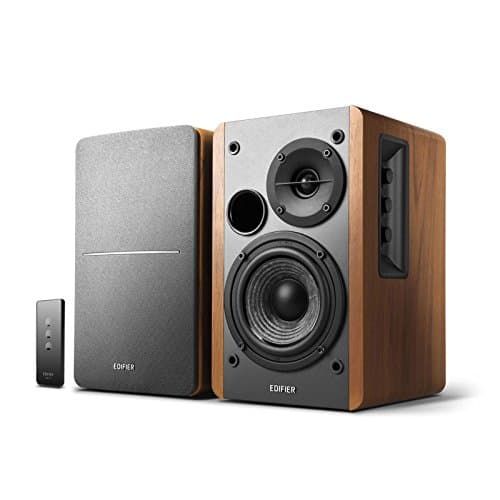
The R1280T has been the default recommendation for “I bought a turntable, what do I plug it into?” for years, and it earns that position by being almost completely uncomplicated. It is a pair of powered speakers: the amplification is inside the right-hand cabinet, a speaker cable runs across to the left one, and two RCA inputs on the back accept whatever you have.
There is one thing it does not include, and getting that clear before you order is the single most useful thing this review can do for you.
What “powered” means and why it matters here
A passivespeaker is a box of drivers and a crossover. It cannot make sound until an amplifier drives it, so a passive system needs a separate amplifier — another box, another power socket, another purchase.
A powered (or active) speaker has that amplifier built in, sized and matched to its own drivers by the people who designed them. For a first vinyl system that is a genuine advantage, and not only on price: it removes a whole category of matching decisions about sensitivity, impedance and power handling.
The R1280T also gives you two RCA inputs, which is unexpectedly practical. A turntable can stay connected to one while a phone, laptop or CD player lives on the other, with no switch box.
The thing it does not include
The R1280T has no phono preamp. Its inputs expect line level, the signal a phone or a CD player produces.
A turntable does not produce line level. Its cartridge generates a few thousandths of a volt, and that signal also needs the RIAA equalization curve applied to it. Feed a raw phono signal into the R1280T and you get sound that is very quiet and noticeably thin and tinny — not broken, just wrong, which is exactly why it confuses people.
There are two ways this is fine:
- Your turntable has a built-in preamp. Most decks under $400 do, usually with a PHONO/LINE switch on the back. Set it to LINE and connect directly. This covers the majority of first-time buyers.
- You add a separate phono stage. A $50-100 box sits between the turntable and the speakers and does the job. That is one extra component and it works perfectly well.
If you are not sure which applies to your deck, do I need a phono preamp? answers it in about thirty seconds. It is worth checking before you order rather than after.
The tone controls are more useful than they look
Physical bass and treble knobs, on the side of the cabinet, have quietly disappeared from most modern speakers in favor of app control or nothing at all. Their presence here matters for records specifically.
Vinyl pressings vary enormously. A 1970s pressing mastered warm and a modern reissue mastered bright are genuinely different, and no amount of equipment quality will make them sound the same. Being able to take two dB off the treble for one record without opening an app is a real convenience.
The caution is the usual one: tone controls should correct a recording, not a room. If everything sounds boomy, the fix is to move the speakers away from the wall or the corner, not to wind the bass down. Placement is free and does the job properly.
Where the physics stops it
These are small cabinets with 4-inch woofers, and there is no engineering that gets deep bass out of that combination. The R1280T sounds balanced and clear within its range and simply does not extend below it. On most records that is fine, because a groove rarely carries much energy below about 40 Hz. On bass-heavy electronic music and on film soundtracks, you will hear the limit.
Edifier includes a line output for a subwoofer, which is a sensible upgrade path. But if deep bass is a priority from day one, a 6.5-inch passive pair with a modest amplifier — see the bookshelf speaker roundup — will get you further for a similar total spend.
Setting them up with a turntable
- Check the preamp question first. Turntable set to LINE, or a separate phono stage in the chain.
- Separate the speakers. They ship with a fairly short interconnect between the two cabinets; plan your shelf around it.
- Keep them away from the turntable.A light deck sitting between two speakers picks up their output through its plinth and feeds it back into the cartridge. That is heard as boom and mud, and it is a common unexplained complaint — see turntable troubleshooting.
- Get them near ear height. Stands or a shelf at seated ear level improves these more than any electronics change would.
Who should buy them
Buy the R1280T if you have just bought a turntable with a built-in preamp and want one purchase that completes the system; if space is limited; or if you want the fewest possible boxes. Within those constraints it is very hard to beat and has been for a long time.
Look elsewhere if you want deep bass without adding a subwoofer, if you want Bluetooth (the R1280DB adds it), if your turntable has no preamp and you would rather not buy a separate one — a powered pair with a phono input solves that in one box — or if you would rather build a system from an amplifier and passive speakers you can upgrade separately.
Frequently asked questions
Can I connect a turntable directly to the Edifier R1280T?
Only if the turntable has a built-in phono preamp — most decks under $400 do, usually with a PHONO/LINE switch on the back. The R1280T's inputs are line level, so a raw phono signal into them sounds faint and thin.
Does the Edifier R1280T have a phono preamp?
No. The R1280T has two line-level RCA inputs and no phono stage. Edifier's R1280DB adds Bluetooth and optical inputs but also has no phono stage. If your turntable has no built-in preamp, budget for a separate one.
Is the Edifier R1280T good for vinyl?
For a first system, yes. It contains its own amplification, has two inputs so a turntable and another source can stay connected, and its tone controls let you take some edge off a bright pressing. Its limits are physics: 4-inch drivers in a small cabinet only reach so low.
What is the difference between the R1280T and the R1280DB?
The DB adds Bluetooth plus optical and coaxial digital inputs. Both are the same size, both use the same driver arrangement and neither includes a phono stage. Choose the DB if you want to stream to the same speakers, the T if you will only use wired sources.
Do I need a subwoofer with the Edifier R1280T?
Not for most records. A 4-inch woofer runs out of extension in the low bass, but vinyl rarely carries much energy below about 40 Hz anyway. The R1280T has a line output for a subwoofer if you want one — a useful upgrade path for film and electronic music.
Are powered speakers better than passive ones for a turntable?
Neither is better; they optimize differently. Powered speakers mean fewer boxes and a lower total cost of entry. Passive speakers plus a separate amplifier usually sound better at the same total spend and let you upgrade each half independently.
Sources
- Crutchfield — Home speakers buying guide — Reference on choosing passive vs powered speakers, room size and amplifier pairing (accessed August 11, 2026)
- Crutchfield — How to choose a phono preamp — On why a phono signal needs a preamp and never running two at once (accessed July 24, 2026)
- Crutchfield — Intro to home audio power amplifiers and preamps — On the preamp/power-amp split, integrated amplifiers and impedance stability (accessed August 11, 2026)
Keep reading
Best Powered Speakers for Turntables
Where the R1280T sits against the rest of the powered field.
See the picksBest Bookshelf Speakers for Vinyl
The passive alternative, and what it costs once you add an amplifier.
See the passive pairsDo I Need a Phono Preamp?
The question this review keeps returning to. Answer it in thirty seconds.
Check firstBest Turntables for Beginners
The decks that pair with these speakers without any extra boxes.
See the decks