Phono Preamp Gain & Impedance Explained
Two numbers decide whether a phono stage and a cartridge belong together. Here is what each one means, how to work out yours, and what a mismatch sounds like.
How this is funded: we earn a commission if you buy through our links, at no extra cost to you. It never changes which product we recommend, and we’ll tell you plainly when to skip one. Full disclosure.
Most phono preamp advice stops at “get one that matches your cartridge” without ever saying what matching means. It means two numbers: gain, measured in decibels, and loading, measured in ohms. Both are printed on the cartridge’s spec sheet and both are printed on the preamp’s. This page shows you how to compare them.
Why a phono signal needs special treatment at all
Two things happen when a record is cut. First, the signal is tiny by the time it comes back off the groove — a cartridge generates its output from a magnet moving a fraction of a millimeter, and the result is measured in millivolts, thousandths of a volt.
Second, the signal is deliberately distorted. Cutting an unmodified signal to vinyl would give bass so wide it cut into the neighboring groove and treble so quiet it disappeared into surface noise. So the cutting engineer applies the RIAA curve: bass reduced, treble boosted. Playback has to apply the exact inverse, which is the second job every phono stage does.
That is why you cannot simply turn up the volume on an aux input. The level would be wrong andthe tonal balance would be wrong — the familiar thin, tinny sound of a turntable plugged into the wrong socket.
Gain: the arithmetic
Gain is amplification expressed logarithmically. The useful conversions:
- 20 dB = 10 times the voltage
- 40 dB = 100 times
- 60 dB = 1,000 times
Now the two ends of the problem. A typical moving-magnet cartridge outputs 2.5 to 5.5 mV— the Ortofon 2M Red is specified at 5.5 mV, the Audio-Technica AT-VM95E at 4.0 mV. Line level, what an amplifier’s aux input expects, is around 300 to 500 mV.
Divide: 400 mV ÷ 4 mV = 100. That is 40 dB. So a moving-magnet cartridge needs about 40 dB of gain, and that is why nearly every MM phono stage is built around that figure.
A low-output moving-coil cartridge produces 0.2 to 0.8 mV— roughly ten times less. Ten times less signal needs ten times more amplification, which is 20 dB more: about 60 dB. That single fact is the whole reason MC cartridges need a different phono stage, and why plugging one into an MM-only input produces a faint, hissy sound no volume knob can rescue.
Working out your own number
- Find your cartridge’s output voltage on the manufacturer’s spec sheet.
- Divide 400 mV by that figure. A 2.5 mV cartridge gives 160; a 5.5 mV cartridge gives 73.
- Convert to dB: 73 times is about 37 dB, 100 times is 40 dB, 160 times is about 44 dB.
- Compare with your preamp’s published gain. Within about 3 dB is fine. More than 6 dB out and you will notice.
This is exactly why a stage with switchable settings — 39, 42 or 45 dB, or the four-position 38/48/56/66 dB arrangement on some units — is worth more than its price difference suggests. It lets one box suit whatever cartridge you end up with.
What a mismatch sounds like
- Gain too low:everything is quiet. You run the volume knob much higher than for streaming or CD, and as you do, background hiss comes up with the music. Dynamics feel flattened. Nothing sounds broken — it just sounds small.
- Gain too high: hard, gritty distortion on loud passages that vanishes in quiet ones, and a volume knob you can barely move off zero. On heavily-cut records the effect is obvious; on quiet ones it may never appear, which makes it confusing to diagnose.
- Loading wrong (MM): a treble that is either notably bright and edgy or slightly dull and closed-in, without any accompanying distortion. This is subtler than gain problems and much rarer, because nearly every MM stage uses the standard value.
- Loading wrong (MC): more consequential. MC cartridges are far more load-sensitive, and a mismatch produces a ringing brightness or a conspicuously lifeless top end.
Loading: why 47 kOhm is on every spec sheet
Loading is the input impedance the phono stage presents to the cartridge. It is not an arbitrary number: a moving-magnet cartridge is a coil, and a coil has inductance. That inductance, the load resistance and the total capacitance of the cable and input together form a filter that shapes the cartridge’s high-frequency response.
Cartridge makers design around 47 kOhmbecause it became the industry convention decades ago, so their published frequency response assumes it. That is why a fixed 47 kOhm input is not a limitation for a moving-magnet user — it is the correct value, and adjustable MM loading solves a problem most people do not have.
Moving coil is different. MC cartridges have far lower inductance and their makers specify a wide range of load values, sometimes as low as 100 ohms. Here adjustable loading genuinely matters, and its absence on a budget MC-capable stage is a real compromise rather than a specification detail.
Capacitance, the third number
MM cartridges also specify a total load capacitance, typically 100-200 pF, and “total” includes your interconnect cables. A long or high-capacitance cable can push the total well past what the cartridge expects, shifting the treble response. If your system sounds bright or dull in a way that cables seem to affect, this is usually why. It is a real effect and a small one; fix gain first.
A worked example
Suppose you own a Fluance RT81 with its stock elliptical cartridge (a 4.0 mV Audio-Technica type), running into a receiver’s phono input with a fixed 36 dB gain.
You need about 40 dB; you have 36. That is a 4 dB shortfall — about 1.6 times too little signal. Not catastrophic, but enough that you will run the volume noticeably higher than on other sources and will hear more of the receiver’s own noise floor. A stage offering a 42 dB setting closes that gap and drops the noise you were amplifying alongside the music.
Now suppose you upgrade to an AT-VM95ML or an Ortofon 2M Blue — both moving magnet, both in the same output range. The gain requirement does not change. That is the useful part: within moving magnet, upgrading the cartridge does not obsolete your phono stage. Moving to moving coil does.
What to do with all this
- Look up your cartridge’s output voltage and recommended load. Both are on the manufacturer’s page.
- Look up your phono stage’s gain and input impedance. If neither is published, that is informative in itself.
- If gain is within a few dB and loading is 47 kOhm for an MM cartridge, you are matched — stop, and spend your money on speakers instead.
- If gain is well short, a switchable stage is the cheapest fix, and it fixes your next cartridge too.
For the practical shortlist, see the best phono preamps under $200 or the under-$100 picks. And if the symptom you are actually chasing is hum rather than level, that is a wiring problem, not a matching one — see turntable troubleshooting.
Stages with gain you can actually set
If the arithmetic above says your cartridge is mismatched, these are the two cheapest ways to fix it — one for moving magnet, one that also covers moving coil. Prices are live and dated.
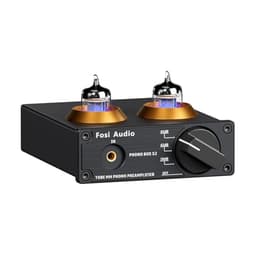
Fosi Audio Box X2
A budget stage where you can actually match the gain to the cartridge
Price as of October 15, 2026. #ad How we’re funded
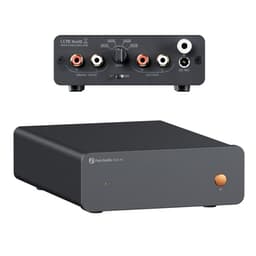
Fosi Audio Box X5
The cheapest honest route into moving-coil cartridges
Price as of October 15, 2026. #ad How we’re funded
Frequently asked questions
How much gain does a moving magnet cartridge need?
About 40 dB. A typical MM cartridge outputs 2.5-5.5 mV and line level is around 300-500 mV, a ratio of roughly 100:1, which is 40 dB. Quieter cartridges want 42-45 dB; hotter ones are comfortable at 36-40 dB.
How much gain does a moving coil cartridge need?
60 dB or more. Low-output MC cartridges produce 0.2-0.8 mV — roughly ten times less than a moving magnet — so they need about 20 dB more amplification. That is why an MM-only stage sounds faint and hissy with an MC cartridge, no matter how far you turn the volume up.
What does 47k ohm loading mean?
It is the input impedance the phono stage presents to the cartridge. Moving-magnet cartridges are designed around 47 kOhm — the value interacts with the cartridge's inductance to shape its high-frequency response — which is why it appears on essentially every MM spec sheet.
What happens if the gain is too low?
The signal arrives at your amplifier below the level it expects, so you turn the volume higher to compensate — which raises the noise floor along with the music. It sounds quiet, thin and slightly hissy rather than obviously broken.
What happens if the gain is too high?
The stage clips on loud passages, producing hard, gritty distortion that appears on peaks and disappears on quiet sections. It can also overload the next input in the chain. Volume set very low with a still-loud system is the tell.
Does capacitance matter for moving magnet cartridges?
Yes, though less than gain. MM cartridges specify a total load capacitance — typically 100-200 pF including the cable — and the interaction with the cartridge's inductance affects treble response. Long or high-capacitance interconnects can audibly change the top end.
Sources
- Elliott Sound Products — Phono preamp / RIAA equalization — Technical reference on RIAA pre-emphasis and the inverse playback curve (accessed July 24, 2026)
- Ortofon — 2M Red — Manufacturer specs: 5.5 mV output, 1.6-2.0 g tracking (1.8 g recommended), 47 kOhm load (accessed July 24, 2026)
- Audio-Technica — AT-VM95E cartridge — Manufacturer specs: 0.3 x 0.7 mil elliptical stylus on an aluminum cantilever, 4.0 mV output at 1 kHz / 5 cm/sec, 1.8-2.2 g tracking force (2.0 g standard), 20-22,000 Hz, 20 dB channel separation at 1 kHz, half-inch mount, AT-VMN95E replacement stylus, and the maker's own statement that "all VM95 Series share the same body" so the stylus "can be replaced with any of the six interchangeable AT-VMN95 replacement styli". Re-read on the access date below, which corrected a tracking-force range previously noted here as 1.8-2.3 g (accessed September 26, 2026)
- Crutchfield — How to choose a phono preamp — On why a phono signal needs a preamp and never running two at once (accessed July 24, 2026)
Keep reading
Schiit Mani 2 Review
A preamp where every number on this page is a switch position.
Read the reviewBest Phono Preamps Under $200
Where switchable gain and MC support actually begin.
See the picksMoving Magnet vs Moving Coil
The output difference that drives all of this arithmetic.
Read the comparisonDo I Need a Phono Preamp?
Before matching one, check whether you already have one.
Check firstTurntable Troubleshooting
What a gain mismatch sounds like next to the faults it mimics.
Fix itWhat Is Hi-Fi?
Why a phono stage's job is defined this precisely in the first place.
Read the explainer