How we ranked these
Every pick had to clear the same four checks, in this order. The order matters: a player that fails the first check cannot be rescued by anything it does well later.
- Does it track safely? A record player that presses too hard on the groove wears your records permanently. That rules out the sealed ceramic-cartridge suitcase players that dominate the sub-$80 shelf. Every player here uses a replaceable magnetic cartridge tracking at a sane force.
- Can you connect it to what you own?A turntable’s output is roughly a thousand times quieter than a phone’s. It needs a phono preamp somewhere. Players with a switchable built-in stage work with powered speakers today and a better external preamp later, which is why most of this list has one.
- Is there an upgrade path?A cartridge whose stylus you can replace — and ideally upgrade — turns a purchase into a platform. The Audio-Technica VM95 and Ortofon OM families both let you snap a better tip onto the body you already own.
- Does the price buy something real? Past about $600 the improvements get subtle and the deck stops being the limiting factor. We say so on the expensive picks rather than pretending the curve is a straight line.
Automatic or manual: the fork that decides everything else
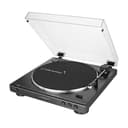
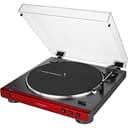
A fully automatic player cues the arm, plays the side, and lifts and returns the arm on its own. There is nothing to set and nothing to get wrong, which is why the AT-LP60X is the most-recommended first record player in the world. The cost of that convenience is a fixed tonearm: no counterweight, no anti-skate, no way to adjust tracking force. The factory picked a setting and you live with it.
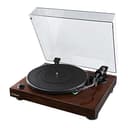
A manualplayer makes you lower the arm yourself, and in exchange gives you a counterweight and anti-skate. That is not fiddliness for its own sake — it is the difference between tracking at the cartridge’s specified force and tracking at whatever the factory chose. It is also the entry requirement for upgrading the cartridge later, because a better cartridge needs a different tracking force. The Fluance RT81 is the cheapest player here that gives you both.
The honest answer for most people: if you are buying your first player and the phrase “tracking force” makes you tired, buy the automatic and enjoy your records. If you already suspect you will still be doing this in five years, buy the manual. Our automatic vs manual guide works through the middle ground, including semi-automatic decks that lift the arm at the end of a side but let you adjust everything else.
What each of these actually needs to make sound
This is the part that trips people up after the box arrives. A record player is one third of a system. The other two thirds are amplification and speakers, and different players include different amounts of them.
- The Victrola Eastwood II includes everything. Speakers, amplifier, preamp, all inside the case. Plug it into the wall and it makes sound. That is its entire appeal and it is a real one.
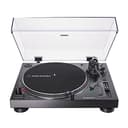
- The AT-LP60X, AT-LP60XBT, Fluance RT81 and AT-LP120XUSB have a built-in switchable phono preamp but no speakers. Pair them with powered speakers and you have a complete system with two cables and no third box.
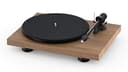
- The Pro-Ject Debut Carbon EVOhas no preamp at all, by design. You supply one — a separate phono stage, an amplifier with a phono input, or speakers with one built in. That shorter signal path is part of what you are paying for.
If you are not sure which category your existing gear falls into, the do I need a phono preamp? decision tree takes about thirty seconds and will save you either a wasted purchase or a silent afternoon.
The all-in-one question, answered honestly
All-in-one players with built-in speakers get a bad reputation, and about three quarters of it is deserved. The problem is not the concept — it is that the cheapest examples use a ceramic cartridge that presses on the groove several times harder than a magnetic one and cannot be replaced when it wears. Play a treasured record on one of those often enough and you will hear the difference.
The Victrola Eastwood II is on this list because it does not do that: it uses a replaceable Audio-Technica magnetic cartridge and offers a wired output, so it can grow into a system later instead of being a dead end. That is the specific line between an all-in-one worth owning and one to avoid, and it is covered in full in do cheap turntables ruin records? And if you are still weighing an all-in-one against a component deck at all, record player vs turntable sets the two products side by side and counts the boxes each one makes you buy.
Where the money goes as you climb
From $90 to $180 you are buying a real cartridge and a real tonearm instead of a novelty. That is the biggest single jump on this page. From $180 to $300you gain adjustability — the counterweight and anti-skate — plus an elliptical stylus that sits deeper in the groove than a conical one. From $300 to $650 you gain platter mass, motor isolation and a better arm, and usually lose the built-in preamp because the designers would rather you chose your own.
Above that, improvements are real but increasingly specific, and the rest of your system starts to matter more than the deck does. Are expensive turntables worth it? walks through exactly where the curve flattens, and the under-$1,000 tier covers what the next step up actually buys.