PLATTER & PLINTH

The Best Bookshelf Speakers for Vinyl

Six passive pairs from $80 to $500 — and the two specifications that tell you which amplifier each one actually needs.

By Stephen V.Last updated How we pick

Speakers change what you hear more than any other component in a vinyl system. A modest turntable through good speakers sounds better than an excellent turntable through poor ones, every time, and it is not close. If you are deciding where to spend next, this is usually the answer.

Every pair here is passive, meaning they contain no amplifier and need one supplied. That is the trade compared with powered speakers: one more box and one more purchase, in exchange for choosing the amplifier, upgrading either half independently, and generally better sound per dollar at the same total spend.

Two numbers decide which amplifier you need: sensitivity (how loud a speaker plays on a given amount of power) and impedance (the electrical load it presents). Both are explained below, and both are why the Klipsch pair on this list works with a cheaper amplifier than the ELAC does.

How this is funded:we earn a commission if you buy through our links, at no extra cost to you. It never changes which product we recommend, and we’ll tell you plainly when to skip one. Full disclosure.

Quick picks

Ranked on published specs, drive/motor design and buyer fit. Select a row to jump to the full write-up. We have not heard most of these units — here is exactly what we do instead.

#ProductBest forPrice
1
ELAC Debut 2.0 B5.2

ELAC Debut 2.0 B5.2

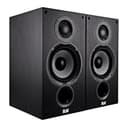
The Debut series is the default recommendation in this price band for a reason: a woven aramid-fiber woofer, a wide-roll cloth dome reaching 35 kHz, braced MDF cabinets and front-firing ports so you can actually put them on a shelf. Balanced rather than exciting, which is what you want for long album listening.

Best overall
2
Klipsch R-40M

Klipsch R-40M

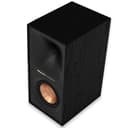
Klipsch publishes the numbers that matter: 91 dB sensitivity, 71 Hz-21 kHz +/-3 dB, 8 ohms compatible, 50 W continuous. That sensitivity is the point — these go loud on very little power, which makes them the natural partner for a small, cheap amplifier. This is the Reference Next-Generation replacement for the discontinued R-41M.

Best with a small amplifier
$199.99 · View on Amazon

Price as of August 31, 2026. #ad How we’re funded

3
Dayton Audio Classic B65

Dayton Audio Classic B65

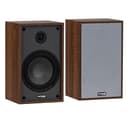
A 6.5-inch woofer and a one-inch soft dome in a wood-veneer cabinet, rated 60 W RMS, for less than a decent cartridge costs. It is the cheapest passive pair we would put in front of a real turntable — the size of the woofer is doing the work that a small budget speaker's port usually fakes.

Best budget pair
$79.98 · View on Amazon

Price as of August 31, 2026. #ad How we’re funded

4
Polk Audio Monitor XT20

Polk Audio Monitor XT20

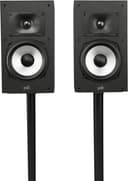
A 6.5-inch dynamically balanced woofer and a one-inch tweeter, rated for 4- and 8-ohm operation. The big woofer buys low-end weight that the 5-inch competition can't match, which suits bass-heavy pressings and rooms where a subwoofer isn't welcome.

Best low-end weight
$249.00 · View on Amazon

$279.0011% off

Price as of August 31, 2026. #ad How we’re funded

5
Q Acoustics 3030i

Q Acoustics 3030i

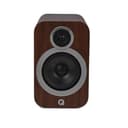
A 165 mm mid/bass driver derived from the 3050i floorstander, in a P2P-braced cabinet with a published 46 Hz bass extension. This is the point where a bookshelf speaker stops needing a subwoofer for most records, and where the turntable in front of it starts being the limiting factor.

Best premium pair
$499.96 · View on Amazon

Price as of August 31, 2026. #ad How we’re funded

6
Micca MB42X

Micca MB42X

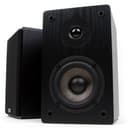
The passive pick for people who want to choose their own amp: a well-reviewed two-way bookshelf speaker that punches above its price, but with no amplifier of its own. Buy these only if you have (or want) a separate amplifier or receiver — they will not work plugged straight into a turntable.

Best compact pair
$119.99 · View on Amazon

Price as of August 31, 2026. #ad How we’re funded

The picks in full

#1Best overall

ELAC Debut 2.0 B5.2

The Debut series is the default recommendation in this price band for a reason: a woven aramid-fiber woofer, a wide-roll cloth dome reaching 35 kHz, braced MDF cabinets and front-firing ports so you can actually put them on a shelf. Balanced rather than exciting, which is what you want for long album listening.

Strengths

  • Front-firing port means shelf and near-wall placement doesn't wreck the bass
  • Woven aramid-fiber woofer is stiffer and better damped than paper or polypropylene
  • Thick braced MDF cabinets — the enclosure is where budget speakers usually cut corners

Trade-offs

  • Needs an amplifier, and rewards a decent one
  • Deliberately neutral voicing — no built-in excitement if that is what you want
TypePassive 2-way bass reflex bookshelf
Woofer5.25" woven aramid fiber
Tweeter1" cloth dome with waveguide
High-frequency responseUp to 35,000 Hz
CabinetBraced MDF, front-firing port
Built-in preampNo — passive

Note. The front port is the practical detail. Rear-ported speakers pushed against a wall get boomy; these were designed for the bookshelf people actually put them on.

Specifications read from the manufacturer / product listing, on August 11, 2026. “Not published” means the maker does not state that figure.

#2Best with a small amplifier

Klipsch R-40M

Klipsch publishes the numbers that matter: 91 dB sensitivity, 71 Hz-21 kHz +/-3 dB, 8 ohms compatible, 50 W continuous. That sensitivity is the point — these go loud on very little power, which makes them the natural partner for a small, cheap amplifier. This is the Reference Next-Generation replacement for the discontinued R-41M.

Strengths

  • 91 dB sensitivity — a 20 W amp drives these to genuinely loud levels
  • Horn-loaded 1" aluminum LTS tweeter gives the presence Klipsch is known for
  • Full published response, impedance and crossover figures, unusual at the price

Trade-offs

  • The 4" woofer runs out of bass at 71 Hz — no low end without a subwoofer
  • The horn's forward treble is a taste; bright pressings can sound brighter still
  • Rear-firing ports, so it turns boomy pushed hard against a wall
TypePassive 2-way bookshelf, bass-reflex (rear ports)
Woofer4" spun-copper TCP
Tweeter1" aluminum LTS on a 90x90 square Tractrix horn
Frequency response71 Hz - 21 kHz +/-3 dB
Sensitivity91 dB in-room (2.83 V / 1 m, half-space anechoic)
Impedance8 ohms compatible
Crossover1,770 Hz
Power handling50 W continuous / 200 W peak
CabinetMDF, 11.7 x 5.8 x 8.5", 7 lbs each

Note. Sensitivity is the spec most people ignore and shouldn't. At 91 dB these play about twice as loud as an 85 dB speaker on the same amplifier, which changes which amp you need to buy. Klipsch qualifies the figure as in-room, measured at 2.83 V into half-space — read it as a comparison against other Klipsch numbers rather than as an anechoic figure.

Specifications read from the manufacturer / product listing, on August 28, 2026. “Not published” means the maker does not state that figure.

#3Best budget pair

Dayton Audio Classic B65

A 6.5-inch woofer and a one-inch soft dome in a wood-veneer cabinet, rated 60 W RMS, for less than a decent cartridge costs. It is the cheapest passive pair we would put in front of a real turntable — the size of the woofer is doing the work that a small budget speaker's port usually fakes.

Strengths

  • 6.5-inch woofer moves real air — most speakers at this price use a 4-inch driver
  • Passive design, so you choose the amplifier and can upgrade it later
  • Keyhole mounts for wall placement, and a five-year warranty

Trade-offs

  • Needs an amplifier — budget for one, which erases part of the price advantage
  • Wood-veneer finish and basic crossover; this is value engineering, not refinement
TypePassive 2-way bookshelf
Woofer6.5"
Tweeter1" soft dome
Power handling60 W RMS
MountingKeyhole wall mounts
Built-in preampNo — passive

Note. Passive means the amplifier is a separate purchase. Pair these with a sub-$100 class-D amp and you have a complete, genuinely listenable system for around the price of one powered pair.

Specifications read from the manufacturer / product listing, on August 11, 2026. “Not published” means the maker does not state that figure.

#4Best low-end weight

Polk Audio Monitor XT20

A 6.5-inch dynamically balanced woofer and a one-inch tweeter, rated for 4- and 8-ohm operation. The big woofer buys low-end weight that the 5-inch competition can't match, which suits bass-heavy pressings and rooms where a subwoofer isn't welcome.

Strengths

  • 6.5" woofer gives noticeably more low-end body than 5" rivals
  • Rated for both 4- and 8-ohm amplifiers, so pairing is forgiving
  • Timbre-matched to the rest of the Monitor XT range if the system grows

Trade-offs

  • Designed and marketed primarily for home theater — voicing leans toward impact over delicacy
  • The larger cabinet needs more shelf depth than a 5-inch pair
TypePassive 2-way bookshelf
Woofer6.5" dynamically balanced
Tweeter1"
Impedance4 and 8 ohm compatible
PlacementBookshelf or stand
Built-in preampNo — passive

Note. Polk sells these into home-theater systems, so listings talk about Atmos and surround. Ignore that: as a stereo pair on the end of a turntable and a small amp, they are simply a big-woofer bookshelf speaker at a fair price.

Specifications read from the manufacturer / product listing, on August 11, 2026. “Not published” means the maker does not state that figure.

#5Best premium pair

Q Acoustics 3030i

A 165 mm mid/bass driver derived from the 3050i floorstander, in a P2P-braced cabinet with a published 46 Hz bass extension. This is the point where a bookshelf speaker stops needing a subwoofer for most records, and where the turntable in front of it starts being the limiting factor.

Strengths

  • Published 46 Hz bass extension from a 6.5" driver borrowed from the 3050i floorstander
  • Point-to-point cabinet bracing measurably reduces panel resonance
  • Magnetic grilles and a genuinely furniture-grade finish

Trade-offs

  • Twice the price of the ELAC pair, and it wants a better amplifier to match
  • Big cabinets for a 'bookshelf' speaker — measure the shelf first
TypePassive 2-way standmount
Mid/bass driver165 mm (6.5")
Bass extension46 Hz (published)
CabinetP2P-braced, magnetic grilles
StandsOptional 3030FSi (sold separately)
Built-in preampNo — passive

Note. At this level the chain matters: a $150 deck into these will tell you exactly how much of a $150 deck you bought. Budget the system, not the speaker.

Specifications read from the manufacturer / product listing, on August 11, 2026. “Not published” means the maker does not state that figure.

#6Best compact pair

Micca MB42X

The passive pick for people who want to choose their own amp: a well-reviewed two-way bookshelf speaker that punches above its price, but with no amplifier of its own. Buy these only if you have (or want) a separate amplifier or receiver — they will not work plugged straight into a turntable.

Strengths

  • Excellent sound-per-dollar for a passive bookshelf
  • A real two-way design with a crossover, unlike single-driver budget boxes
  • Lets you pick the amp and grow the system your way

Trade-offs

  • Passive — needs a separate amplifier or receiver AND a phono preamp
  • Not a plug-and-play choice for a first-time buyer
TypePassive (needs an amp)
Configuration2-way with crossover
AmplifierNone (external required)
Phono preampNone (external required)
Sold asPair

Note. These are the odd one out in a powered-speaker roundup on purpose: they show what the passive route costs in extra boxes. If the word 'amplifier' is new to you, buy powered speakers instead.

Specifications read from the manufacturer / product listing, on July 24, 2026. “Not published” means the maker does not state that figure.

Sensitivity: the spec that decides your amplifier budget

Sensitivity is measured in decibels at 2.83 V from 1 meter, and it tells you how efficiently a speaker turns power into sound. It matters because the scale is logarithmic and therefore unintuitive: every 3 dB of extra sensitivity is worth doubling your amplifier power.

The Klipsch R-40M publishes 91 dB. A typical small bookshelf speaker sits around 85-86 dB. That 5-6 dB gap means the Klipsch pair plays as loud on a 20 W amplifier as the less sensitive pair does on 60-80 W. If your budget is tight and the amplifier is coming out of the same pot, a sensitive speaker effectively subsidizes it.

Sensitivity says nothing about sound quality. Horn-loaded designs like the Klipsch achieve it partly through directivity, which also gives them their characteristic forward presence — a real preference, not a universal improvement.

Impedance: the spec that decides whether the amp copes

Impedance is the electrical load the speaker presents, usually quoted as 8 or 4 ohms nominal. Lower impedance draws more current, which some cheap amplifiers cannot supply cleanly. Most speakers here are 8 ohms nominal; the Polk Monitor XT20 is rated for both 4- and 8-ohm operation, which makes pairing more forgiving.

In practice, any competent modern amplifier drives an 8-ohm bookshelf speaker without complaint. Check the amplifier’s specification if you are running 4-ohm speakers or wiring two pairs at once — our amplifier roundup flags which units state their impedance range.

Woofer size and what it actually buys

The picks here span 4-inch to 6.5-inch woofers, and the difference is audible. A larger cone moves more air, which means lower bass extension without a subwoofer. The Q Acoustics 3030i publishes a 46 Hz bass extension from its 165 mm driver; the Klipsch R-40M publishes 71 Hz from its 4-inch one. On a bass-heavy pressing, that gap is not subtle.

The costs of a bigger woofer are cabinet size — measure the shelf before ordering the Polk or the Q Acoustics — and, sometimes, less crisp midrange integration, because a large cone has to work higher up the frequency range before handing over to the tweeter.

Ports: why front-firing matters on a bookshelf

Most of these are bass-reflex designs with a port that reinforces low frequencies. Where the port faces determines where you can put the speaker. A rear-firing port pushed close to a wall produces boomy, ill-defined bass. A front-firing port, like the ELAC Debut 2.0 B5.2’s, is designed for exactly the shelf placement the category name implies.

This is the most common practical mistake in small-room systems, and it costs nothing to avoid. If your speakers must go against a wall, prioritize a front port. If you have room to pull them out 20-30 cm, rear ports are fine and often sound better for it.

What these need between them and the turntable

A passive speaker needs an amplifier, and a turntable needs a phono stage. That gives you three workable configurations:

  • Turntable with built-in preamp + integrated amplifier + these speakers. The most common route. Any line input on the amplifier works.
  • Turntable + amplifier with a phono input + these speakers. Cleaner and cheaper by one box. The Sony STR-DH190 and Denon PMA-600NE in our amplifier roundup both have phono inputs.
  • Turntable + separate phono stage + amplifier + these speakers. The most upgradeable, and the route to take if you want a better phono stage than any amplifier includes.

If you are unsure which of these describes your gear, do you need an amp for a turntable? works through it in order.

Placement is free and worth more than an upgrade

  1. Get them off the shelf if you can. Stands at ear height beat a bookshelf almost every time, because a shelf both reflects sound and transmits cabinet vibration into the furniture.
  2. Form a triangle. The two speakers and your listening position should be roughly equidistant, with the speakers toed slightly inward toward you.
  3. Keep them away from the turntable. A deck sitting between two speakers picks up their output through its plinth and feeds it back into the cartridge. That is heard as boom and mud rather than obvious howling, and it is a common unexplained problem.
  4. Watch corners. A speaker in a corner gets significantly more bass reinforcement, which sounds impressive for a week and muddy after that.

Passive or powered: a straight answer

Buy powered speakers if you want the fewest boxes, if desk or shelf space is tight, or if you want built-in Bluetooth and a phono input in one purchase. Buy passive speakers if you want the best sound for a given total budget, if you want to upgrade the amplifier and the speakers separately over time, or if you already own an amplifier or receiver. Neither is wrong; they optimize for different things, and the powered speaker roundup covers the other side.

One case neither answer covers: a pair that also has to carry films. A home cinema asks different things of a speaker — dispersion wide enough for a sofa rather than a single seat, a center channel voiced to match, and a sensible handover to a subwoofer — so the shortlist shifts even though the cabinets look the same. Valve & Vinyl’s roundup of the best speakers for home theater covers that side of it.
Frequently asked questions

Do bookshelf speakers need an amplifier?

Passive bookshelf speakers — including every pair on this page — do. They contain no amplification, so they need an integrated amplifier or receiver between them and the source. Powered (active) bookshelf speakers have amplification built in and do not.

What size amplifier do I need for bookshelf speakers?

Look at the speaker's sensitivity and power handling. A 90 dB-sensitive speaker plays loudly on 20-30 W; an 85 dB one wants 50 W or more for the same level. Aim for an amplifier whose rated output falls within the speaker's stated power range, toward the upper end.

Are bookshelf speakers good for vinyl?

Yes — they are the standard choice. Vinyl playback is a full-range stereo signal and bookshelf speakers are designed for exactly that. The only caveat is placement: keep them away from the turntable so cabinet vibration does not feed back into the cartridge.

Do I need a subwoofer with bookshelf speakers?

Not usually for records. A 6.5-inch woofer reaching into the mid-40 Hz range covers almost everything on a vinyl pressing, and bass below about 40 Hz is rarely cut deeply into a groove anyway. Add one if you also watch films on the same system.

What does speaker sensitivity mean in practice?

It is how loud a speaker plays on a given amount of power, in dB at 2.83 V from 1 meter. Every 3 dB of extra sensitivity is worth roughly doubling your amplifier's power — so a 90 dB speaker on 25 W plays about as loud as an 87 dB one on 50 W.

Should bookshelf speakers go on stands?

If you can, yes. Stands put the tweeter near ear height, decouple the cabinet from furniture that would otherwise resonate, and let you position the pair as a proper triangle. It is one of the cheapest genuine improvements available to any system.

Sources

Keep reading