Phono Preamps
The little box that makes a turntable loud enough to hear. What it does, whether you already have one, and which standalone units are worth buying.
The phono preamp is the most misunderstood box in vinyl. It does two jobs at once, and both are essential. First, it amplifies an extremely weak signal: a moving-magnet cartridge puts out only a few thousandths of a volt, far too little for a normal amplifier or powered speaker to use. Second, it applies RIAA equalization— records are cut with the bass turned down and the treble boosted so the groove physically fits, and the preamp reverses that curve on playback. Skip it and vinyl sounds thin, bright and far too quiet.
Here’s the catch that saves people money: you may already have one. A phono stage can live in three places — built into the turntable (often switchable), built into a receiver or amp (look for an input marked “PHONO”), or in a standalone box. You only need one, and running two at once just doubles the distortion. Our do I need a phono preamp? guide is a 30-second decision tree that tells you.
If you do need a standalone unit — because your deck and speakers both lack one, or because you want to bypass a mediocre built-in stage — the good news is that a competent preamp is cheap. A $17 box will make a preamp-less deck play; a $150–$200 unit will genuinely out-perform the stage baked into most turntables and budget receivers, and some add moving- coil support for when you upgrade the cartridge.
Everything in Phono Preamps
Best Phono Preamps
From a $17 fixer to a $200 upgrade that outclasses most built-in stages — compared on gain, loading and noise.
Our top pick
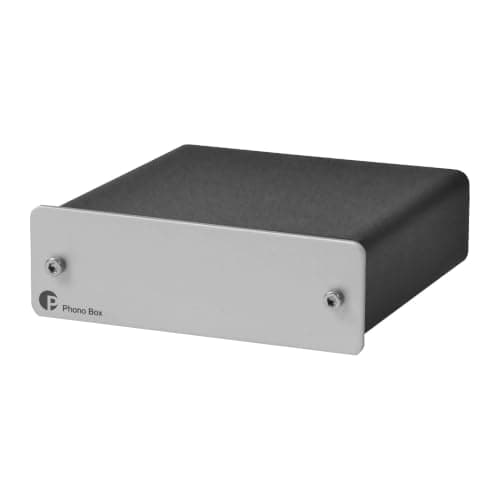
Pro-Ject Phono Box DC
Do I Need a Phono Preamp?
A 30-second decision tree: check your turntable, your speakers and your amp before you spend a cent.
Best Phono Preamps Under $100
What a sub-$100 phono stage can and can't do — and the four that are worth buying, including one that drives headphones.
Best Phono Preamps Under $200
The tier where you get switchable gain, moving-coil support and a published noise floor. Compared on the specs that decide whether a cartridge matches.
Our top pick
Pro-Ject Phono Box DC
Phono Preamp Gain & Impedance Explained
The arithmetic nobody shows you: how many dB of gain your cartridge needs, why 47 kOhm keeps appearing, and how to tell if your stage is a mismatch.
What Is a Built-in Phono Preamp?
How to find the one hiding in your turntable, what the PHONO/LINE switch actually does, and when a built-in stage is worth bypassing.
Tube vs Solid State Phono Preamps
What a tube actually does to a phono signal, why it measures worse and still sells, and how to decide which one suits your records.
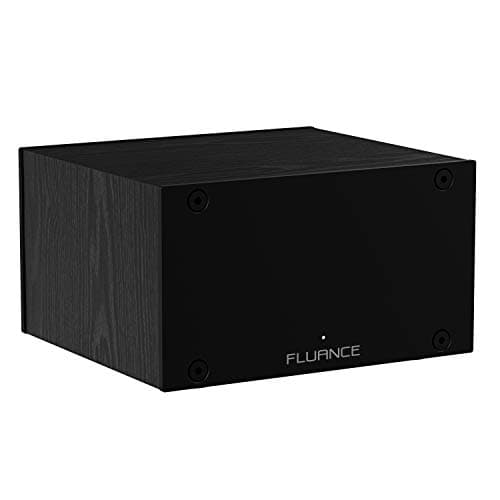
Fluance PA10 Review
A $100 phono stage in a metal case with a proper ground post — what it fixes, what it doesn't, and who should spend more.
Phono vs Line: What That Input Actually Does
Why a turntable cannot use a line input, what the phono socket does differently, and the one wiring mistake that makes records sound thin and quiet.
Do You Need a Phono Preamp With Powered Speakers?
Powered speakers are the case where the usual answer is wrong often enough to matter. Three configurations, and how to tell which one you have.
Schiit Mani 2 Review
Four gain settings, four resistive loads and four capacitance values in a box that costs less than a decent cartridge — the phono stage that ends the upgrade path early.
Best Phono Preamps for Fluance Turntables
The RT82 and up publish no built-in stage at all, so this is the box that makes the deck play - matched to the cartridge Fluance fits to each model.
Best Phono Preamps for Audio-Technica Turntables
Every current AT deck has a switchable stage inside, so the question is when an external one beats it - and what matches a 4 mV VM95 cartridge.
Does a Good Phono Preamp Make a Difference?
Sometimes an enormous one, sometimes none at all - and what decides it is your deck, not the preamp. The four specifications that actually vary.
What actually decides which one you need
Cartridge type.Almost every budget and mid deck uses a moving-magnet (MM) cartridge, and any MM-capable preamp works. If you move up to a moving-coil (MC) cartridge, its output is roughly ten times lower and needs far more gain plus specific loading — so you need an MC-capable stage. Our MM vs MC guide explains which you have.
Gain and noise.A good preamp is quiet and gives the right amount of gain for your cartridge’s output. Adjustable-gain units (like the ART DJ PRE II) are handy for matching a quiet or loud cartridge; a multi-setting unit (like the Schiit Mani 2) covers MM, moving-iron and MC in one box.
The upgrade case.Even if your deck has a built-in stage, a better standalone preamp is one of the cheapest ways to improve a system — a cleaner, quieter phono stage lets the cartridge you already own sound like itself.