PLATTER & PLINTH

The Best Turntables for Beginners

Five decks that are hard to get wrong — ready to play out of the box, safe for your records, and simple to connect to speakers you already own.

By Stephen V.Last updated How we pick

A first turntable should do three things well: arrive ready to play, track at a safe force so it protects your records, and connect to whatever speakers you have without a science project. Every deck below clears that bar. The main fork is whether you want it fully automatic— one button to play and stop, nothing to adjust — or a manual deck with an adjustable arm you can grow into.

If you want the absolute simplest start, an automatic like the AT-LP60X is the classic answer. If you’d rather buy once and not upgrade in a year, the manual Fluance RT81 is the smarter long game. Both are here, plus a wireless option and a safe all-in-one for anyone who wants sound in one box.

How this is funded:we earn a commission if you buy through our links, at no extra cost to you. It never changes which product we recommend, and we’ll tell you plainly when to skip one. Full disclosure.

Quick picks

Ranked on published specs, drive/motor design and buyer fit. Select a row to jump to the full write-up. We have not heard most of these units — here is exactly what we do instead.

#ProductBest forPrice
1
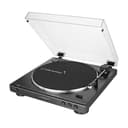
Audio-Technica AT-LP60X

Audio-Technica AT-LP60X

The default first turntable for a reason: it's fully automatic, so you press one button and it cues, plays and returns the arm on its own — nothing to set up wrong. The built-in switchable preamp lets it plug into anything, and it tracks safely enough to trust with your records.

Best overall for beginners
$178.00 · View on Amazon

$199.0011% off

Price as of July 25, 2026. #ad How we’re funded

2
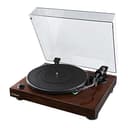
Fluance RT81

Fluance RT81

The best-value entry into real hi-fi: a manual belt-drive deck with an adjustable counterweight and anti-skate, an aluminum platter, and a genuine Audio-Technica elliptical cartridge — for the price of a good all-in-one. The switchable built-in preamp means it works today and upgrades later.

Best to grow into
$299.99 · View on Amazon

Price as of July 25, 2026. #ad How we’re funded

3
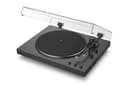
Sony PS-LX310BT

Sony PS-LX310BT

The most flexible one-box deck: fully automatic, with Bluetooth out to a wireless speaker or headphones, a USB port for recording, and a switchable built-in preamp for wired setups. It does everything, which is exactly why it's the easiest recommendation for a first modern turntable.

Best wireless start
$448.00 · View on Amazon

Price as of July 25, 2026. #ad How we’re funded

4
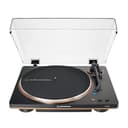
Audio-Technica AT-LP70X

Audio-Technica AT-LP70X

The automatic that grew up: it keeps the one-button convenience of the LP60X but adds a proper VM95-series cartridge and a die-cast platter, so it sounds a clear step better while still cueing itself. The natural pick if you want automation without the budget-deck ceiling.

Best automatic upgrade
$249.00 · View on Amazon

Price as of July 25, 2026. #ad How we’re funded

5
Victrola Eastwood II

Victrola Eastwood II

The all-in-one we can actually recommend: a belt-drive player with built-in speakers, a replaceable Audio-Technica cartridge, and Bluetooth in and out — so it plays records on day one but can also stream to a bigger speaker when you outgrow the built-ins. That upgrade path is what separates it from a throwaway suitcase.

Best all-in-one starter
$96.66 · View on Amazon

Price as of July 25, 2026. #ad How we’re funded

The picks in full

#1Best overall for beginners

Audio-Technica AT-LP60X

The default first turntable for a reason: it's fully automatic, so you press one button and it cues, plays and returns the arm on its own — nothing to set up wrong. The built-in switchable preamp lets it plug into anything, and it tracks safely enough to trust with your records.

Strengths

  • Fully automatic — start and stop at the touch of a button, no manual cueing
  • Switchable built-in preamp connects to powered speakers or a receiver
  • Tracks at a sane force with a replaceable Audio-Technica stylus

Trade-offs

  • Fixed tonearm — no counterweight or anti-skate to adjust
  • Conical (spherical) stylus is a rung below the elliptical on step-up decks
DriveBelt drive
OperationFully automatic
CartridgeAudio-Technica AT3600L (conical, replaceable stylus)
Built-in preampYes — switchable
Speeds33 1/3 and 45 RPM
Bluetooth / USBNo

Note. The fixed tonearm is the trade for the automation: you can't adjust tracking force, but you also can't set it wrong. That's the right trade for a first deck.

Specifications read from the manufacturer / product listing, on July 24, 2026. “Not published” means the maker does not state that figure.

#2Best to grow into

Fluance RT81

The best-value entry into real hi-fi: a manual belt-drive deck with an adjustable counterweight and anti-skate, an aluminum platter, and a genuine Audio-Technica elliptical cartridge — for the price of a good all-in-one. The switchable built-in preamp means it works today and upgrades later.

Strengths

  • Adjustable counterweight and anti-skate — you can set tracking force correctly, which the cheap automatics can't
  • Ships with an Audio-Technica AT95-type elliptical cartridge, a real step up from a conical
  • Built-in preamp is switchable, so you can bypass it when you add a better one

Trade-offs

  • Manual operation — you cue and lift the arm yourself
  • No Bluetooth or USB; this is a wired, listen-at-home deck
DriveBelt drive
OperationManual
CartridgeAudio-Technica elliptical (AT95-type)
Built-in preampYes — switchable
Speeds33 1/3 and 45 RPM
PlatterAluminum

Note. The counterweight and anti-skate are the reason this deck belongs in a different class from the sub-$150 automatics: it lets you dial in tracking force to the cartridge's spec instead of accepting a fixed factory setting.

Specifications read from the manufacturer / product listing, on July 24, 2026. “Not published” means the maker does not state that figure.

#3Best wireless start

Sony PS-LX310BT

The most flexible one-box deck: fully automatic, with Bluetooth out to a wireless speaker or headphones, a USB port for recording, and a switchable built-in preamp for wired setups. It does everything, which is exactly why it's the easiest recommendation for a first modern turntable.

Strengths

  • Bluetooth output pairs straight to a wireless speaker — no other gear needed
  • Fully automatic, with a low-profile design and switchable preamp
  • USB output for digitizing records

Trade-offs

  • Bluetooth trades some fidelity versus a wired connection
  • Low-mass plastic build; the tonearm and cartridge are entry level
DriveBelt drive
OperationFully automatic
WirelessBluetooth output
Built-in preampYes — switchable
Speeds33 1/3 and 45 RPM
USB outputYes

Note. Bluetooth OUT (deck to speaker) is the useful direction here and what makes this deck so flexible; if you care most about sound, use the wired analog output into powered speakers instead.

Specifications read from the manufacturer / product listing, on July 24, 2026. “Not published” means the maker does not state that figure.

#4Best automatic upgrade

Audio-Technica AT-LP70X

The automatic that grew up: it keeps the one-button convenience of the LP60X but adds a proper VM95-series cartridge and a die-cast platter, so it sounds a clear step better while still cueing itself. The natural pick if you want automation without the budget-deck ceiling.

Strengths

  • Fully automatic operation, like the LP60X
  • Upgraded to the VM95C cartridge on a detachable headshell mount
  • Anti-resonance die-cast aluminum platter

Trade-offs

  • Costs more than the LP60X for a similar convenience level
  • Still no on-arm tracking-force adjustment
DriveBelt drive
OperationFully automatic
CartridgeAudio-Technica AT-VM95C (conical, VM95 series)
Built-in preampYes — switchable
Speeds33 1/3 and 45 RPM
PlatterDie-cast aluminum

Note. Because it uses the VM95 cartridge body, you can later drop in a VM95E elliptical or higher stylus without changing the whole cartridge — a real upgrade path the LP60X doesn't offer.

Specifications read from the manufacturer / product listing, on July 24, 2026. “Not published” means the maker does not state that figure.

#5Best all-in-one starter

Victrola Eastwood II

The all-in-one we can actually recommend: a belt-drive player with built-in speakers, a replaceable Audio-Technica cartridge, and Bluetooth in and out — so it plays records on day one but can also stream to a bigger speaker when you outgrow the built-ins. That upgrade path is what separates it from a throwaway suitcase.

Strengths

  • Uses a replaceable Audio-Technica cartridge rather than a sealed ceramic one
  • Bluetooth OUT lets you send records to a proper speaker as you upgrade
  • Built-in speakers and preamp — genuinely plug-and-play

Trade-offs

  • Built-in speakers are convenient, not hi-fi — the sound ceiling is low
  • Not the deck for a collector who wants the best from valued pressings
TypeAll-in-one with built-in speakers
DriveBelt drive
CartridgeAudio-Technica (replaceable)
BluetoothIn and out
Built-in preampYes
Speeds33 1/3, 45 and 78 RPM

Note. The replaceable Audio-Technica cartridge and Bluetooth-out are the two features that make this a safe all-in-one: you can improve the stylus and route to a better speaker instead of being stuck with a sealed ceramic pickup.

Specifications read from the manufacturer / product listing, on July 24, 2026. “Not published” means the maker does not state that figure.

What a beginner deck should have (and skip)

Have: a replaceable cartridge (so a worn stylus is a cheap fix, not a new deck), a sane tracking force, and either a switchable built-in preamp or clear guidance on adding one. Skip:anything with a sealed ceramic cartridge that tracks heavy — the classic novelty suitcase players — if you care about the records you play on it.

The one thing that separates a deck you keep from one you replace is an adjustable tonearm. Fully automatic decks trade that away for simplicity, which is a fine choice for a first player. But if “set it up properly and hear the difference” appeals to you at all, the RT81’s counterweight and anti-skate are worth the small step up in price and effort. Our setup guide makes it easy.

Frequently asked questions

What's the easiest turntable to set up?

A fully automatic deck like the Audio-Technica AT-LP60X or the Sony PS-LX310BT. They arrive with the cartridge fitted and tracking force fixed at the factory, so you plug in, drop a record on, and press a button. There's nothing to balance or align.

Do I need speakers as well as a turntable?

Yes, unless you buy an all-in-one with speakers built in (like the Victrola Eastwood). A standalone turntable needs a phono preamp and speakers. The simplest path is a deck with a built-in preamp plus a pair of powered speakers — see our speakers guide.

How much should a beginner spend on a turntable?

Around $130 to $180 gets a safe, automatic deck; $250 to $300 gets a manual deck with an adjustable arm and a better cartridge that you won't outgrow. Below about $100, most options are ceramic-cartridge players that can wear your records.

Can I connect a beginner turntable to Bluetooth speakers?

Only if the turntable has Bluetooth output, like the Sony PS-LX310BT. A standard turntable has an analog (RCA) output, so to use a wireless speaker you either buy a Bluetooth-equipped deck or add a Bluetooth transmitter after the preamp.

Will a cheap turntable ruin my records?

A deck with a real, correctly-tracking cartridge won't — every pick here is safe. The wear risk comes from ceramic-cartridge suitcase players that track at a high force. Keep valued records for a deck with an adjustable arm and a proper stylus.

Sources

Keep reading