How we ranked these
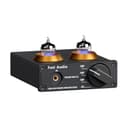
- Gain flexibility first. A phono stage with one fixed gain setting works properly with cartridges whose output happens to match it. A switchable stage works with all of them. That is the single most useful feature at this price and the reason the Fosi Box X2 ranks where it does.
- Noise floor second. You are amplifying by a factor of roughly a hundred, so whatever hiss the circuit generates gets amplified too. Metal cases, external power supplies and a proper ground post all help; the sub-$25 units are where this starts to be audible on quiet passages.
- A real ground terminal third. Most turntables have a thin ground wire that must connect somewhere. A stage without a ground post leaves you improvising, and un-grounded turntables hum.
- Anything genuinely extra last.A headphone output, an aux input, a subsonic filter — useful if you need them, irrelevant if you don’t.
What gain actually means, in numbers
A typical moving-magnet cartridge outputs somewhere between 2.5 and 5.5 millivolts. Line level — what an amplifier’s aux input expects — is around 300 to 500 millivolts. Closing that gap takes roughly 40 dB of gain.
Which means: a stage with a fixed 35 dB gain paired with a quiet 2.5 mV cartridge lands well short, and you compensate by running the volume knob higher, which also raises the noise floor. A stage offering 39, 42 or 45 dB — like the Fosi Box X2 — lets you pick the setting that puts your cartridge where it should be. That is not audiophile fussiness; it is the difference between a system that sounds normal at nine o’clock on the dial and one that needs three.
The full arithmetic, including why every MM spec sheet says 47 kOhm, is in phono preamp gain and impedance explained.
What under $100 will not buy you
Being clear about the ceiling is more useful than overselling the floor.
- Proper moving-coil support. An MC cartridge outputs roughly ten times less signal and needs 60 dB or more of gain plus specific loading. Nothing here does that properly. If you have an MC cartridge, the under-$200 tier is your starting point. See also MM vs MC.
- Adjustable loading.Every unit here is fixed at the standard 47 kOhm, which is correct for essentially all moving-magnet cartridges — so this is a limit that costs most people nothing.
- A published noise-floor figure.At this price makers write “low noise” rather than a number. We would rather see a specification, and we say so rather than inventing one.
- A dramatic upgrade over a good built-in stage. If your turntable or receiver already has a decent phono input, a $25 box is not an improvement. It is a solution to not having one.
The tube question
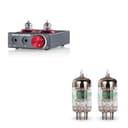
Two picks here — the Fosi Box X2 and the Douk Audio T4 PRO — include small signal tubes. Be clear-eyed about what that means at this price. A tube in a sub-$100 phono stage is a voicing choice, not a fidelity upgrade: it adds a particular low-order harmonic character that many people find pleasant on bright pressings. It is not more accurate than a good solid-state design and generally measures worse.
Buy one because you like the effect, or because the tube sockets let you experiment, or — in the Douk’s case — because it happens to include the headphone amplifier you actually wanted. Don’t buy one expecting the tube to fix a system problem.
That headphone output is worth a sentence of its own, because it is the reason a lot of people end up here. A phono stage with a headphone amp inside is the cheapest complete way to play records privately — no speakers, no amplifier, one box. We compare it against the two alternatives, a receiver with a headphone jack and a Bluetooth deck paired to wireless cans, in how to listen to vinyl with headphones.
Setting one up without hum
Nearly every phono preamp problem is a wiring problem, and nearly all of those are one of these four:
- The ground wire is not connected.That thin spade connector on the turntable’s cable goes to the preamp’s ground post. Skipping it produces a loud mains hum.
- Two phono stages are in series. A turntable with its built-in preamp switched on, feeding a phono input, produces distorted, excessively loud sound. Switch one off.
- The preamp output is in a phono input. Same symptom, opposite cause. A preamp output goes to a line or aux input.
- The power supply is too close to the signal cables. Wall warts radiate. Move the adapter away from the interconnects and the hum often disappears.
The troubleshooting guide covers each of these as a symptom-first decision tree.