PLATTER & PLINTH

The Best Amplifiers for a Turntable

Five amplifiers for a vinyl system — and the one feature that decides whether you need to buy a phono preamp as well.

By Stephen V.Last updated How we pick

An amplifier for a turntable has one requirement beyond the obvious: it needs to receive a phono signal from somewhere. Either the amplifier has a phono input of its own, or your turntable has a built-in preamp, or you buy a separate phono stage. Get that wrong and the system is silent or nearly so, which is by far the most common first-setup problem in vinyl.

Two picks here — the Sony STR-DH190 and the Denon PMA-600NE — have phono inputs, and the Marantz PM6007 has an MM stage with a FET input that is better than most. The two Fosi class-D amplifiers do not, which makes them the right answer only if your turntable already has a preamp or you are buying one anyway.

The other thing worth setting straight before you compare numbers: published wattage figures in this category are not measured the same way, and a “300 W” class-D amplifier is not six times more powerful than a 45 W integrated. That is explained below, because it is the single most misleading spec in home audio.

How this is funded:we earn a commission if you buy through our links, at no extra cost to you. It never changes which product we recommend, and we’ll tell you plainly when to skip one. Full disclosure.

Quick picks

Ranked on published specs, drive/motor design and buyer fit. Select a row to jump to the full write-up. We have not heard most of these units — here is exactly what we do instead.

#ProductBest forPrice
1
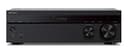
Sony STR-DH190

Sony STR-DH190

The obvious answer for a vinyl system on a budget: a two-channel receiver with a real phono input, 100 W x2 into 8 ohms, Bluetooth, four line inputs, A/B speaker switching and FM. It replaces both the phono preamp and the amplifier in one box, which is why it keeps beating cleverer products on value.

Best overall (has a phono input)
$218.00 · View on Amazon

$249.9913% off

Price as of August 31, 2026. #ad How we’re funded

2
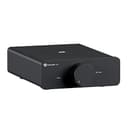
Fosi Audio V3

Fosi Audio V3

A TPA3255 class-D amplifier that drives 2-8 ohm speakers, with a pre-out whose level follows the volume control and swappable op-amps for anyone who wants to tinker. No Bluetooth, no phono stage — just power, which is exactly what a vinyl system usually needs from an amplifier.

Best budget amplifier
$89.99 · View on Amazon

Price as of August 31, 2026. #ad How we’re funded

3
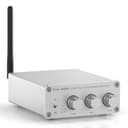
Fosi Audio BT20A-S

Fosi Audio BT20A-S

The V3's more sociable sibling: a pair of TPA3116D2 chips instead of the V3's bigger TPA3255, in exchange for Bluetooth 5.0 and bass and treble controls. For a system that has to serve a turntable and a phone, the Bluetooth input saves buying a second box — and unusually for the category, its power figure is quoted as a real continuous rating.

Best with Bluetooth
$79.99 · View on Amazon

Price as of August 31, 2026. #ad How we’re funded

4
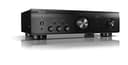
Denon PMA-600NE

Denon PMA-600NE

A proper integrated amplifier with a phono input, 70 W into 4 ohms, two optical and one coaxial digital input, and — the detail that separates it from cheaper boxes — divided circuitry that lets you switch the digital section off entirely for pure analog playback.

Best mid-range integrated
$599.00 · View on Amazon

Price as of August 31, 2026. #ad How we’re funded

5
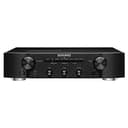
Marantz PM6007

Marantz PM6007

45 W per channel specified properly — 8 ohms RMS, 20 Hz to 20 kHz, not a peak figure — an MM phono stage with a FET input, Marantz's HDAM SA3 output modules and A/B speaker switching. The honest power rating tells you most of what you need to know about how this was built.

Best premium integrated
$535.01 · View on Amazon

Price as of August 31, 2026. #ad How we’re funded

The picks in full

#1Best overall (has a phono input)

Sony STR-DH190

The obvious answer for a vinyl system on a budget: a two-channel receiver with a real phono input, 100 W x2 into 8 ohms, Bluetooth, four line inputs, A/B speaker switching and FM. It replaces both the phono preamp and the amplifier in one box, which is why it keeps beating cleverer products on value.

Strengths

  • Dedicated phono input — a preamp-less turntable plugs straight in
  • 100 W x2 into 8 ohms, with A/B switching for two speaker pairs
  • Bluetooth, four RCA inputs, a 3.5 mm input, FM and a full-size headphone jack

Trade-offs

  • No HDMI and no digital inputs — this is a stereo receiver, not an AV one
  • The phono stage is fine, not special; a separate box still beats it
Type2-channel stereo receiver
Power100 W x2 (8 ohms, 1 kHz)
Phono inputYes
Speaker impedance6 - 16 ohms
InputsPhono, 4x RCA, 3.5 mm, Bluetooth, FM
ExtrasA/B speaker switching, headphone jack, remote

Note. Buying this instead of a separate amp and phono preamp usually saves money and a mains socket. The trade is that you cannot upgrade the phono stage independently later — though its line inputs mean you can always add a better one in front.

Specifications read from the manufacturer / product listing, on August 11, 2026. “Not published” means the maker does not state that figure.

#2Best budget amplifier

Fosi Audio V3

A TPA3255 class-D amplifier that drives 2-8 ohm speakers, with a pre-out whose level follows the volume control and swappable op-amps for anyone who wants to tinker. No Bluetooth, no phono stage — just power, which is exactly what a vinyl system usually needs from an amplifier.

Strengths

  • TPA3255 class-D output drives 2-8 ohm speakers comfortably
  • Volume-controlled pre-out for adding a subwoofer later
  • Socketed NE5532 op-amps can be swapped for higher-grade parts

Trade-offs

  • No phono input — a turntable needs a preamp before this
  • No Bluetooth and no remote; it is a two-knob box on purpose
TypeClass-D integrated (TPA3255)
Speaker impedance2 - 8 ohms
Phono inputNo
Pre-outYes — volume-controlled
Op-ampsSocketed NE5532 (swappable)
Power supply32 V external (included)

Note. Class-D wattage claims are quoted at generous distortion figures across the industry — treat the headline number as a marketing figure and judge it on whether it drives your speakers, which it will.

Specifications read from the manufacturer / product listing, on August 11, 2026. “Not published” means the maker does not state that figure.

#3Best with Bluetooth

Fosi Audio BT20A-S

The V3's more sociable sibling: a pair of TPA3116D2 chips instead of the V3's bigger TPA3255, in exchange for Bluetooth 5.0 and bass and treble controls. For a system that has to serve a turntable and a phone, the Bluetooth input saves buying a second box — and unusually for the category, its power figure is quoted as a real continuous rating.

Strengths

  • Bluetooth 5.0 input alongside the wired input — no second device needed for streaming
  • Rated 100 W x2 RMS into 4 ohms at 0.04% distortion across the full 20 Hz - 20 kHz band, which is a far more honest figure than the peak numbers this category usually advertises
  • Comes with its 24 V power supply and a built-in speaker protection circuit

Trade-offs

  • Still no phono input — the turntable needs a preamp first
  • Tone controls tempt you to fix a room problem you should fix with placement
TypeClass-D integrated (dual TPA3116D2)
Power100 W x2 RMS (4 ohms, 20 Hz - 20 kHz, 0.04% THD)
WirelessBluetooth 5.0 input
Tone controlsBass and treble
Phono inputNo
Power supply24 V external (included)

Note. Fosi replaced the BT20A Pro we previously recommended here; the BT20A-S is the current Bluetooth model in the same line and at the same money. If your turntable already has a built-in preamp — most decks under $400 do — this plus a passive pair is a complete system for well under $250.

Specifications read from the manufacturer / product listing, on August 13, 2026. “Not published” means the maker does not state that figure.

#4Best mid-range integrated

Denon PMA-600NE

A proper integrated amplifier with a phono input, 70 W into 4 ohms, two optical and one coaxial digital input, and — the detail that separates it from cheaper boxes — divided circuitry that lets you switch the digital section off entirely for pure analog playback.

Strengths

  • Phono input plus digital inputs, so records and streaming share one amplifier
  • Digital circuits can be disengaged for an undivided analog signal path
  • 70 W at 4 ohms from Denon's Advanced High Current push-pull design

Trade-offs

  • Substantially more expensive than a class-D amp plus a separate phono stage
  • No network streaming — Bluetooth is the only wireless input
TypeIntegrated stereo amplifier
Power70 W per channel at 4 ohms
Phono inputYes
Digital inputs2x optical, 1x coaxial
WirelessBluetooth
Analog modeDigital circuitry can be disengaged

Note. The analog-mode switch is a genuine feature, not marketing garnish: powering down the DAC section removes a real source of noise from a phono signal that starts out at a few thousandths of a volt.

Specifications read from the manufacturer / product listing, on August 11, 2026. “Not published” means the maker does not state that figure.

#5Best premium integrated

Marantz PM6007

45 W per channel specified properly — 8 ohms RMS, 20 Hz to 20 kHz, not a peak figure — an MM phono stage with a FET input, Marantz's HDAM SA3 output modules and A/B speaker switching. The honest power rating tells you most of what you need to know about how this was built.

Strengths

  • 45 W x2 rated across the full 20 Hz-20 kHz band at 8 ohms — a real specification, not a peak number
  • MM phono stage with a FET input, better than the token phono inputs on cheaper amps
  • Five analog plus three digital inputs, with A/B speaker switching

Trade-offs

  • The most expensive amplifier here by a wide margin
  • MM phono only — a moving-coil cartridge still needs an external stage
TypeIntegrated stereo amplifier
Power45 W x2 (8 ohms RMS, 20 Hz - 20 kHz)
Phono inputYes — MM with FET input stage
Analog inputs5
Digital inputs1x coaxial, 2x optical
ExtrasA/B speaker switching, shielded DAC section

Note. Compare the power spec, not the number: 45 W stated across the full audio band at a low distortion figure is a different claim from '300 W' quoted at peak into an unspecified load.

Specifications read from the manufacturer / product listing, on August 11, 2026. “Not published” means the maker does not state that figure.

Read the power specification, not the number

The Marantz PM6007 is rated at 45 W per channel into 8 ohms, 20 Hz to 20 kHz. The Fosi Audio V3 advertises 300 W x2. Those figures describe different things.

The Marantz specification states the impedance, the frequency range across which the power is delivered, and implies a low distortion figure. It is a continuous RMS rating: the amplifier can produce that power all day, at every frequency, into that load. Class-D wattage claims across the budget market are typically quoted at peak, into an unstated load, at a distortion level far above what anyone would want to listen to, and often at a single frequency.

The practical consequence: judge a budget class-D amplifier by whether it drives your speakers to the volume you want without strain — which the Fosi units comfortably do with any speaker on our bookshelf list — and judge an integrated amplifier by its stated specification. Don’t compare the two numbers directly, because they are not the same measurement.

How much power do you actually need?

Less than the marketing implies. Loudness scales logarithmically: doubling amplifier power buys about 3 dB, which is a just-noticeable step up in volume, not twice as loud.

  • Sensitive speakers (89-91 dB), a normal room: 20-30 W is genuinely enough. The Klipsch R-40M at 91 dB will go louder than most people want on a Fosi V3.
  • Average speakers (85-87 dB): 40-60 W gives comfortable headroom.
  • Insensitive speakers or a large room: this is where a 100 W receiver like the Sony earns its rating.

More common than an underpowered amplifier is an overdriven one: a small amplifier pushed into clipping produces distortion that can damage tweeters. Headroom protects speakers rather than threatening them.

The phono input question, in order

  1. Does your turntable have a built-in preamp?Most decks under $400 do, usually with a PHONO/LINE switch on the back. If yes, any amplifier here works — use a line input and leave the deck on LINE.
  2. If not, does the amplifier have a phono input? The Sony STR-DH190, Denon PMA-600NE and Marantz PM6007 do. That is one box and one purchase fewer.
  3. If neither, buy a phono stage. See under $100 or under $200.

One rule that catches people constantly: never run two phono stages in series. A turntable with its internal preamp switched on, plugged into a phono input, produces distorted, painfully loud sound. Switch one of them off.

Receiver or integrated amplifier?

A stereo receiver like the Sony STR-DH190 is an integrated amplifier plus a radio tuner and usually more input switching. An integrated amplifier like the Denon or Marantz drops the tuner and spends the money on the amplification and the power supply.

At the same price, the integrated amplifier generally sounds better because more of the budget went into the parts that matter. At different prices, the receiver often wins on value: the Sony includes a phono input, four line inputs, Bluetooth, A/B speaker switching and FM for less than an entry integrated costs. For a first vinyl system it is very hard to argue against.

What the expensive amplifiers actually add

Between the Fosi V3 and the Marantz PM6007 there is a large price gap. What it buys, in rough order of audibility:

  • A better power supply. Large transformers and reservoir capacitors let an amplifier deliver current on demand during loud passages instead of sagging. This is where most of the money in a good integrated goes and it is the least visible line item.
  • A better phono stage. The Marantz uses a FET input stage for its MM phono input; budget amplifiers with phono inputs typically use the cheapest circuit that works.
  • Analog isolation. The Denon lets you power down its digital section entirely, removing a real noise source from a phono signal measured in thousandths of a volt.
  • Build and longevity. A well-made integrated amplifier is a twenty-year purchase. A $90 class-D box with an external wall supply is not necessarily.

Where an amplifier upgrade sits in the queue

Honestly? Behind speakers, behind cartridge, and behind setup. Amplifiers operating within their comfortable power range and not clipping sound more alike than any other component category. If you are choosing between a $600 amplifier with $200 speakers and a $200 amplifier with $600 speakers, take the second one every time.

Buy up in amplifiers when you need a specific feature — a phono input, Bluetooth, enough power for insensitive speakers, or A/B switching for two pairs — or when you have already spent well on speakers and want the amplifier to stop being the ceiling.

Frequently asked questions

Do I need an amplifier for my turntable?

You need amplification somewhere. Passive speakers require a separate amplifier. Powered speakers have one built in and do not. Either way the turntable's phono signal also needs a phono preamp — built into the deck, into the amplifier, or as a separate box.

What amplifier do I need for a turntable with no preamp?

One with a phono input. The Sony STR-DH190, Denon PMA-600NE and Marantz PM6007 all have one, which removes the need for a separate phono stage. Class-D amplifiers like the Fosi units have line inputs only and will sound faint and thin with a raw phono signal.

How many watts do I need for a turntable system?

For sensitive speakers around 90 dB in a normal room, 20-30 W is genuinely enough. For average 85-87 dB speakers, 40-60 W gives comfortable headroom. Doubling amplifier power buys only about 3 dB of extra volume, so the number matters less than people expect.

Is a 300W class-D amplifier better than a 45W integrated?

Not necessarily — the two numbers are not measured the same way. A 45 W rating stated across 20 Hz-20 kHz into 8 ohms at low distortion is a continuous, honest figure. Budget class-D wattage claims are typically peak figures at high distortion into an unstated load.

Can I use a home theater receiver for vinyl?

Yes, if it has a phono input or your turntable has a built-in preamp. Many modern AV receivers dropped the phono input, which is why dedicated stereo receivers like the Sony STR-DH190 remain popular with vinyl listeners.

Does the amplifier or the speakers matter more?

The speakers, by a wide margin. Amplifiers running within their comfortable power range and not clipping sound far more alike than speakers do. Given a fixed budget, put more of it into the speakers and buy the amplifier that has the features you need.

Sources

Keep reading