The four specs that decide this category
Gain, in decibels
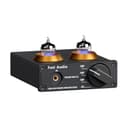
The amount of amplification. A moving-magnet cartridge outputting 2.5-5.5 mV needs roughly 40 dB to reach line level. A moving-coil cartridge outputting 0.2-0.8 mV needs 60 dB or more. A stage with one fixed setting suits a narrow band of cartridges; a stage with four settings, like the Fosi Box X5’s 38/48/56/66 dB, suits almost anything.
Loading, in ohms
The electrical resistance the cartridge sees. Moving-magnet cartridges are designed around 47 kOhm, which is why that figure appears on every spec sheet and why fixed 47 kOhm loading is not a limitation for MM users. Moving-coil cartridges are far more sensitive to loading and often specify a value in the tens or hundreds of ohms, which is where fixed-loading budget stages become a genuine compromise.
Noise floor
You are amplifying a tiny signal by a factor of a hundred or more, so the circuit’s own noise gets amplified with it. iFi publishes -141 dBVfor the Zen Air Phono 2 — a specific, checkable number rather than the word “quiet.” That willingness to publish is itself informative.
Subsonic filtering
Warped records produce large excursions below 20 Hz that you cannot hear but your woofers absolutely can, wasting amplifier power and muddying the midrange. A subsonic filter removes them. Only the iFi here has one, and on a collection with any dished or slightly warped pressings it is the most audible feature in this entire comparison.
Do you actually need moving-coil support?
Probably not yet, and it is worth being blunt about that because MC support is the headline feature on half the boxes in this price range.
Essentially every turntable under $1,000 ships with a moving-magnet cartridge. Moving coil is a later step, it costs more, and most MC cartridges cannot have their stylus replaced at home — a worn one goes back to the manufacturer. Our MM vs MC guide covers the trade honestly.
Buy an MC-capable stage if you already own an MC cartridge, or if you are confident you will within a year or two. The Fosi Box X5’s 66 dB setting is the cheapest credible route in. Otherwise, spend the same money on a better MM-only stage or on the cartridge itself, which will change what you hear far more.
Is a $150 preamp better than the one in my turntable?
Usually yes, and for a structural reason rather than a marketing one. A built-in phono stage lives inside a plinth, inches from a motor and often sharing a power supply with it, amplifying a signal of a few thousandths of a volt. A separate stage sits in its own shielded case with its own supply. The physics favors the separate box before either design has been engineered.
The practical test: switch your turntable’s internal preamp off, run it into the external stage, and listen for the noise floor between tracks with the volume up. If the background gets quieter and the bass gets more defined, the upgrade did what it should. If nothing changes, your built-in stage was already good and your money is better spent downstream.
Where this money is best spent in a whole system
A phono stage upgrade is worth it when it is the actual bottleneck. Here is the order we would follow before spending $200 here:
- Is the deck set up correctly?Tracking force and anti-skate at the specified values — free, and often the biggest single improvement. See the setup guide.
- Is the stylus worn? A tired stylus makes every component downstream sound worse. See how to replace a turntable stylus.
- Are the speakers the limit? They almost always are. See the bookshelf speaker roundup.
- Then the phono stage— particularly if you are currently using one built into a budget receiver.
Connections and the mistakes that undo all of this
Every stage here needs three things wired correctly: the turntable’s RCA cables into the phono input, the thin ground wire onto the ground post, and the outputs into a line or aux input— never another phono input. Running two phono stages in series is the single most common setup error and produces distorted, painfully loud sound.
If your turntable has a built-in preamp, switch it off. If it has no switch and no way to bypass, then you already have a phono stage and adding a second one will not work — check do I need a phono preamp? before ordering.