Schiit Mani 2 Review
Most affordable phono stages give you one gain figure and one load and hope your cartridge agrees. This one gives you sixty-four combinations and a filter for warped records.
How this is funded: we earn a commission if you buy through our links, at no extra cost to you. It never changes which product we recommend, and we’ll tell you plainly when to skip one. Full disclosure.
The short version
Schiit Mani 2
A moving-magnet, moving-coil and moving-iron phono stage with four gain settings, four resistive loads, four capacitance values and switchable passive subsonic filtering, designed and built in the USA. It is the point at which a phono preamp stops being a component you will replace and becomes one you keep. Buy it if you intend to change cartridges. Skip it if you own one moving-magnet cartridge and will never change it — the cheaper fixed-gain boxes do that job. One practical catch, re-checked on October 11, 2026: Schiit still does not sell the Mani through Amazon, so it is a direct order from schiit.com — we have no live price for it and no link here that would earn us anything, so there is none.
Strengths
- Four gain settings (33 / 42 / 48 / 60 dB) cover MM, MI and MC cartridges
- Notably quiet — a clear upgrade over most built-in phono stages
- Designed and assembled in the USA
Trade-offs
- Not sold on Amazon — Schiit ships it direct, and quotes 7-10 days at the time of writing
- More than you need if your cartridge is a basic MM and you have a decent built-in stage
- No frills — it's a purist box, not a feature list
| Cartridge support | MM, MI and MC |
|---|---|
| Gain settings | Four (33 / 42 / 48 / 60 dB) |
| Equalization | RIAA |
| Loading | Switchable — 47 kOhm / 200 / 47 / 38 ohms |
| Origin | Designed and built in the USA |
| Where to buy | Schiit direct — not stocked on Amazon |
Specifications read from the manufacturer / product listing, accessed 2026-09-11. We have not measured this unit — what we do instead.
 Illustrative photo
Not sold on Amazon. Schiit Audio sells it through channels that pay us nothing, so there is no buy link and no price here. The figures on this page come from Schiit Audio’s own published specification, cited below.
What problem this solves
A cheap phono stage makes one assumption on your behalf: that you have a moving-magnet cartridge putting out somewhere around 4–5 mV, and that loading it at 47 kΩ is fine. For a large majority of turntables that assumption is correct and the cheap box is the right purchase.
It stops being correct the moment you do anything interesting with cartridges. A low-output moving coil produces a fraction of that voltage and needs both far more gain and a much lower load impedance. A moving-iron design sits somewhere else again. Change cartridge families with a fixed-gain preamp and you are buying a new preamp too.
The Mani 2 exists to remove that ceiling for a price that is still well inside what most people spend on a cartridge. Schiit specifies four gain settings (33, 42, 48 and 60 dB), four resistive loads (47 kΩ, 200 Ω, 47 Ω and 38 Ω) and four capacitance values (47, 100, 150 and 200 pF). That is sixty-four combinations, and it means the box outlives every cartridge decision you are likely to make.
Gain: what the four settings are for
Gain is the amount of amplification applied to the cartridge’s output. Too little and the signal never reaches usable level, so you run the volume control at maximum and hear the noise floor. Too much and loud passages clip.
Roughly how the four settings map onto real cartridges:
- 33 dB— Schiit publishes a sensitivity of 5.3 mV for 300 mV out here, so this is the hot moving-magnet setting, and the one to drop to if a normal MM sounds loud or distorted a step up.
- 42 dB— the factory default and the standard moving-magnet setting: 1.9 mV for 300 mV out. An Ortofon 2M Red at 5.5 mV or an Audio-Technica VM95E sits here or one step down.
- 48 dB— 1.06 mV for the same output: high-output moving coils and moving-iron designs, which fall between the two families.
- 60 dB— 0.33 mV, which is low-output moving coil territory — the cartridges producing a few tenths of a millivolt.
Set it from your cartridge’s published output figure rather than by trial and error where possible — gain and impedance explained works through the arithmetic, and MM vs MC explains why the two families differ so much in the first place.
Loading: the setting nobody explains
Loading is the electrical impedance the preamp presents back to the cartridge. The cartridge is a coil and a magnet; what it sees at its output affects how it behaves, particularly at the top of its range.
For moving-magnetcartridges, the resistive value is settled — 47 kΩ, and every MM cartridge is specified for it. What varies is capacitance, which includes the capacitance of your tonearm cable, and it shifts the high-frequency response audibly. Manufacturers publish a recommended range; being able to choose 47, 100, 150 or 200 pF lets you land inside it instead of hoping.
For moving-coilcartridges the resistive load is the important one and the values are far lower — the 200, 47 and 38 Ω settings exist for exactly this. A common rule of thumb is to load a moving coil at several times its internal impedance; the cartridge maker usually publishes a recommendation, and the Mani 2 gives you enough steps to follow it.
None of this is audible as a dramatic difference. It is audible as the top end being slightly bright or slightly dull, and being able to correct it is one of the small pleasures of owning an adjustable stage.
The subsonic filter, which is more useful than it sounds
Schiit specifies purely passive low-frequency filtering at 15 Hz, switchable between 6 dB and 12 dB per octave. Two details matter there.
Why you want one.A warped record makes the tonearm rise and fall once per revolution, which at 33 1/3 RPM is about 0.55 Hz. Turntable rumble adds more energy in the same region. None of it is audible as music, but all of it is amplified along with the music, wasting amplifier headroom and making woofers visibly flap. Removing it can make a system sound cleaner in the midrange purely by giving the amplifier less pointless work.
Why “passive” matters.A passive filter uses no active components in the signal path — it is resistors and capacitors doing the work rather than another amplification stage. That is the less intrusive way to do it, and it is unusual at this price.
Two slopes gives you a choice: 6 dB/octave is gentle and safe on everything; 12 dB/octave removes more of the problem and is the one to use with badly warped records. If your records are flat and your deck is quiet, leave the filter out. If you buy secondhand, you will use it.
What it does not have
No tubes, no display, no remote, no balanced outputs, and no volume control — it is a phono stage, not a preamplifier in the wider sense, so it feeds a line input on something else. It also has no mono switch, which is a genuine omission if you collect mono pressings.
Power comes from an external AC wall adapter rather than an internal supply, and the adapter is chosen at the point of ordering: Schiit lists a 115 VAC US plug alongside 230 VAC Europlug, UK and Australian options. Pick the one that matches your mains rather than buying the US version and adding a converter.
Where to buy it, and why there is no price or button on this page
Schiit sells the Mani direct only. Its Amazon listing has gone — the page that used to carry it now reads “Currently unavailable”, and a live catalog search on October 11, 2026 returned the Magni Unity, the Buf and the Skoll F from Schiit’s storefront and no Mani at any price. The preamp itself is not discontinued: schiit.com still sells it, and quoted a 7–10 day ship estimate when we last checked.
So this page has no buy button at all, which is deliberate. Every price on the site comes from a live Amazon feed we re-check daily, so a product that is not on Amazon has no number we are willing to print — and a link to schiit.com pays us nothing, which makes it a link we are not willing to dress up as a recommendation to click. Schiit’s own product page stays cited under the specification table above, where it belongs: as the source of the figures, not as a storefront we are sending you to. If you want the Mani 2, go to schiit.com directly. If you would rather buy from a listing with a live price and fast delivery, the two stages below do the same MM and MC job and we do earn from those.
Where it sits in a system
Between the turntable and a line input on whatever comes next. The turntable’s own preamp, if it has one, must be switched to PHONO so that the Mani 2 is the only phono stage in the chain — the double-preamp mistake is covered in phono vs line.
It pairs naturally with the decks that deliberately omit a preamp: the Fluance RT85, the RT82, the U-Turn Orbit and the Pro-Ject Debut range. On a deck like that, with a good cartridge fitted, the adjustable loading actually earns its keep.
Who should buy it
Buy the Mani 2 if you expect to own more than one cartridge over the life of the deck; if you have or want a moving-coil cartridge; if you buy secondhand records and want the subsonic filter; or if you simply want to stop thinking about the phono stage.
Buy the Fluance PA10 or another fixed-gain moving-magnet stage instead if you own one MM cartridge, are happy with it, and would rather put the difference into the cartridge itself. That is a defensible allocation, and phono preamps under $100 covers the field. The whole range, including the tube options, is in tube vs solid state.
The MM/MC alternatives you can buy today, with live prices
The Mani 2 is a direct order from Schiit, so these are the two stages we rank that do the same moving-magnet and moving-coil job from a listing with a live price. The Pro-Ject publishes adjustable loading; the Fosi publishes four switchable gain settings instead.
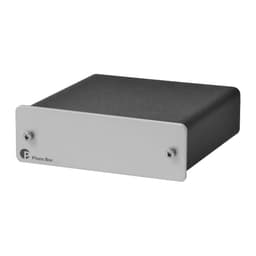
Pro-Ject Phono Box
A refined MM/MC upgrade for a separates system
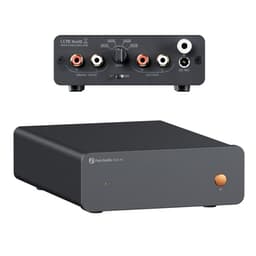
Fosi Audio Box X5
The cheapest honest route into moving-coil cartridges
Price as of October 15, 2026. #ad How we’re funded
Frequently asked questions
Does the Schiit Mani 2 support moving-coil cartridges?
Yes. It offers 33, 42, 48 and 60 dB of gain, which covers everything from a high-output moving-magnet cartridge to a low-output moving coil, plus moving-iron designs. That range is the single biggest reason to choose it over a fixed-gain preamp.
What gain setting should I use on the Mani 2?
Match it to your cartridge's published output. A typical moving-magnet cartridge at 4-5.5 mV wants the lower settings; a low-output moving coil at a few tenths of a millivolt wants 60 dB. If the sound is faint you are too low; if it distorts on loud passages you are too high. Our gain and impedance guide has the arithmetic.
What is loading, and does it matter?
Loading is the resistance and capacitance the preamp presents to the cartridge, and it changes the cartridge's frequency response — particularly the top end. Moving-magnet cartridges are almost universally specified at 47 kΩ; moving coils want much lower values. The Mani 2 offers 47 kΩ, 200 Ω, 47 Ω and 38 Ω resistive, plus 47, 100, 150 and 200 pF of capacitance.
What does the subsonic filter on the Mani 2 do?
It rolls off very low frequencies — Schiit specifies purely passive filtering at 15 Hz, switchable between 6 dB and 12 dB per octave. Warped records and turntable rumble produce energy well below the audible band that wastes amplifier headroom and makes woofers flap. The filter removes it without touching the music.
Is the Schiit Mani 2 better than the Fluance PA10?
It is more capable and costs more. The PA10 is a fixed-gain moving-magnet stage that does one job cleanly. The Mani 2 handles MM, MC and MI cartridges, lets you set gain and loading, and adds a subsonic filter. If you have one MM cartridge and no plans to change, the PA10 is the better value; if you expect to experiment, the Mani 2 saves you buying twice.
Will the Schiit Mani 2 work outside the US?
It runs from an external AC wall adapter, and Schiit's own order page now lets you choose the 115 VAC US plug or a 230 VAC Europlug, UK or Australian adapter. Pick the one for your mains at the point of ordering rather than buying the US version and relying on a converter.
Where do you buy the Mani 2 now?
Direct from schiit.com. Schiit has stopped selling the Mani through Amazon — that listing reads 'Currently unavailable' as of September 2026 — so there is no Amazon offer, no live price and no next-day delivery on it. Schiit's own page quoted a 7-10 day ship estimate when we last checked it. The product itself is not discontinued.
Sources
- Schiit Audio — Mani 2 phono preamp — Manufacturer specs: four gain settings (33/42/48/60 dB), switchable resistive and capacitive loading, passive subsonic filter at 15 Hz (accessed August 19, 2026)
- Elliott Sound Products — Phono preamp / RIAA equalization — Technical reference on RIAA pre-emphasis and the inverse playback curve (accessed July 24, 2026)
- Crutchfield — How to choose a phono preamp — On why a phono signal needs a preamp and never running two at once (accessed July 24, 2026)
- Ortofon — 2M Red — Manufacturer specs: 5.5 mV output, 1.6-2.0 g tracking (1.8 g recommended), 47 kOhm load (accessed July 24, 2026)
Keep reading
Best Phono Preamps
Where this sits against the rest of the field.
See the picksGain and Impedance Explained
How to work out which of the Mani 2's settings your cartridge wants.
Read the guideMoving Magnet vs Moving Coil
The cartridge distinction that makes switchable gain worth paying for.
Read the comparisonBest Phono Preamps Under $200
The price band this competes in, with the fixed-gain alternatives.
See the picks