Stylus profiles, and why they are the whole story
Nearly all of the audible difference between cartridges at this price comes from the shape of the diamond at the end of the cantilever. A record groove is a modulated valley; how much of that modulation the tip can follow depends on its geometry.
Conical (spherical)
A simple rounded point. It sits relatively high in the groove and traces broad modulations well, but it cannot follow the finest, most tightly-spaced ones — which is where high-frequency detail lives. It is forgiving of alignment error, which is why it is fitted to fixed-arm decks. This is what most factory cartridges on budget turntables use, and it is what an upgrade replaces.
Elliptical
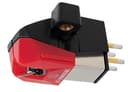
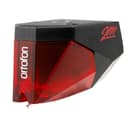
The tip is narrower side-to-side, so it fits deeper into the groove and follows finer modulations. Compared with conical you hear more air, better instrument separation and more texture in vocals. The AT-VM95E and Ortofon 2M Red sit here, and this is the step most people should take first.
Nude elliptical
The same profile, but with the diamond mounted directly rather than bonded to a metal shank. Less mass at the tip means it follows the groove more accurately at high frequencies. The Ortofon 2M Blue is the standard example of this step.
Micro-linear / Shibata
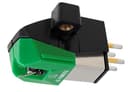
A tip with a long, narrow vertical contact patch that touches a much larger area of the groove wall. Two consequences: it retrieves detail the other profiles physically cannot reach, and it spreads its contact pressure over more area, which reduces wear on both stylus and record. The AT-VM95ML sits here, and at $178 it is one of the better-value tips in the whole hobby.
The catch with the advanced profiles is that they are less forgiving. Alignment, tracking force and anti-skate all have to be right or you lose the benefit and risk uneven wear — see how to set up a cartridge.
MM, MI and MC: what you can and cannot use
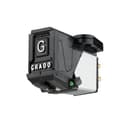
Five of these six are moving magnet and one, the Grado Prestige Green4, is moving iron. Both produce a high output of several millivolts and work with any standard MM phono input, so both are plug-in compatible with essentially any phono stage you own.
Moving coil cartridges are the tier above and need far more gain plus specific loading, which is why none appears on this page. If you are weighing that step, the MM vs MC guide covers the trade, and phono preamps under $200 covers the stage you would need alongside it.
One real compatibility note: Grado’s moving-iron design can pick up hum from the unshielded motor of some direct-drive turntables. On a belt-drive deck it is rarely an issue.
The upgrade trick that saves you money
Both dominant families here — Audio-Technica’s VM95 and Ortofon’s 2M — use a shared body with an interchangeable stylus. That has a consequence worth knowing before you spend anything:
If you already own an AT-VM95C or AT-VM95E, do not buy the whole AT-VM95ML cartridge. Buy the AT-VMN95ML stylus alone and snap it onto the body already mounted and aligned on your arm. Same result, less money, and no realignment. The same applies to moving from an Ortofon 2M Red to a 2M Blue.
That is also an argument for choosing one of these families in the first place: your first cartridge purchase buys into an upgrade path where every later step is a two-second job. Our stylus replacement guide covers the swap.
One caveat before you spend: whether the stylus-only trick is available to you at all depends on the deck. Several entry decks carry an integral cartridge body with its own, much shorter ladder. If yours is an Audio-Technica, our cartridge guide for Audio-Technica turntables has the fitment table — three groups, three different correct answers, and one group where buying a cartridge is not possible.
Running costs nobody mentions
A stylus is a consumable. Manufacturers generally quote lifetimes in the range of several hundred to around a thousand playing hours depending on profile, and a worn stylus does not just sound worse — it damages records. So the real cost of a cartridge is the cartridge plus a replacement stylus every few years.
This is where the interchangeable-stylus families are meaningfully cheaper to own than a cartridge whose stylus is not separately available. It is also where moving coil gets expensive: most MC cartridges have to go back to the manufacturer for a re-tip.
Which one should you buy?
- You have a budget deck with a conical stylus and $70 to spend: the AT-VM95E. It is the single highest-return upgrade in this hobby.
- You want the biggest jump available under $200: the AT-VM95ML. The micro-linear tip reaches groove detail nothing else here can, and it reduces record wear while doing it.
- You want the safest universal choice: the Ortofon 2M Red. Fitted as standard to more turntables than any other cartridge, with a clean upgrade path to the 2M Blue.
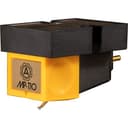
- You find modern pressings bright or fatiguing: the Nagaoka MP-110, which is known for a warmer balance.
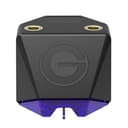
- You want something from a specialist audio brand:the Goldring E3 — a British cartridge maker’s super-elliptical tip, with the stylus angle set at the factory.
- You have a belt-drive deck and want the Grado sound: the Prestige Green4, with the direct-drive hum caveat noted above.
Fitting one
A cartridge upgrade is only an upgrade if it is installed correctly. In order: mount it to the headshell, set overhang using the alignment protractor, balance the arm, set tracking force to the manufacturer’s specified value, and set anti-skate to match. It takes half an hour the first time.
An advanced stylus profile mounted at the wrong angle will sound worse than the conical it replaced and will wear your records unevenly. If that sounds daunting, our step-by-step cartridge setup guide covers each step in order, and the full setup guide covers the deck around it.
Before you order, check the mass against what your arm supports. It is the one fitment limit that is easy to miss: Fluance publishes 3.5 to 6.5 g for the RT81 arm and Ortofon publishes the 2M Red at 7.2 g, so the obvious pairing is outside the maker’s stated window. Our cartridge picks for Fluance decks and picks for Audio-Technica decks work through both ranges deck by deck.