Fluance Ai41 Review
The step up from the entry powered pairs — a larger driver, a proper wood cabinet and enough amplification to fill a real room.
How this is funded: we earn a commission if you buy through our links, at no extra cost to you. It never changes which product we recommend, and we’ll tell you plainly when to skip one. Full disclosure.
The short version
Fluance Ai41
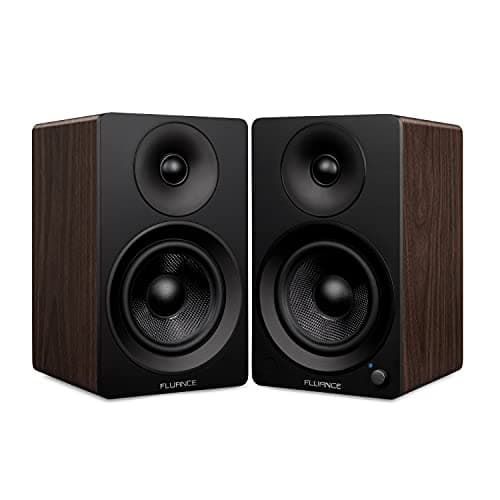
Powered bookshelf speakers built around a 5-inch woven driver in an engineered wood cabinet, with the amplification inside and a subwoofer output for later. It is the pair to buy when the $150 powered speakers are the limiting factor in your system. It has no phono stage, so your turntable needs one.
Strengths
- 5-inch woven drivers and 90W of power fill a real room
- Bluetooth, optical and RCA inputs, plus a subwoofer output
- Handsome cabinet and included remote
Trade-offs
- No built-in phono preamp — the turntable still needs a stage
- Bigger footprint than the compact entry speakers
| Type | Powered (active) bookshelf |
|---|---|
| Power | 90W total |
| Drivers | 5-inch woven |
| Inputs | RCA, optical, Bluetooth 5 |
| Phono preamp | No |
| Extras | Subwoofer output |
Specifications read from the manufacturer / product listing, accessed 2026-07-24. We have not measured this unit — what we do instead.
Price as of October 14, 2026. #ad How we’re funded
There is a specific moment in a vinyl system’s life where the speakers become the problem. You bought a deck around $300 with an adjustable arm and a decent cartridge, you set it up properly, and the entry powered speakers you started with are now the thing standing between you and what the record contains.
The Fluance Ai41 is aimed exactly at that moment. It is not a dramatic product and it does not need to be — it is a bigger driver, a better cabinet and more amplification than the tier below, in the same one-purchase package.
What the extra size buys
The single biggest difference between this and a $150 powered pair is the driver area. A 5-inch woven driver moves noticeably more air than the 4-inch cones in entry pairs, and low-frequency output is largely a function of how much air you can move.
The practical result is not “more bass” in the boomy sense — it is that bass lines keep their shape at volume instead of thinning out, and drums have weight behind them. On a well-recorded record the difference is immediately obvious in the lower midrange, where most of the body of music actually lives.
The second difference is cabinet. Fluance uses engineered wood rather than the thin plastic or MDF common at the entry level. A cabinet that does not flex is a cabinet that is not adding its own sound to the music, and it is the least visible place a speaker’s cost goes.
Powered: what that means here
The amplification is inside, sized and matched to the drivers by the people who designed them. You do not choose an amplifier, you do not read sensitivity or impedance specs, and you do not run speaker cable from a third box. Line-level RCA in, sound out.
The trade is the usual one for active designs: the amplifier and the speakers are one purchase with one lifespan. You cannot upgrade the amplification without replacing the speakers. Our powered vs passive comparison works through when that matters.
The phono question — read this before ordering
The Ai41 has no phono preamp. Its inputs expect line level.
A turntable does not output line level. Connect one with no preamp and the sound is very quiet and noticeably thin — not broken, just wrong, which is why it confuses people rather than obviously alerting them.
Two ways this is fine. Your turntable has a built-in preamp — most decks under $400 do, usually with a PHONO/LINE switch; set it to LINE. Or you add a separate phono stage between the two. If you are unsure which applies to your deck, this takes about a minute to check.
The subwoofer output
There is a line output for a subwoofer, and it is a more sensible upgrade path than it might look. Rather than buying larger speakers to get more low end, you keep a pair sized for your room and add extension underneath when you decide you want it.
For records specifically, most people never will. A groove rarely carries much energy below about 40 Hz, and the Ai41 covers what is actually there. The subwoofer output earns its place if the same system also handles films.
What it does not do
- No phono input. Covered above, and the most common reason someone returns a pair of powered speakers.
- Not a desktop speaker. The cabinets are large enough that on a desk you sit too close for the drivers to integrate properly. This is a room speaker.
- No upgrade path for the amplification. Inherent to powered designs.
Getting the best from them
A pair at this level responds noticeably to placement, and placement is free. Four things in order of effect:
- Get the tweeters near seated ear height. Stands, or a shelf at the right level. Speakers firing at your knees lose their treble before it reaches you, and no amount of tone control puts it back.
- Form a triangle. The two speakers and your listening position roughly equidistant, with the cabinets toed slightly inward. This is what produces a stable stereo image rather than two separate sources.
- Keep them off the turntable’s surface and away from its sides.A deck between two speakers picks up their output through the plinth and feeds it back into the cartridge. It rarely howls; it just makes everything thick and indistinct at volume — see turntable troubleshooting.
- Pull them out of corners. Corner placement adds bass reinforcement that sounds impressive for about a week and muddy afterwards. If the bass is boomy, move the speakers before reaching for the tone controls.
Where they sit in an upgrade path
These are a sensible endpoint for a system built around a deck up to roughly $500. Above that, the honest answer is that a separate amplifier and passive speakers at the same total spend will generally sound better and let you upgrade each half independently — the argument is laid out in powered vs passive speakers.
If you are keeping them, the next upgrade is not more speaker. It is the source: a better cartridge or a separate phono stage feeding these will show a clearer improvement than swapping them for a slightly larger powered pair. And the subwoofer output is there if low-end extension turns out to be the thing you actually want.
Who should buy it
Buy the Ai41 if your turntable has outgrown entry powered speakers; if you want one purchase rather than an amplifier plus passive pair; or if your room is big enough that a 4-inch driver runs out of headroom before you run out of volume.
Buy something cheaper if the budget is tight or the speakers are going on a desk — the Edifier R1280Tdoes that job well. Buy passive instead if you already own an amplifier, or if you want the best sound per dollar and are willing to run three boxes — see the bookshelf speaker roundup.
Frequently asked questions
Do the Fluance Ai41 speakers have a phono preamp?
No. The Ai41 accepts line-level inputs, so your turntable needs a built-in phono preamp — most decks under $400 have one — or you need a separate phono stage between the two. Connecting a raw phono signal gives faint, thin sound.
Are the Fluance Ai41 better than the Edifier R1280T?
They are a genuine step up rather than a lateral move: a larger driver, more amplification and a heavier cabinet, which together mean more low-end weight and more headroom in a bigger room. The Edifier is the better buy on a tight budget or a desk.
Do I need a subwoofer with the Fluance Ai41?
Not for most records. A 5-inch driver in a ported wood cabinet covers what a vinyl groove typically carries. The Ai41 has a subwoofer output if you want one later, which is the sensible way to add low end rather than buying larger speakers up front.
Can I connect a turntable to the Fluance Ai41 with Bluetooth?
The speakers accept Bluetooth from a phone or laptop, but a standard turntable cannot transmit it. You would need a turntable with a Bluetooth transmitter built in, and even then the wired connection sounds better because Bluetooth compresses the signal.
Are powered speakers like these good enough for a serious turntable?
Up to a point. A pair like this will not embarrass a deck up to roughly $500. Above that, a separate amplifier and passive speakers at the same total spend will generally sound better and let you upgrade each half independently.
Where should I place the Fluance Ai41?
At seated ear height, forming a rough triangle with your listening position, toed slightly inward, and away from the turntable. A deck sitting between two speakers picks up their output through its plinth and feeds it back into the cartridge as boom and mud.
Sources
- Crutchfield — Home speakers buying guide — Reference on choosing passive vs powered speakers, room size and amplifier pairing (accessed August 11, 2026)
- Crutchfield — How to choose a phono preamp — On why a phono signal needs a preamp and never running two at once (accessed July 24, 2026)
- Crutchfield — Understanding speaker and amplifier wattage ratings — On RMS versus peak power, and matching an amplifier's output to a speaker's rating (accessed August 11, 2026)
Keep reading
Best Powered Speakers for Turntables
Where the Ai41 sits against the rest of the active field.
See the picksEdifier R1280T Review
The cheaper pair this one is a step up from.
Read the reviewPowered vs Passive Speakers
Whether a powered pair is the right shape of purchase at all.
Read the comparisonDo I Need a Phono Preamp?
These speakers do not have one — check whether your deck does.
Check yours