Powered vs Passive Speakers
The same components in a different number of boxes. Which arrangement suits you depends on three things, and none of them is sound quality.
How this is funded: we earn a commission if you buy through our links, at no extra cost to you. It never changes which product we recommend, and we’ll tell you plainly when to skip one. Full disclosure.
Every speaker needs an amplifier. The only question is whether that amplifier lives inside the cabinet or in a separate box on your shelf. That is the entire distinction between powered and passive speakers, and almost every practical difference follows from it.
What each one is
A passive speaker contains drivers and a crossover network, and nothing else. It has no mains plug. Speaker cable runs from an amplifier to binding posts on the back, and until that amplifier is there the speaker is inert.
A powered(or active) speaker contains an amplifier as well. It plugs into the wall and accepts a line-level signal — RCA, sometimes Bluetooth or optical. In most designs one cabinet holds the amplifier for both and a cable links it to the other.
A note on terminology: strictly, an “active” speaker amplifies each driver separately after an electronic crossover, while a “powered” one simply has an amplifier inside. In the consumer market the words are used interchangeably, and everything on this site follows that common usage.
The three things that actually decide it
1. What you already own
This settles it more often than anything else. Own an amplifier or receiver? Buy passive speakers — you have already paid for the amplification, and buying powered speakers means paying for it twice and leaving your existing amplifier idle.
Own nothing? Powered speakers are one purchase instead of two, and the amplifier inside is matched to the drivers by the people who designed them, which removes a whole category of matching decisions about sensitivity, impedance and power.
2. How much you want to upgrade later
Passive is modular. Speakers and amplifier are separate purchases with separate lifespans — you can keep speakers you love through three amplifiers, or upgrade the amplifier without touching the speakers. Good passive speakers outlive most electronics.
Powered speakers are a single unit. Upgrading anything means replacing everything, and if the amplifier board fails the whole pair is a repair job. That is a real long-term consideration on a purchase you expect to keep a decade.
3. How many boxes and cables you will tolerate
Powered: turntable, speakers, two cables, one mains plug. Passive: turntable, amplifier, speakers, speaker cable at both ends, two mains plugs. Neither is difficult, but the second one is visibly more equipment, and in a small room or on a desk that matters.
Sound quality: the honest position
At a fixed total budget, passive usually wins. The amplifier in a $150 powered pair is a small board built to a cost; a separate $90 amplifier driving $150 passive speakers is generally a better-engineered amplifier, and the speakers themselves got the whole $150 rather than sharing it with electronics.
But powered speakers have a genuine engineering advantage that is often overlooked: the amplifier is matched to the drivers. The designer knows the exact impedance curve and sensitivity, and can size and voice the amplifier accordingly. A passive pair has to work with whatever you connect, which is why sensitivity and impedance are specs you have to read.
In practice the differences between competent examples of each are smaller than the differences caused by placement, room and the recording. Do not agonize.
The phono trap
This catches people constantly, and it applies to both kinds.
Powered speakers accept line level.A turntable does not output line level — it outputs a phono signal of a few thousandths of a volt with the RIAA curve still applied. Connect a turntable with no preamp to powered speakers and you get a faint, thin, tinny sound.
Some powered speakers include a phono stage: the Kanto YU6 and Klipsch The Fives do. Many popular ones do not, including the Edifier R1280T — see our R1280T review. Check for a PHONO input and a ground post before ordering.
The same applies to passive systems: the phono stage has to be in the turntable, in the amplifier, or in its own box. Work out which with do I need a phono preamp?
Where each one wins
- Powered wins: first system with no existing amplifier; desk or small-room setups; a hard total budget under about $200; wanting Bluetooth in the same box; wanting the fewest possible components.
- Passive wins: you already own an amplifier or receiver; you want the best sound at a given total spend; you plan to upgrade over years; you want the option of adding a subwoofer, a second speaker pair or a better amplifier later.
For a first vinyl system with nothing else in the house, powered speakers plus a turntable with a built-in preamp is the simplest good answer, and it is what our beginner guiderecommends. For anyone with an amplifier in a cupboard, passive is the obvious call — and the pairs in best speakers under $200 cover both routes at the same money.
One of each, with live prices
Similar money, completely different purchases. The passive pair also needs an amplifier — budget for that before comparing the two prices.
Powered — amplifier inside
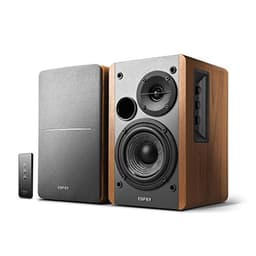
Edifier R1280T
The best-value complete-system speakers
Price as of October 15, 2026. #ad How we’re funded
Passive — needs an amplifier
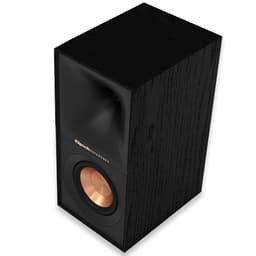
Klipsch R-40M
Getting real volume out of a small, inexpensive amplifier
Price as of October 15, 2026. #ad How we’re funded
Frequently asked questions
What is the difference between powered and passive speakers?
Powered (active) speakers have the amplifier built into the cabinet, so they plug into the mains and accept a line-level signal directly. Passive speakers contain only drivers and a crossover, and need a separate amplifier between them and the source.
Are powered or passive speakers better for a turntable?
Neither is inherently better. Powered pairs are cheaper as a complete system and simpler to set up; passive pairs generally sound better per dollar and let you upgrade the speakers and amplifier separately. Your existing gear usually decides it.
Do powered speakers have a phono preamp?
Some do, most do not. Powered speakers accept line level, which is not what a turntable outputs. Models like the Kanto YU6 include a phono stage; the popular Edifier R1280T does not. Check before buying, or make sure your turntable has one built in.
Can I connect passive speakers directly to a turntable?
No. Passive speakers need an amplifier, and a turntable additionally needs a phono preamp. A turntable wired straight to passive speakers produces essentially no sound — there is nothing in the chain providing power.
Do powered speakers sound worse than passive ones?
Not inherently, and in one respect they have an advantage: the amplifier is chosen and matched to the drivers by the people who designed them. Passive pairs tend to win per dollar at a given total budget because the amplifier is shared and can be better than a small built-in one.
Which is cheaper overall, powered or passive?
Powered, if you own no amplifier — one purchase instead of two. Passive, if you already own an amplifier or receiver, since you only buy the speakers. Compare total system cost rather than the price on the speaker box.
Sources
- Crutchfield — Home speakers buying guide — Reference on choosing passive vs powered speakers, room size and amplifier pairing (accessed August 11, 2026)
- Crutchfield — Intro to home audio power amplifiers and preamps — On the preamp/power-amp split, integrated amplifiers and impedance stability (accessed August 11, 2026)
- Crutchfield — Understanding speaker and amplifier wattage ratings — On RMS versus peak power, and matching an amplifier's output to a speaker's rating (accessed August 11, 2026)
- Crutchfield — How to choose a phono preamp — On why a phono signal needs a preamp and never running two at once (accessed July 24, 2026)
Keep reading
Klipsch R-40M Review
A passive pair whose 91 dB sensitivity keeps the amplifier cheap.
Read the reviewDo You Need an Amp for a Turntable?
The three parts every vinyl system needs, and where yours already are.
Read the explainerBest Powered Speakers for Turntables
The active pairs worth buying, including which include a phono stage.
See the picksBest Bookshelf Speakers for Vinyl
The passive side of the argument, from $80 to $500.
See the picksBest Amplifiers for a Turntable
What a passive pair needs behind it, and which have phono inputs.
See the amplifiersHow to Connect a Turntable Without a Receiver
The powered route in practice — four ways to get sound with no receiver in the house.
Read the guideFluance Ai41 Review
A powered pair examined in full, so you can see what the built-in amp actually gets you.
Read the review