Fluance PA10 Review
The phono stage we recommend more than any other under $100 — and a clear account of the two things it deliberately does not do.
How this is funded: we earn a commission if you buy through our links, at no extra cost to you. It never changes which product we recommend, and we’ll tell you plainly when to skip one. Full disclosure.
The short version
Fluance PA10
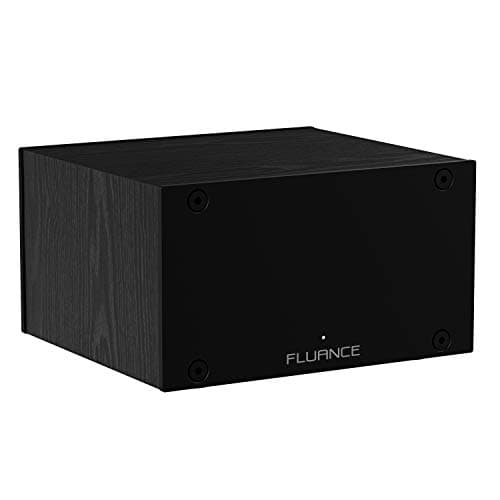
A moving-magnet phono stage that does the fundamentals properly: accurate RIAA equalization, a metal chassis rather than plastic, and a real ground post. It has no gain switch and no moving-coil support, which is the trade for the price. Buy it if you have a standard MM cartridge and need a stage. Look higher if your cartridge is unusually quiet or an MC upgrade is coming.
Strengths
- Accurate RIAA equalization with low noise
- Metal chassis, better isolated than the tiny plastic boxes
- Simple, reliable, and fairly priced
Trade-offs
- Moving-magnet only — no moving-coil support
- No adjustable gain or loading
| Cartridge support | Moving magnet (MM) |
|---|---|
| Equalization | RIAA |
| Output | Line-level RCA |
| Chassis | Metal |
| Gain | Fixed |
Specifications read from the manufacturer / product listing, accessed 2026-07-24. We have not measured this unit — what we do instead.
Price as of October 14, 2026. #ad How we’re funded
A phono preamp is the least glamorous component in a vinyl system and one of the easiest to get wrong, because the market is full of $20 plastic boxes that technically work and $500 boxes that solve problems most people do not have. The Fluance PA10 sits at the point where the fundamentals are done properly and nothing has been added for the spec sheet.
What it has to get right
A phono stage does two jobs. It amplifies a cartridge signal of a few thousandths of a volt to line level, and it applies the RIAA equalization curve that reverses the deliberate bass-cut and treble-boost applied when the record was cut.
The second job is where cheap stages fail invisibly. RIAA accuracy depends on component tolerances, and a stage with sloppy values produces a subtly wrong tonal balance that you cannot identify as a fault because nothing sounds broken — the music just does not sound quite right. Fluance builds the PA10 around the components that keep that curve accurate, which is the least visible and most important thing it does.
The metal case and the ground post
Two things separate this from the $20 tier, and both are physical.
A metal chassis shields the circuit. You are amplifying millivolts by a factor of a hundred, so anything the circuit picks up from a nearby router, dimmer switch or power supply gets amplified with the music. A plastic box does not shield; a metal one does.
A proper ground post is the second. Turntables have a thin separate ground wire that must connect somewhere, and a stage without a dedicated terminal leaves you improvising with a screw. Un-grounded turntables hum loudly and unmistakably. Our troubleshooting guide opens with this fault because it is the single most common one in vinyl.
What it deliberately does not do
No gain switch
The PA10 has one fixed gain setting, chosen for typical moving-magnet cartridges. For an Ortofon 2M Red at 5.5 mV or an AT-VM95E at 4.0 mV, that is correct and you will never think about it.
For a cartridge at the quiet end of the MM range, a fixed setting may leave you running the volume higher than on other sources — which also raises the noise floor. A stage with switchable gain fixes that, and it is the main reason to spend more. The arithmetic is in gain and impedance explained.
No moving-coil support
A moving-coil cartridge outputs roughly ten times less signal and needs about 20 dB more gain plus specific loading. The PA10 does not provide it. If an MC cartridge is anywhere in your plans, buy a stage that handles both — see phono preamps under $200 and MM vs MC.
No subsonic filter
Warped records produce energy below 20 Hz that you cannot hear but your woofers can, wasting amplifier power and thickening the midrange. A subsonic filter removes it. Nothing at this price includes one; it appears in the tier above, and on a collection with dished pressings it is genuinely audible.
Connecting it
- Turntable RCA cables into the PA10’s input.
- Turntable ground wire onto the ground post. Do not skip this.
- PA10 output into a line or aux input— never another phono input.
- If your turntable has a built-in preamp, switch it off or set it to PHONO. Two stages in series produces distorted, painfully loud sound.
- Keep the power adapter away from the signal cables. Wall warts radiate, and moving one six inches sometimes eliminates a hum entirely.
How it compares at this price
The sub-$100 phono stage market splits into three groups, and knowing which one a product belongs to tells you most of what you need.
The ultra-budget fixers— plastic-cased units around $20. They apply RIAA equalization and enough gain, and that is genuinely all they do. Buy one to solve a connection problem, not to improve sound you already have. The PA10 is a clear step above them on shielding and noise.
The gain-switchable stages— around $70, with two or three selectable gain settings. If your cartridge sits at the quiet end of the moving-magnet range, that switch matters more than anything the PA10 offers, and it is the one specification the PA10 genuinely lacks. See phono preamps under $100 for the alternatives.
The tube stages— similar money, with one or two small valves in the signal path. Those are a voicing choice rather than a fidelity upgrade, and they generally measure worse on noise. Our tube vs solid state comparison explains what a tube actually adds and why some people want it.
The PA10 sits deliberately in none of those camps. It spends its budget on doing the standard job cleanly — accurate equalization, a shielded case, a real ground post — rather than on a feature to put on the box. Whether that is the right allocation depends entirely on whether you need any of those features.
Who should buy it
Buy the PA10 if you own a turntable with no built-in preamp — a Fluance RT82, a Pro-Ject Debut Carbon EVO or similar — and a standard moving-magnet cartridge. Buy it also if you want to bypass a budget deck’s built-in stage and hear what a shielded box with its own supply does to the noise floor.
Spend more if your cartridge is unusually quiet, if a moving-coil upgrade is coming, or if warped records are a recurring problem in your collection. Spend less — or nothing — if your turntable or amplifier already has a phono input you have not tried. Check that first with what is a built-in phono preamp?
Frequently asked questions
Is the Fluance PA10 better than a turntable's built-in preamp?
Usually yes, for a structural reason: a built-in stage sits inches from a motor and a mains transformer while amplifying thousandths of a volt. The PA10 does the same job in its own shielded metal case with its own supply. The difference is most audible as a lower noise floor between tracks.
Does the Fluance PA10 work with moving coil cartridges?
No. It is a moving-magnet stage. An MC cartridge outputs roughly ten times less signal and needs about 20 dB more gain, so through the PA10 it would sound faint and hissy no matter how far you turned the volume up.
Does the Fluance PA10 have adjustable gain?
No — it has a single fixed gain setting suited to typical moving-magnet cartridges. If your cartridge sits at the quiet end of the MM range, a stage with switchable gain will match it better. That is the main reason to spend more.
Do I need the Fluance PA10 if I own a Fluance turntable?
Only if your deck has no built-in preamp. The RT81 has a switchable one and does not need this; the RT82 and RT85 have none and do. Never run both at once — set the turntable to its bypass position if it has a switch.
Why does my phono preamp hum?
Almost always the ground wire. The thin spade connector from the turntable must attach to the PA10's ground post. If it is connected and hum persists, move the power adapter away from the signal cables and confirm you have not left two phono stages in series.
Is a $100 phono preamp enough for a good turntable?
For a moving-magnet cartridge on a deck up to roughly $500, yes — it will not be the limiting factor. Above that, or with a low-output cartridge, a stage with switchable gain, a published noise floor and a subsonic filter starts to earn its extra cost.
Sources
- Crutchfield — How to choose a phono preamp — On why a phono signal needs a preamp and never running two at once (accessed July 24, 2026)
- Elliott Sound Products — Phono preamp / RIAA equalization — Technical reference on RIAA pre-emphasis and the inverse playback curve (accessed July 24, 2026)
- Ortofon — 2M Red — Manufacturer specs: 5.5 mV output, 1.6-2.0 g tracking (1.8 g recommended), 47 kOhm load (accessed July 24, 2026)
- Audio-Technica — AT-VM95E cartridge — Manufacturer specs: 0.3 x 0.7 mil elliptical stylus on an aluminum cantilever, 4.0 mV output at 1 kHz / 5 cm/sec, 1.8-2.2 g tracking force (2.0 g standard), 20-22,000 Hz, 20 dB channel separation at 1 kHz, half-inch mount, AT-VMN95E replacement stylus, and the maker's own statement that "all VM95 Series share the same body" so the stylus "can be replaced with any of the six interchangeable AT-VMN95 replacement styli". Re-read on the access date below, which corrected a tracking-force range previously noted here as 1.8-2.3 g (accessed September 26, 2026)
Keep reading
Best Phono Preamps Under $100
Where this stage sits against the rest of the budget field.
See the picksBest Phono Preamps Under $200
What another $50-100 buys: switchable gain, MC support, a subsonic filter.
See the picksPhono Preamp Gain & Impedance Explained
How to work out whether a fixed-gain stage matches your cartridge.
Read the explainerWhat Is a Built-in Phono Preamp?
Check whether you already have one before buying this.
Check first