How to Replace a Turntable Stylus
Two minutes, no tools, no protractor — and the one piece of maintenance that protects your records rather than just improving the sound.
How this is funded: we earn a commission if you buy through our links, at no extra cost to you. It never changes which product we recommend, and we’ll tell you plainly when to skip one. Full disclosure.
Of everything in this hobby, replacing a stylus has the best ratio of effort to consequence. It takes two minutes, needs no tools, and it is the only maintenance job where deferring it does permanent damage to your recordsrather than merely making them sound worse.
It is also the cheapest upgrade path available, because on the common cartridge families a better stylus snaps onto the body you already own.
What actually wears out
The diamond tip is riding in a groove at the end of a cantilever, with a force of a gram or two concentrated on a contact patch measured in microns. Over hundreds of hours two things happen: the tip develops flat facets where it contacts the groove walls, and the rubber suspension holding the cantilever hardens and loses compliance.
A worn, faceted tip no longer matches the groove’s profile. Instead of riding on a curved surface it presses on edges, and those edges are the groove walls carrying your music. That is the mechanism by which a tired stylus destroys a record collection quietly, over months, while sounding merely “a bit dull.”
How to tell it is worn
There is no counter, so you are listening for changes rather than reading a number:
- Dull highs. Cymbals lose shimmer, strings lose air. It happens gradually, which is why it is easy to miss.
- Harsh or spitty sibilance.The “s” and “t” sounds in vocals start splashing, particularly toward the middle of a side.
- Distortion late in a side. Inner grooves are the hardest to track, so wear shows up there first.
- More surface noise on records you know are clean.
- Visible facets under magnification.A phone macro lens or a jeweler’s loupe will show a healthy tip as a point and a worn one as flattened.
Before concluding it is worn: clean it. Accumulated dust on the tip produces almost exactly the same symptoms and is far more common. Brush from back to front — the direction the stylus travels through the groove — and never side to side. If clarity returns, you have your answer.
Stylus, or the whole cartridge?
On most moving-magnet cartridges the stylus assembly — the plastic housing carrying the cantilever and diamond — detaches from the body. That means you replace the wearing part and keep the body, the coils, the mounting and, critically, the alignment.
Replace just the stylus when your cartridge is from a family with available styli, which covers the Audio-Technica VM95 range, the Ortofon 2M range, Nagaoka MP series, Sumiko and Grado. It costs a fraction of a new cartridge and needs no realignment.
Replace the whole cartridgewhen the body is damaged, when the cartridge is old enough that styli are no longer made for it, or when you want to move to a different family entirely. That is a longer job — see how to set up a cartridge.
Moving-coil cartridges are the exception.Most have a non-replaceable stylus and must go back to the manufacturer for a re-tip or exchange. That running cost is a real part of the MM versus MC decision — see MM vs MC.
The upgrade trick
Here is the part worth knowing before you spend anything. Within an interchangeable family, a better stylus fits the same body.
If you own an AT-VM95C with a conical tip, you do not need to buy a new cartridge to get an elliptical or a micro-linear one — you buy the AT-VMN95E or AT-VMN95ML stylus and snap it on. Same body, same alignment, dramatically different tip geometry. The Ortofon 2M range works the same way: a 2M Blue stylus fits a 2M Red body.
So a worn stylus is also an opportunity. If you are replacing it anyway, replacing it with a better one costs only the difference. The cartridges under $200 roundup covers what each tip profile changes.
Handling notes
- Never touch the cantilever or the diamond. Finger oil attracts dust and the cantilever bends with almost no force. Handle only the plastic housing.
- Pull forward and slightly down, steadily. If it resists, check the manual — a few designs use a small locking tab. Force is never the answer.
- Push the new one straight back until it clicks. It should sit flush and square, with no gap and no tilt.
- Keep the old assembly. A worn stylus is still useful for confirming a fitment or as an emergency spare.
Making the next one last
- Brush the stylus every few plays, back to front. Two seconds.
- Play clean records.Dust in the groove is abrasive and it is what wears the tip — see cleaning kits.
- Set tracking force correctly. Too light is as damaging as too heavy, because a skittering stylus hammers the groove walls.
- Lift the arm at the end of a side. Hours in the run-out groove is wear you get nothing back for.
- Use the stylus guard when the deck is not in use.
The replacement and the brush
A replacement stylus for the most common cartridge family on this site, and the brush that makes the next one last longer. Prices are live and dated.
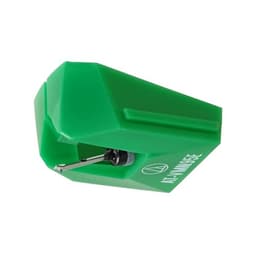
Audio-Technica AT-VMN95E Replacement Stylus
Replacing a worn stylus without touching the alignment
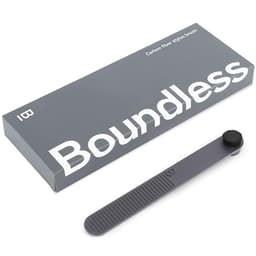
Boundless Audio Carbon Fiber Stylus Brush
The every-few-plays stylus habit
Frequently asked questions
How often should you replace a turntable stylus?
Manufacturers generally quote lifetimes in the range of several hundred to around a thousand playing hours, depending on the tip profile — advanced profiles like micro-linear typically last longer because contact pressure is spread over a larger area. Replace sooner if you hear dulling or hardened sibilance.
How do I know if my stylus is worn?
Listen for high frequencies going dull, sibilance turning harsh or spitty, and distortion appearing toward the end of a side. Visually, a worn tip loses its point under magnification. Increased surface noise on records you know are clean is another common sign.
Does a worn stylus damage records?
Yes — this is the reason not to defer the job. A worn tip no longer matches the groove profile and concentrates pressure on damaged edges, abrading the groove walls permanently. That damage is not recoverable by cleaning or by fitting a new stylus later.
Do I need to realign the cartridge after changing the stylus?
No. Replacing only the stylus assembly leaves the cartridge body untouched in the headshell, so overhang, alignment and azimuth are all preserved. Only re-check the tracking force, and only if the new stylus specifies a different value.
Can I clean a stylus instead of replacing it?
Cleaning fixes dullness caused by accumulated dust, which is a genuinely common misdiagnosis of wear. Brush it back to front every few plays and see whether the problem disappears. If clarity does not return after cleaning, the tip itself is worn.
Are replacement styli interchangeable between brands?
No. A stylus assembly fits only the cartridge family it was designed for — an Audio-Technica VMN95 stylus fits any VM95 body, an Ortofon 2M stylus fits a 2M body, and they are not cross-compatible. Third-party 'compatible' styli vary widely in quality.
Sources
- Audio-Technica — AT-VMN95E replacement stylus — Manufacturer page for the elliptical VM95-series replacement stylus and its fitment list (accessed August 11, 2026)
- Audio-Technica — VM95 Series cartridges — The shared-body VM95 range and its interchangeable stylus upgrade path (accessed July 24, 2026)
- Crutchfield — Phono cartridge guide — Reference on cartridge types, styli and mounting (accessed July 24, 2026)
- Elusive Disc — Turntable setup guide: tracking force & anti-skate — Step-by-step on balancing the tonearm, setting tracking force and anti-skate (accessed July 24, 2026)
Keep reading
How Often to Replace a Stylus
The hour figures by tip profile, and the symptoms that override them.
Read the guideBest Turntable Cartridges Under $200
If the whole cartridge is due for replacement rather than the tip.
See the picksHow to Set Up a Cartridge
The longer job, for when you are changing the body too.
Read the guideBest Record Cleaning Kits
Clean records and a clean stylus are what make a tip last.
See the kitsTurntable Troubleshooting
Is it a worn stylus or a setup problem? Work it out from the symptom.
Fix itBest Turntable Needles & Replacement Styli
Which genuine stylus fits your cartridge, and which one to buy.
See the picksTurntable Maintenance
Everything else that wears out, and how often.
Read the guide