Pro-Ject Debut Carbon EVO Review
A one-piece carbon fiber tonearm, a Sumiko cartridge and nothing else at all — the most single-minded deck we recommend, and the one that asks the most of your system.
How this is funded: we earn a commission if you buy through our links, at no extra cost to you. It never changes which product we recommend, and we’ll tell you plainly when to skip one. Full disclosure.
The short version
Pro-Ject Debut Carbon EVO
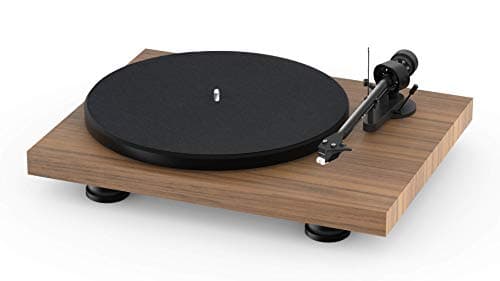
A specialist analog manufacturer's answer to the question 'what if none of the budget went into features?' — a one-piece carbon tonearm, a factory-fitted Sumiko Rainier, electronic speed control, and no preamp, Bluetooth, USB or automation whatsoever. Buy it if the rest of your system is already good. Skip it if the deck would be the most expensive thing in the chain.
Strengths
- Carbon-fiber tonearm and a heavy, damped metal platter for low resonance
- Factory-fitted Sumiko Rainier moving-magnet cartridge
- Electronic speed change and adjustable isolation feet
Trade-offs
- No built-in preamp — needs an external phono stage
- Manual; the premium build is wasted on a casual listener
- Now the outgoing model: Pro-Ject has replaced it with the Debut EVO 2 (aluminum platter, new Pick it MM EVO cartridge)
| Drive | Belt drive (electronic speed change) |
|---|---|
| Operation | Manual |
| Tonearm | One-piece carbon fiber |
| Cartridge | Sumiko Rainier (moving magnet) |
| Built-in preamp | No |
| Speeds | 33 1/3 and 45 RPM (78 with belt change) |
Specifications read from the manufacturer / product listing, accessed 2026-07-24. We have not measured this unit — what we do instead.
Price as of October 14, 2026. #ad How we’re funded
Pro-Ject is an Austrian company that makes analog audio and essentially nothing else, and the Debut line is the product that made its reputation. The Debut Carbon EVO is the current expression of a simple idea: spend the entire budget on the parts that touch the record, and leave everything else out.
What comes out of the box is a heavy plinth, a carbon fiber tonearm, a Sumiko cartridge and a power cable. No preamp. No Bluetooth. No USB. No automation. That is the product, and whether it is right for you depends almost entirely on what else you own.
The tonearm, which is the whole point
A tonearm has one job that sounds trivial and is not: hold the cartridge at a constant angle and constant downforce while the groove pushes it around thousands of times a second. Two properties decide how well it does that. Stiffness, so the arm does not flex. Low mass, so it does not resist the small movements the stylus needs to make.
Those two requirements fight each other, which is why tonearm design is where money goes at this level. Carbon fiber has an unusually favorable stiffness-to-weight ratio, and Pro-Ject forms the arm tube as a single piece— no joints, no collars, no welded sections where a stamped aluminum arm can ring at a specific frequency.
You cannot see this working, and nobody publishes a number that captures it. What you can observe is that it has been the most-copied design at this price for over a decade, which is the market’s way of agreeing.
The Sumiko Rainier
A high-output moving magnet with an elliptical stylus, a low-resonance body and pure copper internal wiring, fitted and aligned at the factory. Sumiko is a specialist cartridge maker, and the Rainier is a dealer-grade cartridge rather than a budget filler — it sells on its own for a substantial fraction of what many entry turntables cost.
Because it is high output and moving magnet, it works with any standard MM phono stage. And the Sumiko body accepts the Olympia and Moonstone styli, so there is an upgrade path that does not require realignment. Our cartridge roundup covers where it sits against the Audio-Technica and Ortofon alternatives.
Electronic speed control
Most belt-drive decks at and below this price change speed by making you lift the platter and move the belt between two pulley steps. The EVO switches 33 and 45 electronically. It is a small convenience that becomes a large one if you own singles, and it also means the motor is regulated rather than merely powered.
Height-adjustable damped feet are the other practical addition — genuinely useful, because leveling a deck on an uneven shelf is otherwise a matter of folded cardboard.
What it demands from you
This is the part that decides whether you should buy it.
- A phono stage. Not optional. Out of the box this deck cannot drive powered speakers or a line input. See phono preamps under $200.
- Careful setup. Level plinth, correct tracking force, correct anti-skate. A deck at this level punishes carelessness more than a cheap one does, because its arm is capable enough for the errors to be audible.
- Something rigid to stand on, away from the speakers.A heavy deck on a springy shelf between two speakers is an acoustic feedback loop that shows up as muddy bass rather than obvious howling — see troubleshooting.
- Downstream components that can show what it does. This is the honest one. In a system with $150 speakers, the speakers are what you are hearing.
The case against
Two arguments worth taking seriously.
The competition spends the money differently. The Fluance RT85 at a lower price fits an acrylic platter and an Ortofon 2M Blue, and publishes a wow and flutter figure. If you weight platter and cartridge above arm engineering, that is a rational preference and the Fluance wins it.
Diminishing returns are real here. The step from a $300 deck to this one is genuine but far smaller than the step from $150 to $300, and it only becomes audible when everything downstream is good enough. Our are expensive turntables worth it? guide makes that case in detail.
The Debut EVO 2, which has since replaced it
Since this review was written, Pro-Ject has removed the Debut Carbon EVO from its own catalog in favor of the Debut EVO 2. The successor keeps the two things this review is built on — the 8.6-inch one-piece carbon tonearm and electronic speed change — and changes two others: the heavy steel platter becomes a 300 mm die-cast aluminum platter with TPE damping, and the factory cartridge is now Pro-Ject’s own Pick it MM EVO rather than the Sumiko Rainier.
Retailers still list the Carbon EVO as run-out stock, and it is usually cheaper than the EVO 2. That is the honest way to read the rest of this page: everything here still describes the deck accurately, and at a real discount it remains a sound buy. At parity, buy the EVO 2.
Who should buy it
Buy the Debut Carbon EVO if you already own a phono stage and speakers worth feeding; if tonearm engineering is the thing you want your money in; or if you want a deck from a specialist analog manufacturer with a long parts and service history behind it.
Buy something else if this would be the most expensive component in your system, if you want to plug into powered speakers today with nothing in between, or if you want any of the features it deliberately omits. There is no shame in the AT-LP120XUSB or the RT81 — they are answering different questions, and for most people those questions are the right ones.
Frequently asked questions
Has the Pro-Ject Debut Carbon EVO been replaced?
Yes. Pro-Ject's current model in this slot is the Debut EVO 2, which keeps the one-piece carbon tonearm and electronic speed change but swaps the steel platter for a die-cast aluminum one with TPE damping and fits Pro-Ject's own Pick it MM EVO cartridge in place of the Sumiko Rainier. The Carbon EVO no longer appears in Pro-Ject's catalog, but retailers still sell remaining stock, usually below the EVO 2's price. At that discount it remains a sound buy; at parity, buy the EVO 2.
Does the Pro-Ject Debut Carbon EVO have a built-in phono preamp?
No. Pro-Ject leaves it out deliberately to keep the signal path short and let you choose a stage matched to your cartridge. You need an amplifier with a phono input, powered speakers with one, or a separate phono preamp.
Why is a carbon fiber tonearm better?
A tonearm has to hold the cartridge at a fixed angle while the groove pushes against it, which demands stiffness without mass. Carbon fiber has an unusually good stiffness-to-weight ratio, and forming it as one piece removes the joints where a stamped aluminum arm can resonate.
What cartridge does the Debut Carbon EVO come with?
A Sumiko Rainier, a high-output moving magnet with an elliptical stylus, mounted and aligned at the factory. It works with any standard MM phono input, and Sumiko's Olympia and Moonstone styli fit the same body if you want to upgrade later.
Is the Pro-Ject Debut Carbon EVO worth it over a Fluance RT85?
They optimize differently. The Pro-Ject spends its budget on the tonearm; the Fluance RT85 spends it on an acrylic platter and an Ortofon 2M Blue cartridge. If you value arm engineering, take the Pro-Ject; if you value the fitted cartridge and platter, take the Fluance.
Can you change speed on the Debut Carbon EVO without moving the belt?
Yes — it has electronic speed control, so 33 and 45 RPM switch at the press of a control rather than by lifting the platter and moving the belt between pulley steps. 78 RPM requires changing the belt position.
Is the Debut Carbon EVO a good first turntable?
Only if you already have a phono stage and decent speakers. It is fully manual, has no built-in preamp and rewards careful setup — a deck like this in an otherwise budget system will not show what it can do, and a mis-set-up example performs worse than a cheap automatic.
Sources
- Pro-Ject — Debut EVO 2 product page — The maker's current Debut page. Published specification: "300mm, die cast aluminium platter with TPE damping and felt mat", an 8.6-inch "one-piece carbon tonearm", speeds "33, 45 (electronic speed change)", and the fitted cartridge: "The new Pick it MM EVO cartridge completes the Debut EVO 2". On the same access date the Debut Carbon EVO's own URL on project-audio.com (/en/product/debut-carbon-evo/) returned HTTP 410 Gone — the maker has removed the outgoing model from its catalog — while Amazon still listed the Carbon EVO in stock. That pairing is the whole basis for calling the Carbon EVO a run-out deal rather than a current model (accessed September 21, 2026)
- Crutchfield — How to choose the right turntable — Buying-guide reference on drive type, cartridges, preamps and setup (accessed July 24, 2026)
- Crutchfield — Phono cartridge guide — Reference on cartridge types, styli and mounting (accessed July 24, 2026)
- Elusive Disc — Turntable setup guide: tracking force & anti-skate — Step-by-step on balancing the tonearm, setting tracking force and anti-skate (accessed July 24, 2026)
- Crutchfield — How to choose a phono preamp — On why a phono signal needs a preamp and never running two at once (accessed July 24, 2026)
Keep reading
Audiophile Pressings Explained
What to spin on it, and what a premium reissue actually buys you.
Read the guideBest Turntables for Audiophiles
The company this deck keeps, and the philosophy behind all of it.
See the picksBest Turntables Under $1000
Everything else in the tier, including the acrylic-platter alternative.
See the picksBest Phono Preamps Under $200
The purchase this deck requires before it makes any sound.
See the picksHow to Set Up a Cartridge
The alignment work a deck at this level assumes you will do.
Read the guide