Fluance RT82 Review
The point in Fluance's range where the preamp disappears and an Ortofon cartridge appears — a deliberately purist deck at a price where purism is rare.
How this is funded: we earn a commission if you buy through our links, at no extra cost to you. It never changes which product we recommend, and we’ll tell you plainly when to skip one. Full disclosure.
The short version
Fluance RT82
A belt-drive deck with a servo-controlled isolated motor, an Ortofon OM cartridge and no phono preamp at all. Everything the price would otherwise have spent on electronics went into the mechanical parts instead. Buy it if you have a phono stage or are willing to buy one. Skip it if you want to plug straight into powered speakers today.
Strengths
- Ortofon OM10 elliptical cartridge — upgradeable up the OM range with a stylus swap
- Servo-controlled motor for steadier speed
- No built-in preamp means a shorter, cleaner signal path to an external stage
Trade-offs
- No built-in preamp — you must have a phono input or a separate preamp
- Manual operation
| Drive | Belt drive |
|---|---|
| Operation | Manual |
| Cartridge | Ortofon OM10 (elliptical) |
| Built-in preamp | No |
| Speeds | 33 1/3 and 45 RPM |
| Motor | Servo-controlled DC |
Specifications read from the manufacturer / product listing, accessed 2026-09-26. We have not measured this unit — what we do instead.
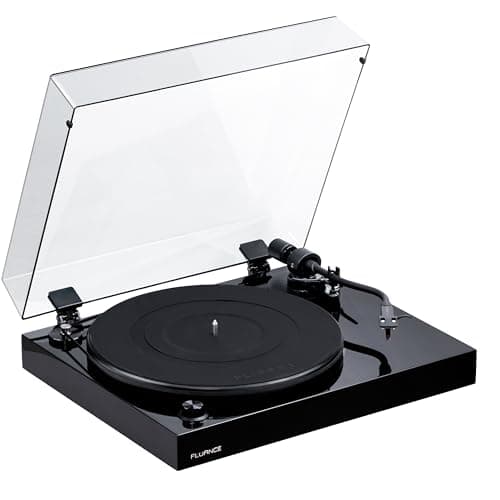
Price as of October 15, 2026. #ad How we’re funded
Fluance’s range does something unusual: it gets simpler as it gets more expensive. The RT81 has a built-in phono preamp. The RT82, one step up, does not. That looks like a downgrade on a feature list and is the opposite — it is the moment the range stops being aimed at people who want a deck to work with anything, and starts being aimed at people building a system.
Understanding that swap is the whole review. You give up a circuit and you get back a better motor, a better cartridge and a shorter signal path.
What the servo-controlled motor is doing
The RT82 uses a belt drive with an isolated, speed-controlled motor. Both halves of that matter.
Isolation physically separates the motor from the plinth so its vibration has a longer, more damped path to the platter and the stylus. A stylus reads groove modulation measured in microns; motor buzz reaching it appears as noise underneath the music rather than as an obvious hum.
Speed control means the motor is regulated rather than simply being fed mains power and trusted. Belt-drive decks drift as belts age and as temperature changes; a servo circuit measures and corrects. The audible payoff is steadier pitch on sustained notes — piano, organ, solo strings — where wavering speed is most obvious.
Fluance publishes a wow and flutter figure of 0.07% for the RT85 further up the range. They do not publish one for this model, and we have left that spec row unpublished rather than borrow the number from a different deck.
The Ortofon cartridge
The RT82 ships with an Ortofon OM series cartridge, mounted and aligned at the factory. Ortofon is a Danish specialist that makes cartridges and nothing else, and having one fitted at this price is a meaningful part of what you are paying for — it is a component with its own retail value rather than a spec-sheet line.
It sits on a standard half-inch mount, so the upgrade path is open in both directions: you can move up Ortofon’s own range, or fit an Audio-Technica, Nagaoka or Sumiko instead. Our cartridges under $200 roundup covers what each changes, and 2M Red vs 2M Blue explains the stylus-only upgrade trick within the Ortofon range.
The missing preamp: what it costs and what it buys
What it costs you: a purchase, and a decision. Out of the box this deck cannot drive powered speakers or a line input. Connect it to an aux socket and you get a faint, thin, tinny sound that people routinely mistake for a fault. You need one of: an amplifier with a phono input, powered speakers with a phono input, or a separate phono stage.
What it buys you:a phono stage amplifies a signal of a few thousandths of a volt. Putting that circuit inside a plinth, inches from a motor and a mains transformer, is a compromise no designer would choose if the customer did not demand it. Taking it out shortens the signal path and lets you pick a stage matched to your cartridge — see gain and impedance explained for what matching actually means.
The practical arithmetic: if you already own an amplifier with a phono input, the RT82 is straightforwardly better value than the RT81. If you do not, add a phono stage to the price before you compare the two decks.
Living with it
It is fully manual. You lower the arm with the cueing lever and lift it at the end. There is no auto-return, so a side left running circles the run-out groove until someone notices. That is the standard trade for an adjustable arm, and it is covered in automatic vs manual turntables.
There is no Bluetooth and no USB. This is a wired deck for a wired system, and Fluance has not tried to hedge that.
Setup is the usual ten minutes: level the plinth, balance the arm, set tracking force to the Ortofon’s specification, match anti-skate. Skip it and the deck performs worse than a factory-set automatic costing half as much — the setup guide walks through it in order.
What to pair it with
Because this deck arrives incomplete by design, the pairing decision matters more than it does with a deck that includes everything. Three configurations work well.
Separate phono stage plus powered speakers. The most common route and the cheapest complete one. A sub-$100 stage feeds a pair of powered speakers, and you have three boxes and a system that sounds well ahead of its price. See phono preamps under $100 and speakers under $200.
An amplifier with a phono input plus passive speakers.Removes a box, because the amplifier does both jobs. A stereo receiver with a phono input is the classic answer and usually the best value — see amplifiers for a turntable.
Powered speakers with a phono input built in.The fewest boxes available with a preamp-less deck: two components total. Fewer powered speakers include a phono stage than people expect, so check for a PHONO input and a ground post before ordering — our powered speaker roundup flags which do.
Whichever you choose, remember the rule that catches everyone: exactly one phono stage in the chain. This deck has none, so nothing needs switching off — but if you later add an amplifier with a phono input and a separate stage, use one or the other.
Living with the upgrade path
The RT82’s standard half-inch mount and adjustable counterweight mean the cartridge is a genuine variable rather than a fixed feature. That has a practical consequence worth planning for: the factory Ortofon OM is good, and the tier above it is a real step.
The cheapest meaningful move is a stylus rather than a cartridge — within the Ortofon range a better stylus fits the same body, exactly as covered in 2M Red vs 2M Blue. Moving to a different family — an Audio-Technica VM95 body, for instance, with its longer and cheaper stylus ladder — means a full alignment job with a protractor, which this deck’s fixed headshell makes a table-top exercise rather than a quick swap. Neither is difficult; both are covered in how to set up a cartridge.
Who should buy it
Buy the RT82 if you already have a phono stage or an amplifier with a phono input; if you want the mechanical parts of the deck — motor, platter, cartridge — to have received all of your money; or if you are building a system deliberately rather than buying an appliance.
Buy the RT81 instead if you want to plug into powered speakers today with nothing in between. Buy the AT-LP120XUSB instead if you need USB, three speeds or a removable headshell. And look at the tier above if you want the acrylic platter and 2M Blue that Fluance’s own RT85 adds for a few hundred more.
Frequently asked questions
Does the Fluance RT82 have a built-in preamp?
No, and that is deliberate. Fluance leaves the phono stage out of the RT82 and above so the signal path is shorter and you choose your own. You will need an amplifier with a phono input, powered speakers with one built in, or a separate phono preamp.
Is the Fluance RT82 worth it over the RT81?
It depends on whether you already have a phono stage. The RT82 upgrades the motor to a servo-controlled isolated design and the cartridge to an Ortofon OM, but removes the built-in preamp the RT81 has. If you have to buy a preamp, factor that into the comparison.
What cartridge does the Fluance RT82 come with?
An Ortofon OM series cartridge, pre-mounted and aligned at the factory. It uses a standard half-inch mount, so you can fit any common cartridge later, and Ortofon's own stylus range gives an upgrade path without changing the body.
Is the Fluance RT82 fully manual?
Yes. You lower the cueing lever at the start of a side and lift it at the end — there is no auto-return. That is the standard trade for an adjustable tonearm with a counterweight and anti-skate.
What phono preamp should I use with the Fluance RT82?
Any standard moving-magnet stage works, since the fitted Ortofon OM is a high-output MM cartridge. A sub-$100 unit will do the job; a stage with switchable gain lets you match the cartridge more precisely and is the better long-term buy.
Does the Fluance RT82 have Bluetooth or USB?
Neither. It is a wired, listening-focused deck by design. If you want to stream to a wireless speaker or digitize records, those are different products — Fluance's own range does not cover them, and the Audio-Technica AT-LP120XUSB does.
Sources
- Crutchfield — How to choose the right turntable — Buying-guide reference on drive type, cartridges, preamps and setup (accessed July 24, 2026)
- Ortofon — 2M Red — Manufacturer specs: 5.5 mV output, 1.6-2.0 g tracking (1.8 g recommended), 47 kOhm load (accessed July 24, 2026)
- Crutchfield — How to choose a phono preamp — On why a phono signal needs a preamp and never running two at once (accessed July 24, 2026)
- Elusive Disc — Turntable setup guide: tracking force & anti-skate — Step-by-step on balancing the tonearm, setting tracking force and anti-skate (accessed July 24, 2026)
Keep reading
The First 10 Records to Buy
What to spin first, chosen to prove a new deck is set up correctly.
See the picksFluance RT85 Review
The same plinth and motor with an acrylic platter and a 2M Blue.
Read the reviewAT-LP120XUSB vs Fluance RT82
Belt against direct drive at almost identical money.
Read the comparisonFluance RT82 vs RT85
The step up, with the acrylic platter and the 2M Blue priced as two separate upgrades.
Compare themFluance RT81 Review
The cheaper sibling that keeps the built-in preamp.
Read the reviewFluance RT81 vs RT82
The same pair head to head: the servo motor's published speed figures against the phono stage you give up.
Compare themBest Phono Preamps Under $200
The purchase this deck assumes you will make.
See the picksBest Turntables Under $500
Everything else in the tier this deck sits in.
See the picks