Phono vs Line: What That Input Actually Does
Two RCA sockets that look identical, wired to completely different circuits. Getting them the wrong way round is the single most common vinyl wiring mistake.
How this is funded: we earn a commission if you buy through our links, at no extra cost to you. It never changes which product we recommend, and we’ll tell you plainly when to skip one. Full disclosure.
On the back of most amplifiers there is a row of RCA sockets. One pair is labeled PHONO. The others say AUX, CD, TAPE, TUNER or LINE. Physically they are identical — same connector, same colors. Electrically they are not remotely the same thing, and a turntable will only work properly with one of them.
This page explains what the difference is, how to tell which one you need, and what each of the two possible mistakes sounds like — because the symptoms are distinctive enough that you can diagnose the problem by ear.
The short version
A line inputtakes a normal-strength audio signal — roughly 0.3 to 2 volts — and passes it on to the volume control unchanged. Every source you own except a turntable produces that.
A phono input takes the output of a phono cartridge, which is about a thousand times smaller, does two things to it that no other input does, and only then passes it on.
The two things a phono stage does
1. Gain: it makes a tiny signal usable
A moving-magnet cartridge produces a few thousandths of a volt — Ortofon publishes 5.5 mV for the 2M Red, for example. A line input expects something on the order of a volt. That is a gap of roughly 100 to 1, which is why a turntable plugged into an AUX socket is not just a bit quiet but almost inaudible.
A phono stage supplies around 40 dB of gain for a moving-magnet cartridge to close that gap. Moving-coil cartridges output less again and need more, which is why better preamps have switchable gain — see gain and impedance explained.
2. RIAA equalization: it undoes what the cutting lathe did
This is the part most explanations skip, and it is the more interesting half.
Bass frequencies have long wavelengths, so cutting them at natural level would carve wide grooves and drastically reduce how much music fits on a side. Treble cut at natural level sits close to the noise floor of the vinyl surface. So since 1954, records have been cut to a standard curve — the RIAA curve — that cuts the bass and boosts the treble during mastering.
A phono stage applies the exact inverse: boosting bass and cutting treble by the same amounts at the same frequencies. Only after that inverse curve is applied does the record sound like the recording.
This is why a turntable through a line input does not merely sound quiet — it sounds thin and tinny. You are hearing the record with its deliberately reduced bass and deliberately boosted treble still in place.
Diagnosing by ear: the two failure modes
Both mistakes have a distinctive sound, which makes them easy to identify without opening anything up.
Faint, thin, no bass, still quiet at full volume.There is no phono stage in the chain. Either the turntable’s PHONO/LINE switch is set to PHONO and you are plugged into a line input, or the turntable has no internal preamp at all and nothing downstream is providing one. Fix: switch the deck to LINE, or add a preamp.
Very loud, distorted, boomy and bass-heavy. There are twophono stages in the chain. The signal has been amplified and RIAA-corrected twice. Almost always this is a turntable set to LINE plugged into an amplifier’s PHONO socket. Fix: switch the deck to PHONO, or move the cable to a line input. Either works; doing both re-creates the first problem.
The rule underneath both: exactly one phono stage in the chain. Not zero, not two.
How to identify a phono input on sight
Three tells, in order of reliability:
- The label. It says PHONO. Sometimes MM, or MM/MC on better amplifiers, which additionally tells you which cartridge types it accepts.
- A small screw terminal beside it, usually marked GND or with a ground symbol. Only phono inputs have one, because only a phono signal is small enough to need the turntable chassis tied to a common ground reference. If you see a lone screw post next to a pair of RCA sockets, that is a phono input.
- Position. On older receivers PHONO is usually the leftmost input in the row. Not a rule, but a useful prompt.
If none of your amplifier’s inputs qualifies — which is normal on anything designed in the last twenty years — you need the phono stage to come from somewhere else. That is what do I need a phono preamp works through.
The turntable’s own PHONO/LINE switch
Confusingly, the same two words appear on the back of many turntables, meaning something related but not identical.
- PHONO position: the deck sends out the raw cartridge signal. Its internal preamp is bypassed. Use this only when something downstream has a phono stage.
- LINE position:the deck’s internal preamp is in circuit and it sends out a line-level signal. Use this for powered speakers, AUX inputs, soundbars and Bluetooth adapters.
So the switch describes what the turntable is sending, and the socket label describes what the amplifier is expecting. Match them: PHONO to PHONO, LINE to a line input. Never PHONO-out into a line input (too quiet), never LINE-out into PHONO (too loud).
Grounding, briefly
If you are using a phono input and hear a steady low hum that changes when you touch the turntable’s metalwork, the ground wire is the culprit. Most decks have a thin single wire with a spade or ring terminal; it goes to the GND post beside the phono input.
A few notes. Some turntables have no ground wire because their tonearm is grounded through the RCA shields — that is fine and normal. And if you are using the deck in LINE mode into a line input, an unconnected ground wire is usually harmless, because the signal is now large enough that a small amount of induced noise is inaudible. More hum diagnosis lives in our troubleshooting guide.
Where the phono stage can live
Four options, and you want exactly one of them active:
- Inside the turntable— the switchable stage on decks like the Fluance RT81 or the Sony PS-LX310BT. See turntables with a built-in preamp.
- Inside the amplifier— a PHONO input on a receiver or integrated amp. See amplifiers with phono inputs.
- Inside the speakers— a handful of powered speakers have a phono stage built in. See powered speakers with a phono preamp.
- In its own box— a standalone phono preamp between the deck and everything else. See the phono preamp roundup.
The standalone box is the one that is easiest to upgrade later, and the one that gives you the most control over gain and loading. The built-in options are the ones that cost nothing extra. Both are legitimate; what is not legitimate is two of them switched on at once.
Three ways to get a phono stage into the chain
If your turntable has no internal preamp and nothing downstream has a PHONO input, one of these three fixes it. You need exactly one of them — never two at once.
If you need to add a phono stage
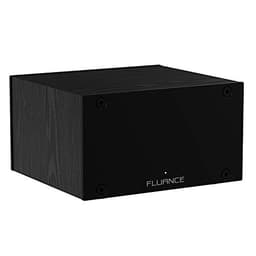
Fluance PA10
A solid mid-priced MM upgrade
Price as of October 14, 2026. #ad How we’re funded
If you want the amp to have one
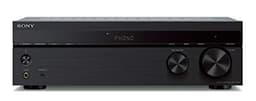
Sony STR-DH190
One box that replaces both the phono preamp and the amplifier
Price as of October 14, 2026. #ad How we’re funded
If you want the speakers to have one
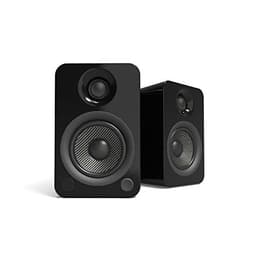
Kanto YU4
A complete turntable system on a desk or a narrow shelf — no separate preamp
Frequently asked questions
What is the difference between a phono input and a line input?
A line input expects a signal of roughly 0.3 to 2 volts and passes it straight through. A phono input expects a few thousandths of a volt, amplifies it by around 100 times, and applies the RIAA equalization curve — restoring bass that was cut and cutting treble that was boosted when the record was made. They look identical because they use the same RCA connectors, but the circuits behind them are not interchangeable.
What happens if I plug a turntable into a line input?
You get a very quiet, thin, tinny sound with almost no bass, even at full volume. That is the raw cartridge output with no amplification and no RIAA correction. The turntable is not broken — it needs a phono stage somewhere in the chain.
What happens if I plug a line-level source into a phono input?
You get a very loud, distorted, bass-heavy mess, and you may overload the input stage. This is also what happens when you connect a turntable whose internal preamp is switched on to a PHONO socket — the signal is amplified and equalized twice.
What does 'phono' mean on an amplifier?
It means that input has a phono preamp behind it: extra gain plus RIAA equalization, and usually a grounding post beside it. It is the only input on a typical amplifier designed to accept a turntable's raw cartridge output directly.
Can I use a phono input for a CD player or a streamer?
No. Those are line-level sources and will overload a phono input badly. Use any input labeled AUX, CD, TAPE, TUNER or LINE for them.
Why is there a small screw terminal next to the phono input?
That is the ground post. A phono signal is tiny, so the turntable's chassis and tonearm need a common ground reference with the preamp or you get a steady mains hum. The turntable's thin ground wire attaches there. Only phono inputs have one, which is a quick way to identify them.
Does 'phono out' on a turntable mean it has a preamp?
The opposite. A switch marked PHONO/LINE on the back of a turntable selects the raw cartridge output (PHONO) or the internally-preamplified output (LINE). Set it to LINE for powered speakers and AUX inputs; set it to PHONO only when something downstream has its own phono stage.
Sources
- Elliott Sound Products — Phono preamp / RIAA equalization — Technical reference on RIAA pre-emphasis and the inverse playback curve (accessed July 24, 2026)
- Crutchfield — How to choose a phono preamp — On why a phono signal needs a preamp and never running two at once (accessed July 24, 2026)
- Crutchfield — How to choose the right turntable — Buying-guide reference on drive type, cartridges, preamps and setup (accessed July 24, 2026)
- Ortofon — 2M Red — Manufacturer specs: 5.5 mV output, 1.6-2.0 g tracking (1.8 g recommended), 47 kOhm load (accessed July 24, 2026)
Keep reading
Do I Need a Phono Preamp?
The decision tree: check what you own, then find out what is missing.
Read the explainerWhat Is a Built-In Phono Preamp?
How to tell whether your turntable already has one.
Read the explainerBest Turntables With a Built-In Preamp
Decks that solve this at the source, with a switch on the back.
See the picksTurntable Setup Diagram
Every valid wiring path drawn out, with the illegal ones marked.
Read the guide