Turntable Setup Diagram: How It All Connects
Every valid turntable system is one of five signal chains. Find yours, and the box you are missing becomes obvious.
How this is funded: we earn a commission if you buy through our links, at no extra cost to you. It never changes which product we recommend, and we’ll tell you plainly when to skip one. Full disclosure.
Almost every “how do I connect this” question about turntables is really the same question: which boxes do I need and in what order? There are only five valid arrangements, and once you can see them the missing component is obvious.
This page gives you the rule first, then the five chains, then how to work out which one you are in.
The rule
Between the cartridge and the speaker drivers, a signal must pass through exactly one phono stage and exactly one power amplifier.
That is the whole thing. Every wiring mistake in vinyl is a violation of it, and every violation has a distinctive symptom:
- Zero phono stages: faint, thin, no bass, still quiet at maximum volume.
- Two phono stages: very loud, distorted, boomy, unpleasant.
- Zero power amplifiers: silence, or an extremely faint sound from passive speakers.
- Two power amplifiers:generally means feeding a powered speaker from an amplifier’s speaker terminals — do not, it can damage the speaker’s input.
Full symptom detail for the first two is in phono vs line.
The four functions, and which box does each
A vinyl system performs four jobs. Understanding which box does which is how you avoid buying a duplicate.
- Transduction. The cartridge converts groove wiggle into a tiny electrical signal. Only the turntable does this.
- Phono stage. Amplify that signal by roughly 100 times and apply the inverse RIAA curve. Can live in: the turntable, an amplifier, a powered speaker, or its own box.
- Volume and power amplification. Drive actual speaker drivers. Can live in: an amplifier or receiver, or inside powered speakers.
- Transduction back. The speakers turn electricity into air movement.
Jobs 2 and 3 are the flexible ones, and every one of the five chains is a different answer to “which box is doing them”.
Working out which chain you are in
Two questions, and they resolve it completely.
Question 1: are your speakers powered or passive? Powered (active) speakers plug into mains power and have a volume knob or a remote. Passive speakers have only two wire terminals on the back and no power lead. If they are passive you need an amplifier, which puts you in Chain D or E. If powered, you are in A, B or C. The full comparison is in powered vs passive speakers.
Question 2: where is the phono stage?Check the turntable for a PHONO/LINE switch, the amplifier for a PHONO input with a ground screw, and the powered speakers for the same. Whichever box has it is the one doing job 2 — and if none of them do, you need to add the box in the middle of Chain B.
Cables, briefly
Almost everything in these chains is stereo RCA, red and white, and any decent-quality pair works. Three practical notes:
- Keep phono-level runs short. Before the phono stage the signal is tiny and vulnerable to induced noise. A short cable from turntable to preamp matters more than a short one from preamp to amplifier.
- The ground wire is separate. A thin wire with a spade or ring terminal, going to the GND post beside the phono input. Its job is hum suppression.
- Passive speakers use speaker cable, not RCA.Bare wire or banana plugs into terminals. Never connect an amplifier’s speaker outputs to any RCA input.
Where Bluetooth and USB fit
Neither changes the rule; both are alternative routes for the same signal after the phono stage.
Bluetooth.On a Bluetooth turntable the internal preamp feeds a transmitter, and the receiving speaker contains its own amplifier. So a Bluetooth chain is still exactly one phono stage and one power amplifier — it just replaces the RCA cable with a radio link. See Bluetooth turntables.
USB. A USB turntable takes the line-level signal after its internal preamp, converts it to digital and sends it to a computer. The computer is then doing the amplification and speaker duties. Covered in how to record vinyl to a computer.
Sonos and similar.A Sonos speaker with a line input behaves exactly like a powered speaker in Chain A or B — the phono stage still has to come from somewhere. See how to connect a turntable to Sonos.
After the wiring: the physical setup
A correctly-wired system still needs the deck itself set up properly — leveled, belt fitted, arm balanced, tracking force dialed. That is a separate job and it matters at least as much as the wiring: how to set up a turntable covers the sequence and how to balance a tonearm covers the part that protects your records.
One placement rule belongs here rather than there, because it is about the system rather than the deck: keep the turntable away from the speakers, and ideally not on the same shelf. Speaker energy reaching the plinth is read by the cartridge as signal, and the resulting feedback loop is the most common cause of muddy, booming vinyl sound.
The five valid chains
Every working turntable system is one of these. Find the one whose first box matches your deck and whose last box matches your speakers, and the middle is what you need to buy.
Chain A — deck with a preamp, powered speakers
Turntable (preamp ON / LINE)Powered speakersTwo boxes. The most common first system, and the cheapest complete one.
Chain B — deck without a preamp, separate stage, powered speakers
Turntable (no preamp)Phono preampPowered speakersThree boxes, the most upgradeable. The phono stage can be replaced independently later.
Chain C — deck without a preamp, powered speakers with one built in
Turntable (no preamp)Powered speakers (PHONO input)Two boxes with a preamp-less deck. Only works with the small number of speakers that have a phono input.
Chain D — deck without a preamp, amplifier with a phono input, passive speakers
Turntable (no preamp)Amplifier (PHONO input)Passive speakersThe classic separates system. The amplifier does both the phono stage and the power amplification.
Chain E — deck with a preamp, amplifier without one, passive speakers
Turntable (preamp ON / LINE)Amplifier (any line input)Passive speakersHow to use a modern amplifier that dropped the phono socket. Set the amp to AUX, not PHONO.
Filling the gap in your chain
Whichever box your chain is missing, one of these three is usually it.
The missing middle box (Chain B)
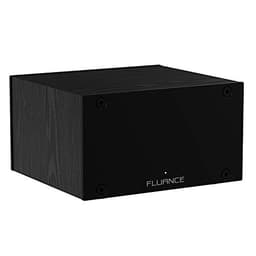
Fluance PA10
A solid mid-priced MM upgrade
Price as of October 15, 2026. #ad How we’re funded
An amp with a phono input (Chain D)
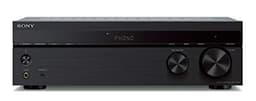
Sony STR-DH190
One box that replaces both the phono preamp and the amplifier
Price as of October 15, 2026. #ad How we’re funded
Powered speakers (Chains A and B)
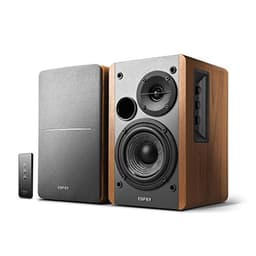
Edifier R1280T
The best-value complete-system speakers
Price as of October 15, 2026. #ad How we’re funded
Frequently asked questions
How do you connect a turntable to speakers?
Through a chain with exactly one phono stage and exactly one power amplifier in it. With powered speakers the amplification is already inside them, so you only need the phono stage — from the turntable, from the speakers, or from a separate box. With passive speakers you need an amplifier as well.
What order do turntable components go in?
Always: turntable, then phono stage, then volume control and power amplification, then speakers. Some of those functions live in the same box — a receiver with a phono input does the second and third — but the order never changes.
Do I need both a preamp and an amplifier for a turntable?
You need both functions, but not always both boxes. A phono preamp raises the cartridge signal to line level and applies RIAA equalization; an amplifier drives the speakers. An integrated amp with a phono input does both. Powered speakers contain the amplifier, so with them you only need to source the phono stage.
How do I know if my chain is wired correctly?
Count the phono stages. Exactly one between cartridge and speaker is correct. Zero gives you a faint, thin, bass-less sound at full volume. Two gives you a loud, distorted, boomy sound. Those two symptoms are diagnostic — you can tell which mistake you made by ear.
Where does the turntable ground wire go?
To the ground screw next to the phono input on whichever box provides the phono stage — an amplifier, a standalone preamp or a powered speaker with a phono input. If you are running the deck's own preamp into a line input, the ground wire usually is not needed.
Can I connect a turntable straight to a soundbar or a TV?
Only if the turntable's own preamp is switched on and the soundbar has an analog line input — a 3.5 mm jack or RCA sockets. Many modern soundbars are HDMI and optical only, in which case you would need a separate analog-to-digital converter, and at that point a pair of powered speakers is the simpler answer.
Sources
- Crutchfield — How to choose a phono preamp — On why a phono signal needs a preamp and never running two at once (accessed July 24, 2026)
- Crutchfield — How to choose the right turntable — Buying-guide reference on drive type, cartridges, preamps and setup (accessed July 24, 2026)
- Crutchfield — Intro to home audio power amplifiers and preamps — On the preamp/power-amp split, integrated amplifiers and impedance stability (accessed August 11, 2026)
- Elliott Sound Products — Phono preamp / RIAA equalization — Technical reference on RIAA pre-emphasis and the inverse playback curve (accessed July 24, 2026)
Keep reading
The First 10 Records to Buy
Once the chain is connected, this is what to put on it.
See the picksPhono vs Line
What the two socket labels mean, and how each mistake sounds.
Read the explainerConnect a Turntable Without a Receiver
Chains A, B and C in more detail.
Read the guideHow to Set Up a Turntable
The mechanical setup once the wiring is decided.
Read the guideHow to Build a Hi-Fi System
Choosing which chain to build in the first place, and what to spend.
Read the guide