PLATTER & PLINTH

The Best Powered Speakers With a Built-In Phono Preamp

A turntable, a pair of speakers, one cable. This is the shortest complete vinyl system there is — and only a handful of speakers can actually do it.

By Stephen V.Last updated How we pick

Most powered speakers accept a line-level signal and nothing else. Plug a preamp-less turntable into them and you get a faint, thin sound that is usually mistaken for a fault. A small group of powered speakers solve this by putting the phono stage inside the cabinet— and when they do, the entire system becomes two boxes and one RCA cable.

That is genuinely the tidiest vinyl setup available. No separate amplifier, because the speakers are powered. No separate preamp, because the phono stage is built in. Nothing to switch, nothing to match, no third power lead.

The trade is flexibility. A built-in phono stage is fixed-gain and moving-magnet only, and you cannot upgrade it without replacing the speakers. If you expect to move to a moving-coil cartridge or to care about loading, a standalone preamp is the better architecture. For everyone else, the speakers below remove a box for very little money.

Every model here publishes a phono input on its own specification sheet. Prices are live and dated; we have not heard most of these, and we explain what we do instead.

How this is funded:we earn a commission if you buy through our links, at no extra cost to you. It never changes which product we recommend, and we’ll tell you plainly when to skip one. Full disclosure.

Quick picks

Ranked on published specs, drive/motor design and buyer fit. Select a row to jump to the full write-up. We have not heard most of these units — here is exactly what we do instead.

#ProductBest forPrice
1
Kanto YU4

Kanto YU4

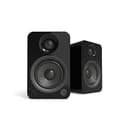
The smaller of Kanto's two vinyl-ready pairs, and the one most people should buy: a built-in phono preamp means a preamp-less turntable plugs straight in, and the 4-inch Kevlar drivers fit a desk or a narrow shelf where the YU6 will not. You are paying for the phono stage and the cabinet, not for watts.

Best overall
$379.99 · View on Amazon

Price as of August 31, 2026. #ad How we’re funded

2
Andover Audio Spinbase 2

Andover Audio Spinbase 2

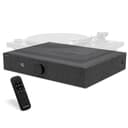
A single-box speaker system the turntable physically sits on top of, with the phono stage inside. Its patented ISOGroove anti-feedback design exists precisely because a deck on a speaker is normally a terrible idea — this is the one product built to make that arrangement work when you have one shelf and no more.

Best for a single shelf
$349.00 · View on Amazon

Price as of August 31, 2026. #ad How we’re funded

3
Kanto YU6

Kanto YU6

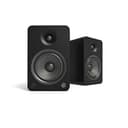
The one-box answer for a turntable: powered speakers with a built-in phono preamp, so a preamp-less deck plugs straight in with nothing between them. Add Bluetooth, a subwoofer output and real 5.25-inch drivers and it's the tidiest good-sounding vinyl system you can buy.

Best for a larger room
$579.99 · View on Amazon

Price as of August 31, 2026. #ad How we’re funded

4
Klipsch The Fives II

Klipsch The Fives II

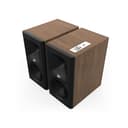
The premium powered pair with a dedicated phono input built in: Klipsch's horn-loaded sound, HDMI-ARC for a TV, Bluetooth, and a switchable phono stage so a turntable connects directly. It's the splurge that turns one purchase into a full living-room system.

Best sounding, at a price
$1,349.00 · View on Amazon

Price as of August 31, 2026. #ad How we’re funded

The picks in full

#1Best overall

Kanto YU4

The smaller of Kanto's two vinyl-ready pairs, and the one most people should buy: a built-in phono preamp means a preamp-less turntable plugs straight in, and the 4-inch Kevlar drivers fit a desk or a narrow shelf where the YU6 will not. You are paying for the phono stage and the cabinet, not for watts.

Strengths

  • Built-in phono preamp — a turntable with no internal stage connects directly
  • Compact enough for a desk at 5.5 x 7.5 x 8.7 inches per cabinet
  • aptX Bluetooth and a remote, so the same pair serves streaming duty

Trade-offs

  • 4-inch drivers give up real low end to the 5.25-inch YU6
  • One phono input — a second source has to use the line or Bluetooth input
TypePowered (active) bookshelf
Phono preampYes — built in
Drivers4" Kevlar woofer, 1" silk dome tweeter
BluetoothYes — Qualcomm aptX
Peak power140 W (published)
Cabinet size5.5" W x 7.5" D x 8.7" H each

Note. Peak power is a marketing figure, not an RMS rating — Kanto does not publish RMS for this pair, so treat 140 W as a ceiling, not an output. The reason to buy it is the phono stage and the size, not the number.

Specifications read from the manufacturer / product listing, on August 19, 2026. “Not published” means the maker does not state that figure.

#2Best for a single shelf

Andover Audio Spinbase 2

A single-box speaker system the turntable physically sits on top of, with the phono stage inside. Its patented ISOGroove anti-feedback design exists precisely because a deck on a speaker is normally a terrible idea — this is the one product built to make that arrangement work when you have one shelf and no more.

Strengths

  • Phono input built in, so a preamp-less deck needs nothing else
  • ISOGroove anti-feedback design is engineered for a turntable placed on top of it
  • Bluetooth, analog, optical and USB inputs alongside the phono stage

Trade-offs

  • One cabinet means no stereo separation worth the name — soundstage is the price of the footprint
  • Not upgradeable: you cannot keep the speakers and add a better preamp later
TypeSingle-cabinet powered speaker system for turntables
Phono inputYes — built in
Other inputsBluetooth, analog, optical digital, USB
AmplificationDual Direct Drive (published)
IsolationPatented ISOGroove anti-feedback
ControlIR remote — input, volume, tone

Note. Andover does not publish an RMS power figure or a frequency response for the Spinbase 2, which is why neither appears above. Buy it for the footprint and the feedback engineering, not for a spec sheet.

Specifications read from the manufacturer / product listing, on August 19, 2026. “Not published” means the maker does not state that figure.

#3Best for a larger room

Kanto YU6

The one-box answer for a turntable: powered speakers with a built-in phono preamp, so a preamp-less deck plugs straight in with nothing between them. Add Bluetooth, a subwoofer output and real 5.25-inch drivers and it's the tidiest good-sounding vinyl system you can buy.

Strengths

  • Built-in phono preamp — connect a turntable directly, no extra box
  • Bluetooth plus a subwoofer output for future expansion
  • 5.25-inch Kevlar drivers with genuine output

Trade-offs

  • Costs more than a preamp-less powered pair plus a cheap phono box
  • One phono input — set its preamp mode to match your deck
TypePowered (active) bookshelf
Phono preampYes — built in
Drivers5.25-inch Kevlar
BluetoothYes
ExtrasSubwoofer output, remote

Note. The built-in phono stage is the reason to pick these over the Edifiers: with a preamp-less turntable (like the Fluance RT82 or a bare U-Turn) they're a complete system with no third box to buy.

Specifications read from the manufacturer / product listing, on August 28, 2026. “Not published” means the maker does not state that figure.

#4Best sounding, at a price

Klipsch The Fives II

The premium powered pair with a dedicated phono input built in: Klipsch's horn-loaded sound, HDMI-ARC for a TV, Bluetooth, and a switchable phono stage so a turntable connects directly. It's the splurge that turns one purchase into a full living-room system.

Strengths

  • Built-in switchable phono preamp — a turntable plugs straight in
  • HDMI-ARC, optical, USB and Bluetooth for a TV and every other source
  • Klipsch horn-loaded tweeters with real output and dynamics

Trade-offs

  • Considerably more expensive than the value picks
  • The horn sound is lively — audition it if you prefer a laid-back tone
TypePowered (active) bookshelf
Phono preampYes — switchable input
InputsHDMI-ARC, optical, USB, Bluetooth, phono/line
TweeterHorn-loaded
ExtrasRemote, subwoofer output

Note. Like the Kanto YU6, the built-in phono stage means a preamp-less deck needs nothing else — the difference is Klipsch's horn sound and full home-theater connectivity for the higher price.

Specifications read from the manufacturer / product listing, on July 24, 2026. “Not published” means the maker does not state that figure.

How to confirm a speaker really has a phono stage

Marketing copy is loose about this, and “works with turntables” is not the same claim as “has a phono preamp”. Two reliable checks:

  • An input labeled PHONO, not AUX, LINE or RCA. Some speakers label a single input PHONO/LINE with a switch, which is also fine — that switch is the phono stage going in and out of circuit.
  • A ground screw beside that input.This is the strongest tell. A ground post exists to tie a turntable’s chassis and tonearm to the preamp’s ground reference, and it is only needed for a phono-level signal. Nobody fits one next to a line input.

If a speaker has neither, it takes line level only. That is not a problem — it just means the phono stage has to come from the turntable or from a separate box. Our guide to phono preamps with powered speakers walks through the four possible combinations.

One cabinet or two: the Spinbase question

Three of the picks above are conventional stereo pairs. The Andover Spinbase 2 is not — it is a single cabinet designed for the turntable to sit directly on top of, with the phono stage inside and a patented anti-feedback design called ISOGroove.

That anti-feedback engineering exists because placing a turntable on a speaker is normally a bad idea. Speaker output shakes the plinth, the cartridge reads that vibration as signal, and the loop turns into a low booming howl. Andover has built a product specifically to make that arrangement survivable, and it is the right answer if you have exactly one shelf.

What you give up is stereo separation. Two drivers a few inches apart in one box cannot produce the image that two cabinets a meter apart can. If you have the space for a pair, buy a pair. If you genuinely do not, this is the product designed for that constraint rather than a compromise you improvise.

What the built-in stage is and is not

Every phono stage in this roundup is a fixed-gain moving-magnet circuit. That is the right choice for the market — virtually every cartridge fitted to a turntable under $1,000 is a moving magnet, and 47 kΩ at around 40 dB of gain suits all of them.

The limits are worth stating:

  • No moving-coil support. A low-output MC cartridge produces a fraction of the voltage these expect, and will sound faint. See MM vs MC.
  • No adjustable loading.You cannot tune capacitance to your cable and cartridge — the reason the Schiit Mani 2 exists.
  • No upgrade path.Improving the phono stage means buying different speakers, or bypassing it with an external stage into the line input — which works, and makes the built-in one redundant.

None of that matters if you own one moving-magnet cartridge and want fewer boxes. All of it matters if you are building a system you expect to develop.

Setting one up

Four steps, and it is genuinely this short:

  1. Set the turntable’s own switch to PHONOif it has one. This bypasses the deck’s internal preamp so the speakers’ stage is the only one in the chain.
  2. Run a normal RCA cable from the turntable to the speakers’ PHONO input.
  3. Attach the turntable’s thin ground wire to the ground screw. Skip this and you will usually hear a steady mains hum.
  4. Select the phono input on the speaker or remote and play a record.

If it comes out loud and distorted, the deck is still set to LINE and you have two phono stages in series. If it comes out faint and thin, the speaker is on its line input rather than its phono input. Both symptoms are explained in phono vs line.

When to buy line-only speakers instead

If your turntable already has a switchable built-in preamp — most decks under $400 do — then a phono input on the speakers buys you nothing, and the money is better spent on the drivers. In that case go to our powered speaker roundup or speakers under $200, where the Edifier and Fluance pairs offer more speaker per dollar precisely because they are not paying for a phono circuit.

The speakers on this page are for the other case: a deck with no preamp, and a desire not to own a third box.

Frequently asked questions

Which powered speakers have a built-in phono preamp?

It is a minority of the market. Kanto's YU4 and YU6, Andover Audio's Spinbase 2 and Klipsch's The Fives II all publish a phono input. Most mainstream powered speakers — Edifier's R1280 range, Fluance's Ai series, Micca's passive pairs — do not.

Can I connect a turntable directly to Kanto YU4 or YU6 speakers?

Yes. Both have a built-in phono preamp, so a turntable with no internal stage connects straight to the phono input with an RCA cable plus the ground wire. If your turntable does have its own preamp, set it to PHONO so only one stage is in circuit.

Are speakers with a built-in phono preamp worth it?

They are if your turntable has no preamp and you want the fewest boxes. You are effectively buying the phono stage bundled, usually for less than a decent standalone unit costs. They are not worth it if your deck already has a switchable preamp, because you would be paying for a circuit you will not use.

Is a built-in phono preamp in speakers as good as a separate one?

Generally no, for the same reason a preamp inside a turntable is not: it is a small part of the budget, sharing a cabinet with amplifiers and a power supply. The gap is modest with a moving-magnet cartridge and matters more as the cartridge improves. Nothing stops you adding a better external stage later and feeding the line input instead.

Do I still need a ground wire with powered speakers?

If you are using their phono input, yes — connect the turntable's ground wire to the ground screw beside it. If you are feeding a line input from a turntable with its own preamp, the ground wire is usually unnecessary because the signal is large enough that induced hum is inaudible.

Can I put my turntable on top of my speakers?

Only on a product designed for it, like the Andover Spinbase 2 with its ISOGroove anti-feedback design. On ordinary speakers, a turntable placed on the cabinet will pick up speaker vibration through the plinth and produce acoustic feedback — a low booming howl that gets worse as you turn it up.

Sources

Keep reading