PLATTER & PLINTH

The Best Turntables With a Built-In Preamp

A record player with the phono stage inside plugs into anything with a spare input. The only question that separates a good one from a bad one is whether you can switch it off.

By Stephen V.Last updated How we pick

A turntable’s output is roughly a thousand times quieter than a CD player’s, and it comes out with the bass cut and the treble boosted. Something has to undo that before a speaker can use it. A deck with a built-in preampdoes the job inside the plinth, which means it works with powered speakers, a soundbar, a Bluetooth adapter or the AUX input on an old receiver — anything with a line-level input.

The catch is that a free preamp inside a $200 turntable is a free preamp inside a $200 turntable. It is fine, it is not the best available, and on the good decks a rear switch lets you bypass it later and feed a standalone stage instead. On the bad decks the preamp is permanently in circuit, which caps the deck forever and creates the two-preamps-in-series problem if you ever plug it into a phono input.

So the ranking below is built on one filter first — is the preamp switchable?— and then on everything that normally decides a turntable. Every deck here publishes a switchable stage. Prices are live and dated; we have not heard most of these units, and we explain exactly what we do instead.

How this is funded:we earn a commission if you buy through our links, at no extra cost to you. It never changes which product we recommend, and we’ll tell you plainly when to skip one. Full disclosure.

Quick picks

Ranked on published specs, drive/motor design and buyer fit. Select a row to jump to the full write-up. We have not heard most of these units — here is exactly what we do instead.

#ProductBest forPrice
1
Fluance RT81

Fluance RT81

The best-value entry into real hi-fi: a manual belt-drive deck with an adjustable counterweight and anti-skate, an aluminum platter, and a genuine Audio-Technica elliptical cartridge — for the price of a good all-in-one. The switchable built-in preamp means it works today and upgrades later.

Best overall
$299.99 · View on Amazon

Price as of August 31, 2026. #ad How we’re funded

2
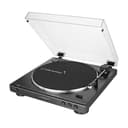
Audio-Technica AT-LP60X

Audio-Technica AT-LP60X

The default first turntable for a reason: it's fully automatic, so you press one button and it cues, plays and returns the arm on its own — nothing to set up wrong. The built-in switchable preamp lets it plug into anything, and it tracks safely enough to trust with your records.

Best under $200
$179.00 · View on Amazon

$199.0010% off

Price as of August 31, 2026. #ad How we’re funded

3
Denon DP-300F

Denon DP-300F

A fully automatic belt-drive deck with a built-in preamp and a die-cast aluminum platter — the convenient choice for someone who wants set-and-forget play but a more substantial build than the budget automatics. It has a proper counterweight, so it's automatic and adjustable.

Best automatic with an adjustable arm
$449.00 · View on Amazon

$499.0010% off

Price as of August 31, 2026. #ad How we’re funded

4
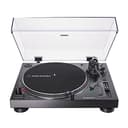
Audio-Technica AT-LP120XUSB

Audio-Technica AT-LP120XUSB

The tinkerer's deck: a direct-drive, fully manual turntable with adjustable tracking force, anti-skate, selectable pitch and a USB output for digitizing records. It ships with the VM95E elliptical and a switchable preamp, so it's ready to play and ready to grow.

Best direct drive
$349.00 · View on Amazon

$449.0022% off

Price as of August 31, 2026. #ad How we’re funded

5
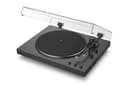
Sony PS-LX310BT

Sony PS-LX310BT

The most flexible one-box deck: fully automatic, with Bluetooth out to a wireless speaker or headphones, a USB port for recording, and a switchable built-in preamp for wired setups. It does everything, which is exactly why it's the easiest recommendation for a first modern turntable.

Best for wireless as well
$448.00 · View on Amazon

Price as of August 31, 2026. #ad How we’re funded

6
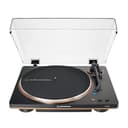
Audio-Technica AT-LP70X

Audio-Technica AT-LP70X

The automatic that grew up: it keeps the one-button convenience of the LP60X but adds a proper VM95-series cartridge and a die-cast platter, so it sounds a clear step better while still cueing itself. The natural pick if you want automation without the budget-deck ceiling.

Best automatic upgrade path
$249.00 · View on Amazon

Price as of August 31, 2026. #ad How we’re funded

The picks in full

#1Best overall

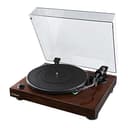
Fluance RT81

The best-value entry into real hi-fi: a manual belt-drive deck with an adjustable counterweight and anti-skate, an aluminum platter, and a genuine Audio-Technica elliptical cartridge — for the price of a good all-in-one. The switchable built-in preamp means it works today and upgrades later.

Strengths

  • Adjustable counterweight and anti-skate — you can set tracking force correctly, which the cheap automatics can't
  • Ships with an Audio-Technica AT95-type elliptical cartridge, a real step up from a conical
  • Built-in preamp is switchable, so you can bypass it when you add a better one

Trade-offs

  • Manual operation — you cue and lift the arm yourself
  • No Bluetooth or USB; this is a wired, listen-at-home deck
DriveBelt drive
OperationManual
CartridgeAudio-Technica elliptical (AT95-type)
Built-in preampYes — switchable
Speeds33 1/3 and 45 RPM
PlatterAluminum

Note. The counterweight and anti-skate are the reason this deck belongs in a different class from the sub-$150 automatics: it lets you dial in tracking force to the cartridge's spec instead of accepting a fixed factory setting.

Specifications read from the manufacturer / product listing, on July 24, 2026. “Not published” means the maker does not state that figure.

#2Best under $200

Audio-Technica AT-LP60X

The default first turntable for a reason: it's fully automatic, so you press one button and it cues, plays and returns the arm on its own — nothing to set up wrong. The built-in switchable preamp lets it plug into anything, and it tracks safely enough to trust with your records.

Strengths

  • Fully automatic — start and stop at the touch of a button, no manual cueing
  • Switchable built-in preamp connects to powered speakers or a receiver
  • Tracks at a sane force with a replaceable Audio-Technica stylus

Trade-offs

  • Fixed tonearm — no counterweight or anti-skate to adjust
  • Conical (spherical) stylus is a rung below the elliptical on step-up decks
DriveBelt drive
OperationFully automatic
CartridgeAudio-Technica AT3600L (conical, replaceable stylus)
Built-in preampYes — switchable
Speeds33 1/3 and 45 RPM
Bluetooth / USBNo

Note. The fixed tonearm is the trade for the automation: you can't adjust tracking force, but you also can't set it wrong. That's the right trade for a first deck.

Specifications read from the manufacturer / product listing, on July 24, 2026. “Not published” means the maker does not state that figure.

#3Best automatic with an adjustable arm

Denon DP-300F

A fully automatic belt-drive deck with a built-in preamp and a die-cast aluminum platter — the convenient choice for someone who wants set-and-forget play but a more substantial build than the budget automatics. It has a proper counterweight, so it's automatic and adjustable.

Strengths

  • Fully automatic start and stop with a real counterweight for tracking force
  • Built-in switchable phono preamp
  • Solid die-cast platter and a well-regarded, long-lived design

Trade-offs

  • Stock headshell/cartridge is basic; many owners upgrade it
  • Styling is dated next to newer decks
DriveBelt drive
OperationFully automatic
CartridgeDenon DSN-85 (included)
Built-in preampYes — switchable
Speeds33 1/3 and 45 RPM
PlatterDie-cast aluminum

Note. It's unusual in offering both full automation and an adjustable counterweight, which makes it a good fit for someone who wants convenience without the fixed-arm compromise of the cheapest automatics.

Specifications read from the manufacturer / product listing, on July 24, 2026. “Not published” means the maker does not state that figure.

#4Best direct drive

Audio-Technica AT-LP120XUSB

The tinkerer's deck: a direct-drive, fully manual turntable with adjustable tracking force, anti-skate, selectable pitch and a USB output for digitizing records. It ships with the VM95E elliptical and a switchable preamp, so it's ready to play and ready to grow.

Strengths

  • Direct drive with high torque — instant speed and a stable, DJ-style platter
  • USB output records vinyl straight to a computer
  • Full manual control: counterweight, anti-skate, pitch, and three speeds including 78 RPM

Trade-offs

  • Fully manual — no auto return
  • Heavier and larger than the belt-drive decks; overkill if you only ever play at home casually
DriveDirect drive
OperationManual
CartridgeAudio-Technica AT-VM95E (elliptical)
Built-in preampYes — switchable
Speeds33 1/3, 45 and 78 RPM
USB outputYes

Note. 78 RPM plus USB makes this the obvious deck for archiving older records, but note that true 78s need a dedicated stylus — the stock elliptical is cut for modern microgroove records.

Specifications read from the manufacturer / product listing, on July 24, 2026. “Not published” means the maker does not state that figure.

#5Best for wireless as well

Sony PS-LX310BT

The most flexible one-box deck: fully automatic, with Bluetooth out to a wireless speaker or headphones, a USB port for recording, and a switchable built-in preamp for wired setups. It does everything, which is exactly why it's the easiest recommendation for a first modern turntable.

Strengths

  • Bluetooth output pairs straight to a wireless speaker — no other gear needed
  • Fully automatic, with a low-profile design and switchable preamp
  • USB output for digitizing records

Trade-offs

  • Bluetooth trades some fidelity versus a wired connection
  • Low-mass plastic build; the tonearm and cartridge are entry level
DriveBelt drive
OperationFully automatic
WirelessBluetooth output
Built-in preampYes — switchable
Speeds33 1/3 and 45 RPM
USB outputYes

Note. Bluetooth OUT (deck to speaker) is the useful direction here and what makes this deck so flexible; if you care most about sound, use the wired analog output into powered speakers instead.

Specifications read from the manufacturer / product listing, on July 24, 2026. “Not published” means the maker does not state that figure.

#6Best automatic upgrade path

Audio-Technica AT-LP70X

The automatic that grew up: it keeps the one-button convenience of the LP60X but adds a proper VM95-series cartridge and a die-cast platter, so it sounds a clear step better while still cueing itself. The natural pick if you want automation without the budget-deck ceiling.

Strengths

  • Fully automatic operation, like the LP60X
  • Upgraded to the VM95C cartridge on a detachable headshell mount
  • Anti-resonance die-cast aluminum platter

Trade-offs

  • Costs more than the LP60X for a similar convenience level
  • Still no on-arm tracking-force adjustment
DriveBelt drive
OperationFully automatic
CartridgeAudio-Technica AT-VM95C (conical, VM95 series)
Built-in preampYes — switchable
Speeds33 1/3 and 45 RPM
PlatterDie-cast aluminum

Note. Because it uses the VM95 cartridge body, you can later drop in a VM95E elliptical or higher stylus without changing the whole cartridge — a real upgrade path the LP60X doesn't offer.

Specifications read from the manufacturer / product listing, on July 24, 2026. “Not published” means the maker does not state that figure.

Switchable versus always-on: why it is the whole decision

Every deck above has a small switch on the back marked something like PHONO / LINE. In the LINE position the internal preamp is doing the RIAA correction and the amplification. In the PHONO position the signal leaves the deck raw, exactly as the cartridge produced it, and something downstream has to handle it.

That switch is worth more than any spec on the box, for three reasons:

  • It future-proofs the deck.The preamp is the single cheapest component to upgrade in a vinyl system — a $100 external stage beats what fits inside a plinth for free. A switchable deck lets you make that upgrade without replacing the turntable.
  • It stops the double-preamp mistake.Plug a LINE-mode deck into a receiver’s PHONO input and the signal is amplified and RIAA-corrected twice. It sounds distorted, bass-heavy and wrong, and the usual conclusion is that the turntable is broken. It is not.
  • It shortens the signal path when you want it short. With the internal stage bypassed, the cartridge feeds one preamp instead of passing through a spare one.

An always-on preamp is not automatically disqualifying — the all-in-ones in our all-in-one roundup all have one, and it never matters there because nothing downstream expects a phono signal. It matters the moment you own separates.

What a built-in preamp lets you plug into

This is the practical reason people search for one. With the internal stage switched on, a turntable will drive:

  • Powered speakers— the Edifier and Fluance pairs in our powered speaker roundup take a line input and nothing else, so a built-in preamp is what makes that pairing work at all.
  • Any AUX, CD, TAPE or TUNER input on an amplifier or receiver, including modern ones that dropped the phono socket.
  • A Bluetooth transmitter or a soundbar with a 3.5 mm input, via an RCA-to-3.5 mm cable.
  • A computer interface for digitizing — see how to record vinyl to a computer.

What it does notdo is drive headphones or passive speakers. Both need power amplification, which is a separate stage again — see do you need an amp.

How to check the deck you already own

Three checks, in order, and they take under a minute:

  1. Look at the back panel. A PHONO/LINE switch beside the RCA outputs means yes, and it is switchable. This is the common case on anything from Audio-Technica, Fluance, Sony or Denon in the last decade.
  2. Look for a 3.5 mm output or a captive cable ending in a headphone plug.That is nearly always an always-on internal preamp — the connector implies a line-level signal.
  3. Plug it into an AUX input and press play. If it is loud enough to be normal, there is a preamp in circuit. If it is faint and tinny at full volume, there is not.

The full version of that test, with the failure modes, is in what is a built-in phono preamp.

When to buy a deck without one instead

Two situations. First, if your amplifier already has a PHONO input — then the internal stage is redundant and you are better off spending the money on the platter and arm, which is what the decks over $500 do. Second, if you already own or intend to buy a standalone preamp, in which case a preamp-free deck like the Fluance RT82 puts every dollar into mechanics.

For everyone else — and that is most first-time buyers — a switchable built-in stage costs almost nothing, works today, and gets out of the way later. It is the right default.
Frequently asked questions

Do all turntables have a built-in preamp?

No. Roughly speaking, entry-level and mid-price decks aimed at beginners include one, and enthusiast decks above $400 often leave it out deliberately to keep the signal path short and let you choose your own. Check the back panel for a PHONO/LINE switch, or the specification sheet for 'built-in phono equalizer' or 'built-in preamp'.

Is a built-in phono preamp as good as an external one?

Usually not, and the reason is budget rather than physics: the internal stage in a $200 deck represents a few dollars of the build cost, sitting inside a chassis with a motor in it. A $100 standalone unit has a dedicated power supply and no motor next to it. The gap is real but modest, and it is the cheapest upgrade in a vinyl system when you want to make it.

Can I turn off a built-in phono preamp?

On most current decks, yes — a rear PHONO/LINE switch bypasses it. Every turntable on this page has one. Some budget players and most all-in-ones have the preamp permanently in circuit, with no way to bypass it.

What happens if I use a built-in preamp and an external one at the same time?

The signal gets amplified and RIAA-corrected twice. It sounds loud, distorted and bass-heavy, and it can overload the second stage's input. Set the deck to PHONO, or set the receiver to a line input — one preamp in the chain, never two.

Do I need a built-in preamp for powered speakers?

You need a phono stage somewhere. Most powered speakers only accept line-level input, so either the turntable provides the preamp or you add an external one between them. A few powered speakers have a phono stage of their own — those are covered in our roundup of powered speakers with a built-in phono preamp.

Does a built-in preamp make a turntable worse?

Not in itself. What matters is whether it can be bypassed. A switchable stage costs you nothing — the circuit is out of the path when the switch is set to PHONO. A permanently-wired one caps the deck at whatever that circuit can do.

Sources

Keep reading