Amplifier and Speakers for a Turntable
Nobody buys an amplifier on its own. Here is how the two halves have to fit together — impedance, sensitivity and real power — and three pairings that already do.
How this is funded: we earn a commission if you buy through our links, at no extra cost to you. It never changes which product we recommend, and we’ll tell you plainly when to skip one. Full disclosure.
Search data for this site is unambiguous about one thing: people do not shop for an amplifier and then, separately, for speakers. They search for amp and speakers for turntable as a single object, because that is how the purchase actually feels. You have a record player and no way to hear it, and you want to know what pair of things fixes that.
This page treats it as one decision. The rules first, because they are short and they eliminate most bad pairings, then three complete combinations that already satisfy them.
Rule 1: impedance is a compatibility check, not a preference
Speakers present an electrical impedance to the amplifier, quoted in ohms — almost always 4, 6 or 8 nominal. Amplifiers publish the range they are designed to drive.
The rule: the speaker’s impedance must fall inside the amplifier’s stated range. A Sony STR-DH190 specifies 6–16 ohms, so a 4-ohm speaker is outside what Sony will stand behind. A Fosi V3 specifies 2–8 ohms and will happily drive the 4-ohm loads that trouble cheaper receivers.
Why it matters: a lower impedance draws more current for the same voltage. An amplifier not designed for it runs hot, and protection circuits cut in mid-record. This is a check you do once, on two spec sheets, and then never think about again.
Rule 2: sensitivity decides how much power you actually need
Speaker sensitivity is quoted as a dB figure at 2.83 V and one meter — Klipsch publishes 91 dB for the R-40M, for instance. It tells you how loud the speaker plays for a given input.
The arithmetic that makes this useful: every 3 dB of sensitivity is worth a doubling of amplifier power. A 90 dB speaker on a 25 W amplifier plays as loud as an 87 dB speaker on 50 W, and as loud as an 84 dB speaker on 100 W.
The practical consequence is that a sensitive speaker lets you buy a cheaper, smaller amplifier and still have headroom. It is a far more efficient place to spend money than doubling wattage, which buys 3 dB — a barely noticeable increase in loudness.
Rule 3: you need less power than the boxes imply
Amplifier marketing sells watts because watts are a big number. In a normal domestic room, at volumes that do not annoy neighbors, 20 to 50 W per channel is enough for almost any bookshelf speaker.
Two caveats that are worth the extra headroom:
- Peaks.Music has transients — a drum hit can demand ten times the average power for a fraction of a second. An amplifier with margin handles them cleanly.
- Clipping is what kills tweeters. A small amplifier driven past its limit produces a distorted, squared-off waveform with far more high-frequency energy than the music had. That is much more dangerous to a tweeter than a big amplifier played at a sensible level.
Which is why the “match the watts” instinct is backwards. A speaker’s power rating is a ceiling, not a target. More clean power is safer than less. Crutchfield’s reference on wattage ratings, cited below, makes the same point about RMS versus peak figures.
Rule 4: decide where the phono stage lives before you buy either box
This is the step people skip and then have to fix. A turntable needs a phono stage, and it can live in one of three places:
- In the turntable, if it has a PHONO/LINE switch. Then any amplifier works, phono input or not.
- In the amplifier, if it has a PHONO input and a ground post. Every amplifier in the pairings below except the Fosi V3 has one.
- In its own box — a standalone stage between the two.
Exactly one of them, never two. If you end up with a preamp in both the deck and the amplifier, switch one off — phono vs line explains what happens if you do not.
Rule 5: buy the speakers first
If the budget has to be split unevenly, put more of it into the speakers. They are the component that converts electricity into air movement, they are the one interacting with your room, and the audible differences between two speakers at the same price are far larger than between two competent amplifiers at the same price.
A rough allocation for a vinyl system, ignoring the turntable: about 60% speakers, 40% amplifier. Deviate towards the amplifier only if you have chosen an insensitive or low-impedance speaker that genuinely demands it.
What the three pairings below are doing
Each combination satisfies all five rules. The budget pair uses a wide-impedance Class-D amplifier so the speaker choice is unconstrained, and needs a separate phono stage. The middle pair uses a stereo receiver with a phono input, so the chain is complete without a third box — and pairs it with a 90 dB speaker so the receiver’s power is never the limit. The top pair is the one that stops being a starter system: a real integrated amplifier with a phono stage and a defeatable digital section, driving braced-cabinet speakers.
None of these is the only right answer. They are three that we can defend from the published specifications, which is a different claim from having heard them — see how we pick. If you would rather choose each half yourself, the amplifier roundup and the bookshelf speaker roundup rank the fields separately.
Three complete pairings
Amplifier and speakers together, at three budgets. Each pairing is checked against the impedance and sensitivity rules above — not assembled by price alone.
Under $250 — the honest budget pair
A 2-8 ohm Class-D amplifier and a 60 W bookshelf pair. No phono stage in either, so add one — and it still comes in under the price of one mid-range speaker.
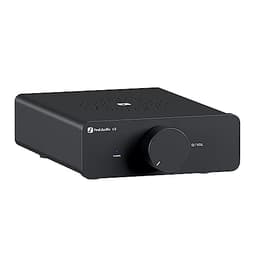
Fosi Audio V3
The cheapest amplifier worth putting behind passive speakers
Price as of October 13, 2026. #ad How we’re funded
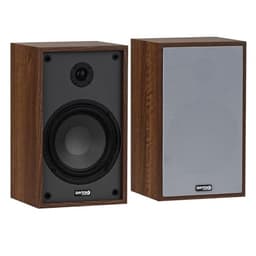
Dayton Audio Classic B65
The cheapest passive pair worth wiring to a turntable
Price as of October 13, 2026. #ad How we’re funded
Around $400 — the one with the phono input
The receiver has a phono input, so the whole chain is two boxes plus the deck. The Klipsch's 91 dB sensitivity means 100 W per channel is far more than enough.
Sony STR-DH190
One box that replaces both the phono preamp and the amplifier
Price as of October 13, 2026. #ad How we’re funded
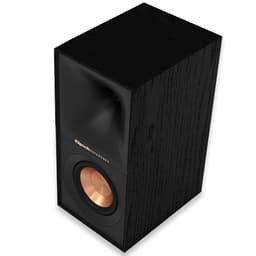
Klipsch R-40M
Getting real volume out of a small, inexpensive amplifier
Price as of October 13, 2026. #ad How we’re funded
Around $800 — the one you keep
A phono input, a defeatable digital section and 70 W into 4 ohms, driving braced-cabinet speakers that reach 35 kHz. This is where the system stops being a starter.
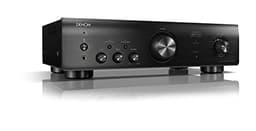
Denon PMA-600NE
A real hi-fi integrated that still has a phono input
Price as of October 13, 2026. #ad How we’re funded
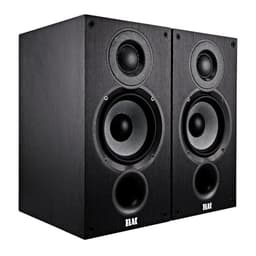
ELAC Debut 2.0 B5.2
The best-balanced passive pair around $250
Frequently asked questions
What amplifier and speakers do I need for a turntable?
An amplifier with enough clean power for your speakers' sensitivity and room, speakers whose impedance the amplifier is rated to drive, and a phono stage somewhere in the chain — in the turntable, in the amplifier, or in its own box. Get those three right and almost any sensible pairing works.
How many watts do I need for a turntable system?
Far fewer than the boxes suggest. In a normal room, 20-50 W per channel drives most bookshelf speakers to volumes you will not want to exceed. What matters more is speaker sensitivity: every 3 dB of extra sensitivity halves the power needed for the same volume, so an 90 dB speaker needs half the amplifier of an 87 dB one.
Does the amplifier need a phono input?
Only if nothing else in the chain has a phono stage. If the turntable has a switchable built-in preamp, any line input will do and you can buy an amplifier without a phono socket. If the turntable has no preamp, either buy an amplifier with a phono input or add a standalone stage.
Can I use a home theater receiver for a turntable?
Yes, if it has a phono input or you add an external phono stage — and if you can put it in a stereo or direct mode that bypasses the surround processing. A two-channel stereo receiver is usually better value for a vinyl-only system because none of the budget went into video switching.
Should I match amplifier watts to speaker watts?
No, and this is the most persistent myth in the category. A speaker's power handling is a maximum, not a requirement. An amplifier with more power than the speaker's rating is fine at sensible volumes; an underpowered amplifier driven into clipping is far more likely to damage a tweeter than a large clean one.
Is an amplifier plus passive speakers better than powered speakers?
Not inherently — it is a different architecture. Separates let you upgrade each half independently and generally scale further. Powered speakers put the amplifier where the designer wants it, need fewer boxes and cost less to get started. Our powered vs passive comparison works through the trade in detail.
Sources
- Crutchfield — Understanding speaker and amplifier wattage ratings — On RMS versus peak power, and matching an amplifier's output to a speaker's rating (accessed August 11, 2026)
- Crutchfield — Home speakers buying guide — Reference on choosing passive vs powered speakers, room size and amplifier pairing (accessed August 11, 2026)
- Crutchfield — Intro to home audio power amplifiers and preamps — On the preamp/power-amp split, integrated amplifiers and impedance stability (accessed August 11, 2026)
- Klipsch — Reference R-40M spec sheet (PDF) — Manufacturer specs: 91 dB in-room sensitivity, 71 Hz - 21 kHz +/-3 dB, 8 ohms compatible, 1,770 Hz crossover, 50 W / 200 W power handling (accessed August 28, 2026)
Keep reading
Best Amplifiers for a Turntable
The amplifier half on its own, ranked.
See the picksBest Bookshelf Speakers for Vinyl
The speaker half on its own, ranked.
See the picksPowered vs Passive Speakers
Whether you need an amplifier at all.
Read the comparisonHow to Build a Hi-Fi System
Where the amp-and-speakers decision sits in the whole budget.
Read the guide