Klipsch R-40M Review
Ninety-one decibels of sensitivity from a four-inch woofer and a horn. That single number changes which amplifier you need — and it is the reason this speaker exists.
How this is funded: we earn a commission if you buy through our links, at no extra cost to you. It never changes which product we recommend, and we’ll tell you plainly when to skip one. Full disclosure.
The short version
Klipsch R-40M
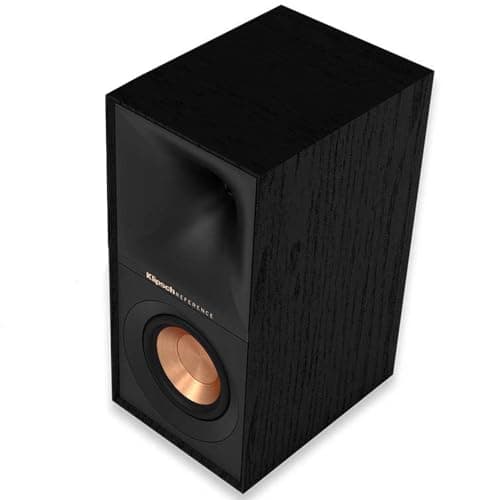
A small passive two-way with a 4-inch spun-copper TCP woofer and a 1-inch aluminum LTS tweeter on a 90x90 square Tractrix horn, published at 91 dB in-room sensitivity and 8 ohms compatible. That sensitivity means it plays loud on modest amplification, which makes it the cheapest sensible partner for a small integrated amp. The 71 Hz bass limit is the honest trade — this is a speaker for detail and efficiency, not for low end.
Strengths
- 91 dB sensitivity — a 20 W amp drives these to genuinely loud levels
- Horn-loaded 1" aluminum LTS tweeter gives the presence Klipsch is known for
- Full published response, impedance and crossover figures, unusual at the price
Trade-offs
- The 4" woofer runs out of bass at 71 Hz — no low end without a subwoofer
- The horn's forward treble is a taste; bright pressings can sound brighter still
- Rear-firing ports, so it turns boomy pushed hard against a wall
| Type | Passive 2-way bookshelf, bass-reflex (rear ports) |
|---|---|
| Woofer | 4" spun-copper TCP |
| Tweeter | 1" aluminum LTS on a 90x90 square Tractrix horn |
| Frequency response | 71 Hz - 21 kHz +/-3 dB |
| Sensitivity | 91 dB in-room (2.83 V / 1 m, half-space anechoic) |
| Impedance | 8 ohms compatible |
| Crossover | 1,770 Hz |
| Power handling | 50 W continuous / 200 W peak |
| Cabinet | MDF, 11.7 x 5.8 x 8.5", 7 lbs each |
Specifications read from the manufacturer / product listing, accessed 2026-09-29. We have not measured this unit — what we do instead.
Price as of October 15, 2026. #ad How we’re funded
The number that matters: 91 dB
Klipsch publishes 91 dB sensitivity for the R-40M, qualified on their own spec sheet as an in-room figure measured at 2.83 V into half-space. On a small bookshelf speaker that is a high number, and it is the single most consequential specification on the sheet.
Read the qualification honestly: an in-room, half-space measurement flatters a speaker relative to a full-anechoic one, so treat 91 dB as a figure to compare against other Klipsch models rather than as a laboratory absolute. Even discounted, it sits well above the class.
Sensitivity is how loud a speaker plays for a given electrical input, and the arithmetic is unforgiving in a useful way: 3 dB of extra sensitivity is worth a doubling of amplifier power. A typical competitor at 86–87 dB needs roughly twice the amplifier for the same volume. An 85 dB speaker needs four times.
What that buys you in practice:
- A cheaper amplifier does the job. A 25–30 W integrated amp drives these to volumes most people never reach at home.
- You stay out of clipping. The commonest way to kill a tweeter is an underpowered amplifier pushed past its limit. High sensitivity keeps the amplifier working well inside itself.
- Budget shifts to the source. If the speakers do not force you into a large amplifier, the money can go into the turntable and cartridge instead — which is where it does more good.
This is also why the R-40M appears in our amplifier-and-speaker pairings as the middle recommendation: it makes a modest receiver behave like a bigger one.
What a Tractrix horn is doing
The tweeter is a 1-inch aluminum dome, but it is not firing directly into the room. It sits behind a 90x90 square Tractrix horn — a flared waveguide with a specific mathematical profile. Klipsch describes the Next-Generation horn as having larger outer dimensions than the one it replaces, which is their stated reason for claiming directivity control across a wider band of frequencies.
A horn does two things. First, it acts as an impedance match between the small, stiff tweeter diaphragm and the large volume of air in the room, which is where a large part of that 91 dB sensitivity comes from. Second, it controls dispersion: the “90x90” means the horn is designed to spread sound across roughly 90 degrees horizontally and vertically and not much beyond.
Controlled dispersion is genuinely useful in a small or reflective room, because less high-frequency energy is thrown at the side walls and ceiling to arrive back at your ears late and smeared. It is also why Klipsch speakers reward being aimed at the listening position rather than pointed straight down the room.
The cost is that horns sound different. More immediate, more forward, and to some listeners harder than a conventional dome. Klipsch’s Linear Travel Suspension is their answer to that — a low-mass Kapton suspension intended to reduce distortion in the tweeter’s movement. Whether the result reads as “detailed” or “bright” is a genuine taste question, and we have not heard this pair, so we are describing the design rather than pronouncing on the sound — see how we pick.
71 Hz: the honest limitation
Klipsch publishes a frequency response of 71 Hz – 21 kHz ±3 dB. The number to look at is the 71.
A four-inch woofer in a small cabinet cannot move enough air to produce deep bass, and no amount of engineering changes that. Below 71 Hz the output falls away. In musical terms, that is the bottom of a bass guitar’s range and most of what a kick drum contributes below its attack.
Two honest readings of the same fact. On one hand, plenty of music lives entirely above 71 Hz and the R-40M will play it complete — and a small box that does not attempt deep bass often sounds tighter in the upper bass than one that tries and fails. On the other, if you listen to electronic music, hip-hop or organ recordings, you will notice what is missing and you should either buy a larger speaker like the ELAC B5.2 or Q Acoustics 3030i or plan for a subwoofer. Staying inside the brand, the step that buys low end is the R-50M: Klipsch publishes 58 Hz for it against this speaker’s 71, from a 5.25-inch woofer rather than a 4-inch one. Our Klipsch roundup sets the two published tables side by side.
The cabinet, the woofer and the ports
The woofer is a 4-inch spun-copper TCP cone — thermoformed crystalline polymer, which Klipsch says it borrowed from the Reference Premiere line for its steeper cone angling and added ribbing. The copper color is Klipsch’s long-running visual signature rather than an acoustic property.
The cabinet is MDF in a textured wood-grain vinyl finish, at 11.7 by 5.8 by 8.5 inches and 7 lbs each, and it is bass-reflex via rear-firing ports. That port placement is a real constraint rather than a detail: a rear-ported speaker shoved against a wall gets a boomy upper bass, so leave a few inches behind them or accept the coloration.
Nominal impedance is published as 8 ohms compatible, which makes these an easy load, and the crossover sits at 1,770 Hz. Any amplifier rated for 6–16 ohms or 4–8 ohms will drive them without complaint, and that includes the inexpensive stereo receivers with phono inputs in our amplifier roundup.
Setting them up for vinyl
Three things matter more than usual with a horn-loaded speaker:
- Toe them in. Controlled dispersion means aiming matters. Point each speaker at the listening position rather than straight ahead, and the stereo image tightens noticeably.
- Get the tweeters near ear height. The vertical dispersion is also about 90 degrees, so a speaker on a low shelf firing past your knees is throwing its treble at the floor. Stands or a shelf at seated ear height.
- Keep them away from the turntable. This applies to every speaker in a vinyl system but especially to efficient ones, because they will be producing more sound pressure for the same amplifier setting. Speaker energy reaching the plinth becomes acoustic feedback — see troubleshooting.
Who should buy them
Buy the R-40M if you are building a separates system on a real budget and want the amplifier to be the cheap part; if your room is small; or if you value detail and immediacy over low-end weight.
Buy the ELAC Debut B5.2 instead if you want more bass extension and a more relaxed balance for the same sort of money, accepting that you will need a bit more amplifier. Buy a powered pair instead if you would rather not own an amplifier at all — the trade is set out in powered vs passive.
Frequently asked questions
How much power do the Klipsch R-40M need?
Very little by the standards of the category. Klipsch publishes 91 dB in-room sensitivity, measured at 2.83 V into half-space, which means 20-30 W per channel is comfortably enough for a normal room. Power handling is quoted at 50 W continuous and 200 W peak, so most amplifiers are within range.
Do the Klipsch R-40M need a subwoofer?
For most music, no. For bass-heavy material in a larger room, they benefit from one. Klipsch publishes a frequency response of 71 Hz to 21 kHz +/-3 dB, so the bottom octave and a half of a recording is simply not there. That is normal for a 4-inch woofer and it is the price of the size.
What is the difference between the Klipsch R-40M and the R-41M?
The R-40M is the Reference Next-Generation replacement for the R-41M, which has been discontinued. The headline changes are a redesigned 90x90 square Tractrix horn, a spun-copper TCP woofer in place of the older IMG cone, and a slightly different published response: 91 dB in-room sensitivity and 71 Hz at the bottom, against the R-41M's 90 dB and 68 Hz. Power handling, impedance and cabinet material are unchanged.
Are the Klipsch R-40M good for vinyl?
They suit vinyl well for two specific reasons. Their high sensitivity means a small integrated amplifier with a phono input drives them properly, keeping the system simple. And their forward, detailed presentation flatters the midrange where most of a record's information sits. If you want warmth and weight rather than clarity, a larger, less sensitive speaker will suit you better.
Are Klipsch speakers too bright?
Horn-loaded tweeters are more efficient and more directional than dome tweeters, and that reads as forward or bright to some listeners, especially close up. Klipsch's Linear Travel Suspension design exists to reduce distortion in that tweeter. Whether the balance suits you is genuinely a matter of taste — it is the most polarizing thing about the brand and we will not pretend otherwise.
Do the Klipsch R-40M come as a pair?
Yes, they are sold as a pair. They are passive, so they also need an amplifier or receiver — there is no amplification inside the cabinet.
Can I wall-mount the Klipsch R-40M?
The cabinet is compact at 11.7 by 5.8 by 8.5 inches and 7 lbs each, which makes bracket mounting practical. The ports fire rearward, though, so leave the cabinet room to breathe — a rear-ported speaker pressed flat to a wall gets boomy, and a horn-loaded speaker close to a boundary can sound harder than it should.
Sources
- Klipsch — Reference R-40M spec sheet (PDF) — Manufacturer specs: 91 dB in-room sensitivity, 71 Hz - 21 kHz +/-3 dB, 8 ohms compatible, 1,770 Hz crossover, 50 W / 200 W power handling (accessed August 28, 2026)
- Crutchfield — Home speakers buying guide — Reference on choosing passive vs powered speakers, room size and amplifier pairing (accessed August 11, 2026)
- Crutchfield — Understanding speaker and amplifier wattage ratings — On RMS versus peak power, and matching an amplifier's output to a speaker's rating (accessed August 11, 2026)
Keep reading
Best Bookshelf Speakers for Vinyl
Where this sits against the rest of the passive field.
See the picksAmplifier and Speakers for a Turntable
How to pick the amplifier this speaker is asking for.
Read the guidePowered vs Passive Speakers
Whether a passive speaker is the right architecture for you at all.
Read the comparisonKlipsch R-41M Review
The discontinued model this one replaces, and what changed between them.
Read the archiveBest Klipsch Speakers for a Turntable
Where this sits in the current range, and which Klipsch models take a record player directly.
See the rangeBest Amplifiers for a Turntable
The other half of the system, ranked.
See the picks