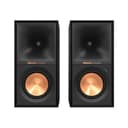
The one question that sorts the whole range
A turntable puts out a signal thousands of times quieter than a phone or a CD player, and a differently shaped one: the RIAA curve has to be undone before it sounds like music. A phono preamp does both jobs. Plug a preamp-less deck into an ordinary line input and you get something faint, thin and trebly — not a fault, just the wrong input. If none of that is familiar yet, read do I need a phono preamp? before you spend anything.
Klipsch answers that question three different ways across this page, and the difference between them is the difference between one purchase and three.
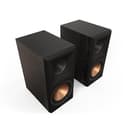
- Phono input, with a ground screw terminal. The R-50PM and the R-40PM. Klipsch’s spec sheet for both prints the analog input as “Phono/Line analog (with switch and ground screw terminal),” and the manual they share has a page headed CONNECTIONS — TURNTABLE. A deck with no preamp of its own plugs straight in, its earth wire lands on a post, and there is nothing else to buy. The Fives II has the phono input too, at four times the money.
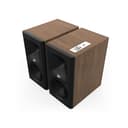
- Phono input, no ground terminal published. The Three Plus. Klipsch’s sheet lists “RCA (with Phono Pre-Amp)” and its manual’s rear-panel legend names only a Phono/Line Input. The phono stage is real; the place to put the turntable’s earth wire is not published. On a deck with a captive ground lead that can mean a hum you cannot chase down.
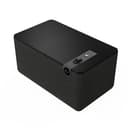
- No amplifier at all. The R-40M, R-50M and RP-600M II are passive. They have binding posts and nothing else. You supply an amplifier and a phono stage, whether as two boxes or as one integrated amp with a phono input. That is not a criticism — it is the traditional hi-fi route and it upgrades better than anything else here — but it means the sticker is the start of the budget, not the end of it.
Our powered versus passive comparison works through that trade in general terms. What follows is how it lands inside this one brand.
How we chose these seven
Five criteria, applied in this order. None of them rests on a listening claim, because we make none.
- It has to be a stereo pair or a stereo system. This ruled out most of the Klipsch catalog in one line: the surround packages, the center channels, the subwoofers, the in-walls, the soundbars, the Atmos-enabled towers. A record has two channels and that is all it will ever have.
- Klipsch has to publish a spec sheet for it. Every model here has a PDF on Klipsch’s own servers listing frequency response, drivers, enclosure type, inputs and dimensions. That is where every number in the tables above came from. It is also why the powered models show “Not published” against sensitivity — Klipsch prints no such row for them, and we are not going to invent one.
- It has to be currently purchasable. Every one of the seven was confirmed as a live listing with a real price on the day this page was published. That test is what removed the R-41M, which we still keep a review of for reference, and the older R-15M and R-51M, which Klipsch no longer lists as current Reference models.
- The seven have to differ from one another. There is no point ranking three speakers that do the same job at the same price. The spread here is deliberate: two woofer sizes in the passive Reference line, the same two in the powered line, one single-cabinet system, and one Reference Premiere pair for people running small amplifiers.
- Every pick has to survive its own trade-offs section. If we could not write three honest drawbacks from the published data, the pick did not belong on the page. Read them — on this brand more than most, the drawbacks are where the buying decision actually lives.
Sensitivity is the Klipsch number, and here is how to read it
Everything Klipsch is known for traces back to one design decision: the horn. A horn loads the tweeter so that more of the amplifier’s power becomes sound and less becomes heat, and the published consequence is sensitivity — how loud a speaker plays for a given input. Klipsch publishes it for every passive model and it is the single most useful figure on the sheet.
The three passive picks here read 91 dB (R-40M), 92 dB (R-50M) and 94.5 dB (RP-600M II). Every 3 dB of sensitivity halves the amplifier power needed to reach the same level, so the 3.5 dB between the cheapest and the dearest is rather more than a halving. In practice that is the difference between needing a real integrated amplifier and getting away with a small, cheap one, which is exactly why Klipsch turns up so often on the end of low-power tube amps.
Two honest caveats. First, Klipsch footnotes all three figures the same way: “SPL at 1M, half-space anechoic with 2.83V input,” and labels the Reference numbers in-room. Half-space measurement flatters a speaker against a true free-field figure, so these numbers are best read against each other rather than against another brand’s. Second, sensitivity tells you about loudness, not about tone. A 94.5 dB speaker is not a better speaker than an 88 dB one; it is an easier one to drive.
The powered models publish nothing comparable, and that is not an oversight. An active speaker has its amplifier matched to its drivers at the factory, so sensitivity and nominal impedance stop being facts you need. What Klipsch publishes instead is total system power — 70 W for the R-40PM, 120 W for the R-50PM, 120 W for The Three Plus — and a maximum output figure in dB. Those are not interchangeable with sensitivity and this page does not treat them as though they were.
What the passive route actually costs
The R-50M is the best-sounding value on this page on paper, and it is also the one most likely to be bought by accident. A passive speaker plugged into a turntable does nothing at all — no quiet sound, no thin sound, silence. Between the deck and an R-50M there has to be a phono stage and an amplifier, and the honest way to compare it with the R-50PM is to add those in.
Three routes work, and they land in different places:
- A turntable with its own switchable preamp, plus a basic integrated amplifier. The cheapest way in. Most decks in the $200-$400 band have a built-in phono stage with a PHONO/LINE switch; set it to LINE and any line-level amplifier works. Budget for the amp as a real line item, not an afterthought.
- An amplifier with a phono input. One box instead of two, and the arrangement we usually recommend for passive speakers. Our amplifier roundup flags which models include the phono stage, because it is the difference between finishing the system today and buying again.
- A separate phono box plus a power or integrated amp. The most flexible and the most expensive. It is also the route that best suits the RP-600M II, because at 94.5 dB it will expose a noisy phono stage that a less sensitive speaker would have buried.
None of that makes passive the wrong answer. It upgrades in a way active speakers cannot: you can change the amplifier, change the phono stage, change the cartridge, and keep the speakers for twenty years. It does mean that if the R-50M and the R-50PM look like a $150 decision, they are not.
One more cost people forget on the passive side: stands. All three passive picks are meant to sit with the tweeter near ear height, and the RP-600M II in particular is a 15.75-inch cabinet that will dominate a shelf. Our speaker stand roundup has the arithmetic for working out the height you need, and it matters especially in a vinyl system, where getting the speakers off the turntable’s furniture removes a real feedback path.
If you searched for vintage Klipsch
It is one of the most common ways people arrive at this brand, and it usually means one of two different things.
If it means the look — real wood veneer, a squat rectangular box, visible cloth — then Klipsch still makes it new. The Heritage line is hand-assembled in Hope, Arkansas, and Klipsch’s own Heritage page currently lists the Heresy IV, Forte IV and Cornwall IV alongside La Scala and Klipschorn. They are magnificent, they are exactly the thing people picture, and every one of them is a floorstander costing several times the most expensive speaker on this page. We have not put them here because this is a bookshelf page, not because they are a bad idea. If the budget is there and the room is there, Heritage is the most obviously vinyl-shaped thing Klipsch builds.
If it means actually old — an early Heresy, a KG-series pair, a set of Quartets off a local listing — then this page cannot help you, and we would rather say so than pretend. We only cover products with a current listing and a published spec sheet, because that is the only way to keep the numbers on this site honest. Used Klipsch is a genuinely good way to buy speakers, but it is a secondhand-market skill: check the surrounds, check the crossover caps have been looked at, and listen before you pay.
What we left out, and why
- ProMedia 2.1. The best-known Klipsch computer speakers, and a perfectly good desktop 2.1 system — but Klipsch publishes its connections as a headphone jack and a miniplug input. There is no phono input and no RCA input, so a turntable would need a separate phono preamp and an adapter. If you searched for Klipsch computer speakers because there is also a record player on the desk, the R-40PM is the honest answer: same brand, same horn, and Klipsch badges it PC READY and TURNTABLE READY on the same sheet.
- The R-41M. Discontinued, and replaced in the Reference Next-Generation line by the R-40M that sits at number three here. What is left on the retail shelf is end-of-line stock at unpredictable prices. Our original R-41M review stays up as an archive with the discontinuation noted and no buy link.
- The R-51M and R-15M. Both still have listings, and both belong to Reference generations that Klipsch has superseded. Buying the current generation at a similar price is the better call, which is what the R-50M is.
- Everything designed for a screen. The Cinema soundbars, the surround bundles, the center channels, the subwoofer range. A record has two channels; a 5.1 package sold at a bookshelf-pair price is spending your money on speakers your turntable will never feed.
- The Reference Premiere floorstanders. Out of scope for a bookshelf page, and out of the price band this site covers. The RP-600M II is the bookshelf end of that same line, and it carries the Cerametallic woofer and the titanium tweeter the towers use.
Setting a turntable up with any of these
- Decide where the phono stage lives, once. It must exist exactly once in the chain. If your deck has a PHONO/LINE switch and you are using the R-50PM’s phono input, set the deck to PHONO and the speaker to PHONO. If the deck is set to LINE, set the speaker to LINE too. Doubling up sounds distorted and shrill; leaving it out entirely sounds faint and thin.
- Land the ground wire. Most turntables have a thin spade lead separate from the RCAs. On the R-40PM and R-50PM it goes on the ground screw terminal. On a passive system it goes on the amplifier’s GND post. If there is nowhere to put it and you get hum, that is the cause, and our troubleshooting guide works through the rest of the sequence.
- Get the speakers off the turntable’s furniture. A cartridge cannot tell vibration arriving through a shelf from vibration in the groove. Sharing a sideboard with a horn-loaded speaker is the classic way to build a low howl that gets worse as you raise the volume.
- Leave the rear ports room to breathe. Every passive pick here and both powered Reference pairs are bass-reflex through a rear port. Pushed flat against a wall they get boomy, and on a turntable that boom feeds straight back into the plinth.
- Then set the tweeter near ear height. It is the cheapest change on this list and the one people skip. On the horn-loaded models it matters more than usual, because a Tractrix horn is a directivity device — aiming it is part of the design.