PLATTER & PLINTH

Best Record Players With a Radio

Four one-box music centers that also tune AM or FM, ranked on the tuner specification each maker prints - because only one of the four publishes how its radio actually tunes.

By Stephen V.Last updated How we pick

The verdict

The Jensen JMC-1250 is the record player with a radio to buy.It is the only one of these four whose maker publishes a real tuner specification rather than the word “radio” in a feature list: AM/FM with PLL digital tuning and 20 AM plus 20 FM presets, with a backlit display and a remote to reach them. It suits a person who will actually listen to stations — who wants presets, not a dial to hunt along. The budget pick is the Crosley CR704B Musician, the cheapest cabinet here with an AM/FM tuner inside, for someone who wants the radio as a bonus rather than as the reason to buy. If the cabinet matters more than the tuner, the Victrola Empireis the wood one — but read the band note below first, because it is FM only.

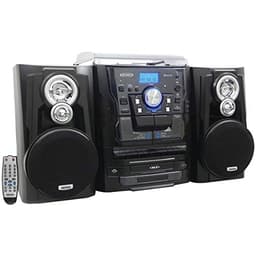
Jensen JMC-1250

Best overall

Jensen JMC-1250

Crosley CR704B Musician 8-in-1

Budget pick

Crosley CR704B Musician 8-in-1

$139.36 · View on Amazon

Price as of November 22, 2026. #ad How we’re funded

A record player with a radio is a music center: one cabinet holding a turntable, a tuner, usually a CD tray, usually a cassette deck, Bluetooth and a pair of small speakers. It is the format our turntable and CD player combo roundup covers from the disc side, and the radio is the part buyers ask about most often and get told the least about.

That is the problem this page exists to solve. Every maker here lists “AM/FM” or “radio” among the sources. Exactly one of them — Jensen — publishes how the tuner works: PLL digital tuning, 20 AM presets and 20 FM presets. One of them, the Victrola Empire, lists FM and does not list AM at all. And one cabinet you will see recommended alongside these, the Victrola Century, does not have a radio: its own six sources are vinyl, CD, cassette, Bluetooth and aux, with no tuner among them. It is a fine machine and it is on our cassette roundup— it is simply not a radio.

None of these four publishes a cartridge or a tracking force, which is the real cost of buying music this way. If record wear matters to you more than station presets, stop here and read are suitcase record players bad and then the separates shortlist instead.

How this is funded: we earn a commission if you buy through our links, at no extra cost to you. It never changes which product we recommend, and we’ll tell you plainly when to skip one. Full disclosure.

Quick picks

Ranked on published specs, drive/motor design and buyer fit. Select a row to jump to the full write-up. We have not heard most of these units — here is exactly what we do instead.

#ProductBest forPrice
1
Jensen JMC-1250

Jensen JMC-1250

The one to buy if the CD half is the half you care about, and not by a small margin: it is the only pick here with a three-disc CHANGER rather than a single tray, it plays MP3 CDs and home-burned CD-R/RW discs, and it adds programmable memory, random play and repeat across one disc or all three. A remote and a backlit display come with it, which matters more than it sounds when the unit lives across the room.

Best overall
2
Crosley CR7025A Hayes 8-in-1

Crosley CR7025A Hayes 8-in-1

The only combo here that publishes what is under the lid: a belt-drive DC motor, a cueing lever, turntable auto-stop, 10 W RMS of amplification and an 80 Hz - 20 kHz frequency response. Its rivals in this class list their sources and stop. It also carries the most of them — vinyl, CD, cassette, AM/FM, Bluetooth, aux, USB playback, and an RCA output so the sound can leave the box.

Best with a line out
$186.35 · View on Amazon

Price as of November 22, 2026. #ad How we’re funded

3
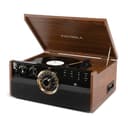
Victrola Empire 6-in-1

Victrola Empire 6-in-1

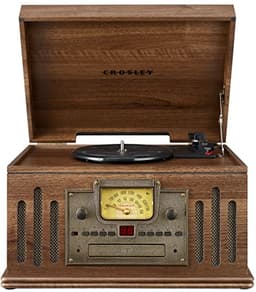
The one bought for the room as much as for the records: a wide wood cabinet with a lit analog radio dial and gold accents, playing vinyl, CDs, cassettes, FM radio, Bluetooth and aux. An RCA line output is listed and the cable is in the box, which is the detail that keeps a furniture-first purchase from becoming a dead end.

Best cabinet
$209.99 · View on Amazon

$289.9928% off

Price as of November 22, 2026. #ad How we’re funded

4
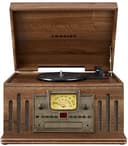
Crosley CR704B Musician 8-in-1

Crosley CR704B Musician 8-in-1

The cheapest way into a full-format combo that still gives you a cueing lever. Vinyl at three speeds, CD, cassette, AM/FM, Bluetooth in and an aux input, in a walnut-finish cabinet. It is essentially the Hayes with the published specs and the RCA output taken away, for meaningfully less money.

Best value
$139.36 · View on Amazon

Price as of November 22, 2026. #ad How we’re funded

The picks in full

#1Best overall

Jensen JMC-1250

The one to buy if the CD half is the half you care about, and not by a small margin: it is the only pick here with a three-disc CHANGER rather than a single tray, it plays MP3 CDs and home-burned CD-R/RW discs, and it adds programmable memory, random play and repeat across one disc or all three. A remote and a backlit display come with it, which matters more than it sounds when the unit lives across the room.

Strengths

  • Three-disc CD changer, MP3 CD and CD-R/RW compatible, with programmable memory, random play and repeat-all
  • Dual auto-stop cassette deck and a PLL-tuned AM/FM receiver with 20 AM and 20 FM presets
  • Three-speed deck with pitch control, a dust cover, a remote and a backlit display

Trade-offs

  • The biggest cabinet here — 25 lb and roughly 15 x 16 x 12 in; this is furniture, not a portable
  • The listing names Bluetooth but never says whether it transmits as well as receives
  • Drive type, cartridge and tracking force are not published, and no line output is listed
TypeAll-in-one music center (turntable, 3-CD changer, dual cassette, radio)
PlaysVinyl, CD (incl. MP3 CD and CD-R/RW), cassette, AM/FM, Bluetooth
SpeedsThree-speed (the listing does not name the three)
CD loadingThree-disc changer
CassetteDual deck, auto stop
RadioAM/FM, PLL digital tuning, 20 AM + 20 FM presets
ExtrasRemote, pitch control, dust cover, 5-mode preset EQ, backlit LCD, clock / sleep / timer
Size15.0" x 16.1" x 12.0", 25 lb
DriveNot published
CartridgeNot published

Note. A dust cover is not a small thing on a combo. Most units in this class leave the platter under a lid you raise to reach the CD well, and dust on a stylus is the fastest route to a noisy record.

Specifications read from the manufacturer / product listing, on September 29, 2026. “Not published” means the maker does not state that figure.

#2Best with a line out

Crosley CR7025A Hayes 8-in-1

The only combo here that publishes what is under the lid: a belt-drive DC motor, a cueing lever, turntable auto-stop, 10 W RMS of amplification and an 80 Hz - 20 kHz frequency response. Its rivals in this class list their sources and stop. It also carries the most of them — vinyl, CD, cassette, AM/FM, Bluetooth, aux, USB playback, and an RCA output so the sound can leave the box.

Strengths

  • Publishes drive type, output power and frequency response — rare in this class
  • Cueing lever and auto-stop, so the arm is lowered and lifted mechanically
  • RCA output means you can drive real speakers later instead of being stuck

Trade-offs

  • 10 W RMS into two small in-cabinet drivers is background-listening power, not hi-fi
  • Cartridge type and tracking force are not published, so record wear is unknowable up front
  • The most expensive of the two Crosleys, and the CD tray is the same basic mechanism
TypeAll-in-one music center (8-in-1)
PlaysVinyl, CD, cassette, AM/FM, Bluetooth, aux, USB
Speeds33 1/3, 45 and 78 RPM
DriveBelt drive, DC motor
Arm convenienceCueing lever and auto-stop
Amplifier power10 W RMS (5 W RMS x 2), 20 W peak
Frequency response80 Hz - 20 kHz
OutputsRCA line out, headphone jack
CartridgeNot published

Note. Read that frequency response honestly: 80 Hz is where the cabinet stops, roughly the bottom of a cello. A combo like this is for hearing a record, not for feeling it.

Specifications read from the manufacturer / product listing, on August 28, 2026. “Not published” means the maker does not state that figure.

#3Best cabinet

Victrola Empire 6-in-1

The one bought for the room as much as for the records: a wide wood cabinet with a lit analog radio dial and gold accents, playing vinyl, CDs, cassettes, FM radio, Bluetooth and aux. An RCA line output is listed and the cable is in the box, which is the detail that keeps a furniture-first purchase from becoming a dead end.

Strengths

  • Wide wood cabinet with a lit analog dial — the most convincing console look here
  • RCA line output with the cable included, so external speakers need no extra purchase
  • Physical input-select and volume knobs rather than a menu

Trade-offs

  • The priciest pick, and the premium buys cabinet rather than mechanism
  • FM only — AM is not listed, unlike the two Crosleys and the Jensen
  • Drive type, cartridge and output power are all unpublished
TypeAll-in-one music center (6-in-1), wood cabinet
PlaysVinyl, CD, cassette, FM radio, Bluetooth, aux
Speeds33 1/3, 45 and 78 RPM
BluetoothIn (output not listed)
OutputsRCA line out (cable included), headphone jack
RadioFM (AM not listed)
DriveNot published
CartridgeNot published

Note. A wide cabinet is an acoustic decision as well as a decorative one: the two drivers sit further apart than on a compact combo, which is the only way a one-box player gets real stereo separation.

Specifications read from the manufacturer / product listing, on August 28, 2026. “Not published” means the maker does not state that figure.

#4Best value

Crosley CR704B Musician 8-in-1

The cheapest way into a full-format combo that still gives you a cueing lever. Vinyl at three speeds, CD, cassette, AM/FM, Bluetooth in and an aux input, in a walnut-finish cabinet. It is essentially the Hayes with the published specs and the RCA output taken away, for meaningfully less money.

Strengths

  • Cueing lever on the cheapest combo here, so the stylus is lowered mechanically
  • Covers all four physical formats plus Bluetooth streaming in
  • Walnut-finish cabinet rather than the molded plastic common at this price

Trade-offs

  • No RCA output listed — the headphone jack is the only way the sound gets out
  • No published drive type, output power or frequency response
  • Bluetooth is receive-only, so records cannot be streamed to a better speaker
TypeAll-in-one music center (8-in-1)
PlaysVinyl, CD, cassette, AM/FM, Bluetooth, aux
Speeds33 1/3, 45 and 78 RPM
Arm convenienceCueing lever
OutputsHeadphone jack (RCA output not listed)
BluetoothIn (output not listed)
DriveNot published
CartridgeNot published

Note. The missing line output is why this ranks below the Hayes rather than above it on value. Without one, the built-in speakers are the ceiling for as long as you own it.

Specifications read from the manufacturer / product listing, on August 28, 2026. “Not published” means the maker does not state that figure.

How these were ranked

  • What the maker publishes about the tuner, first.A radio is either a usable appliance or a line in a feature list, and the difference shows up in the specification. Jensen publishes PLL digital tuning and forty total presets; the other three publish the letters “AM/FM” or “FM” and nothing else. We did not estimate sensitivity, signal-to-noise or antenna type for any of them, because none of the four states those figures.
  • Which bands are actually listed.The Victrola Empire’s published source list says FM radio. AM is not among the six sources. If you listen to AM talk or sport, that is a dealbreaker on an otherwise lovely wooden cabinet, and it is the single most important line on this page.
  • Whether the sound can leave the box. An RCA line output turns a music center from a closed appliance into a source you can grow out of: it can feed real powered speakers later. The Crosley Hayes and the Victrola Empire both publish an RCA line out. The Crosley Musician publishes a headphone jack and does not list an RCA output at all, which is why it sits at the value end rather than the top.
  • Published amplifier power, where it exists. Only the Hayes prints one: 10 W RMS, as 5 W per channel, with a 20 W peak figure. That is a small number and an honest one. The others publish nothing, so the table says so.

What a music center radio is good at, and what it is not

The honest case for this category is convenience in one plug. You want your records, your CDs, the local station in the kitchen and your phone over Bluetooth, and you want all of it in one piece of furniture with one power cord. Every machine here does that. Nothing in separates land does it without four boxes and a shelf.

The honest case against is that the radio is the easiest job in the cabinet and the turntable is the hardest, so a cabinet built to a price tends to spend its money where the customer can see it. None of these four publishes a cartridge type, a tracking force or a wow-and-flutter figure. That is not a coincidence, and it is the same finding our all-in-one roundup reached from the other direction.

If you want the radio andyou care about the records, the better-built route is a separate deck plus a receiver with a tuner in it — the system our turntable-to-receiver guide walks through. That is two boxes instead of one, and it is the trade this page is asking you to make knowingly rather than by accident.

Antennas, because nobody mentions them

Reception on every machine of this type depends on an antenna you may not have noticed: typically a wire FM lead taped to the back of the cabinet, and for AM a small loop or an internal ferrite bar. Jensen is the only maker here that publishes a tuning method at all, and even Jensen does not publish an antenna specification. Practically: unroll the FM wire fully and run it up a wall before you decide a machine has a weak tuner, and keep the cabinet away from the back of a television, which is the loudest interference source in most living rooms.

None of that is a claim about how any of these four sound. We have not heard them. Everything above is read from published specification and listing text, which is the standard this whole site is built on — see our methodology.

Frequently asked questions

What is the best record player with a radio?

The Jensen JMC-1250, because it is the only one whose maker publishes a real tuner specification: AM/FM with PLL digital tuning and 20 AM plus 20 FM presets, reachable from a remote and a backlit display. Every other machine in this class lists the word radio and stops. If you want the cheapest cabinet with a tuner inside, the Crosley CR704B Musician is the budget pick.

Do record players with a radio get AM as well as FM?

Not all of them. The Jensen JMC-1250, the Crosley CR704B Musician and the Crosley CR7025A Hayes all publish AM/FM. The Victrola Empire publishes FM radio only - AM is not listed among its six sources. Check the band list before you buy if AM stations are the reason you want a tuner at all.

Does the Victrola Century have a radio?

No. Its published six sources are vinyl, CD, cassette, Bluetooth and aux - there is no tuner among them, which is why it is not on this page. It is a capable cassette-and-CD cabinet and it appears on our cassette roundup instead.

Can I connect a music center to better speakers later?

Only if it has an RCA line output, and not all of them do. The Crosley Hayes and the Victrola Empire both publish one. The Crosley Musician publishes a headphone jack and does not list an RCA output, so its sound is largely stuck inside the cabinet. If growing into real powered speakers later matters to you, treat the line output as a requirement rather than a bonus.

Are record players with a built-in radio bad for your records?

The radio is irrelevant to record wear; the tonearm and cartridge are what matter, and that is where this category is weakest. None of these four publishes a cartridge model or a tracking force, which means nobody can tell you what the stylus is doing to a groove. If your records are valuable, a separate deck with a published cartridge and an adjustable tonearm is the safer route.

Why do so few of these machines publish tuner specifications?

Because the tuner is a low-cost module bought in rather than designed, and because almost no buyer asks. That makes the one maker that does publish - Jensen, with PLL digital tuning and forty presets - unusually informative by default. We rank on published figures rather than on how a machine is supposed to sound, so a published specification is worth more here than a brand reputation.

Is a radio in the cabinet better than streaming the same station?

They are different things. A tuner picks up a broadcast with no account, no app and no internet connection, and it keeps working when your network does not. Streaming gets you stations outside your transmitter range and usually better audio on a weak signal. Every machine here has Bluetooth as well, so you can do both from the same cabinet - the tuner is the part that works with nothing else switched on.

Sources

Keep reading