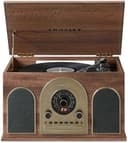
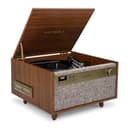
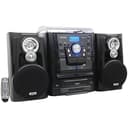
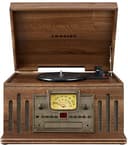
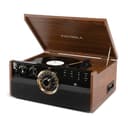
How we ranked them
Every pick above is a real, currently listed product from a named brand, and every specification in its table was read from that product’s own listing. Where a row says Not published, that is not a gap in our research — it is the finding. A manufacturer that will tell you a cabinet is walnut but not what the cartridge is has told you which of the two it thinks you are buying.
The order follows four criteria, applied in this sequence:
- Published mechanical detail. Drive type, output power, frequency response, cueing, auto-stop. Only the Crosley Hayes publishes more than one of these, which is why it leads a list where it is also the most expensive Crosley.
- A way out of the box. An RCA line output, or Bluetooth transmit, or both. Four of the five have one; the Crosley Musician does not, and that single omission is what keeps it out of the top two despite being the cheapest full-format unit here.
- Arm handling. A cueing lever lowers the stylus on a damped descent instead of dropping it. On a player that will mostly be used casually, often by someone else in the house, this is the feature that protects records.
- Format coverage and the CD half specifically. An 8-in-1 that includes AM as well as FM, USB playback and a front-loading tray is genuinely more useful than a 6-in-1 — provided the first three criteria are already satisfied.
We have not listened to these units and do not claim to have. Everything above is reasoning from published specifications and from what the physics of a one-box player allows, which is exactly how our methodology says we work when we do not own the hardware.
What a combo can and cannot do
The honest ceiling on any of these is set by three things that no feature list can talk you out of.
The speakers share a cabinet with the platter. A stylus is a vibration sensor. Put it eight inches from a driver that is producing vibration and some of what you hear is the player hearing itself. Every one-box player manages this rather than solves it, which is why volume beyond conversational level tends to get muddy rather than louder.
Stereo separation is limited by cabinet width. Two drivers a foot apart cannot produce a soundstage. The Victrola Empire does better than the compact units purely because it is wider — that is not marketing, it is geometry.
The bass stops early. The one combo here that publishes a frequency response says 80 Hz. That is roughly the bottom note of a cello, and it is a fair estimate for the rest of the class too. Kick drum and bass guitar fundamentals live below it.
None of that makes a combo a bad purchase. It makes it a specific purchase: a kitchen, an office, a spare room, a gift for someone with inherited records and a shelf of CDs. Judged as that, a well-chosen combo is excellent. Judged as a hi-fi, none of them survive the first hour.
The cartridge question, and why we keep raising it
Not one of the five publishes its cartridge type or tracking force. That matters more here than it would on a CD player, because a stylus that tracks too heavily wears the record itself — damage that does not undo when you upgrade the player later. We explain the mechanism in are suitcase record players bad, and the same logic applies to any player that will not tell you what it tracks at.
The practical rule: play whatever you like on a combo, but keep anything rare, first-pressing or sentimental for a deck with an adjustable counterweight. Replacing the needle is the one piece of maintenance a player in this class asks for — worth doing every year or two on a player in daily use. Our guide to how often to replace a stylus has the hour counts.
The better path, if the CD player is negotiable
Almost everyone who searches for a combo is really solving one of two problems: “I have records and CDs and one shelf,” or “I want one thing to buy.” If it is the second, there is a route worth knowing about, because it costs about the same and sounds like a different hobby.
A proper entry deck with a built-in phono stage, run into a pair of powered speakers, lands in the same total budget as the units on this page. The deck has a real magnetic cartridge with a published tracking force and an adjustable counterweight; the speakers are two separate boxes you can place properly, so there is an actual soundstage and bass below 80 Hz. A standalone CD player, if you still want one, plugs into the speakers’ second input. Start with our turntables for beginners picks and the powered speakers roundup.
If it is the first problem — genuinely wanting CDs and cassettes and radio in one cabinet — then buy the combo, and buy one with a line output. That way the day the built-in speakers start to annoy you costs you a cable rather than the whole unit. Of the five here, four give you that option.
And if you are still weighing up which shelf deserves the money in the first place, our vinyl versus CD comparison covers the parts of that argument that can actually be checked — what wears out, what the running costs are, and the documented case of a famous “all-analog” vinyl line that turned out to have a digital step in the chain.
What to check when yours arrives
Three checks, none of which take more than a minute, that catch most of what goes wrong with a player in this class:
- Speed. Play a familiar record and listen for pitch. Belt-drive units at this price can run slightly fast or slow out of the box; the Jensen has a pitch control specifically so you can correct it.
- The 45 adapter and the speed selector. Playing a 45 at 33 is the single most common complaint filed against every player in this category, and it is not a fault.
- Where it sits. Not on the same shelf as a subwoofer, not on a hollow-topped cabinet, and level — a combo is far more sensitive to footfall and resonance than a separates deck, because the speakers are already inside it. Our turntable setup guide covers placement in more detail.