Are Suitcase Record Players Bad?
Yes, for one specific and mechanical reason — not because of snobbery. Here is exactly what goes wrong, how to tell whether yours is affected, and the cheapest way past it.
How this is funded: we earn a commission if you buy through our links, at no extra cost to you. It never changes which product we recommend, and we’ll tell you plainly when to skip one. Full disclosure.
Yes — the typical suitcase record player is bad for your records, and it is worth being precise about why, because the reason is mechanical and specific rather than a matter of taste. Once you know the mechanism you can also tell which players are affected and which are not, which is more useful than a blanket warning.
Two things this page will not do. It will not tell you your collection is ruined — it almost certainly is not. And it will not tell you the answer is a thousand-dollar turntable. The step that matters costs less than most people assume.
The mechanism: tracking force and the ceramic cartridge
A stylus sits in a groove and is pressed down by a set weight, the tracking force. On a normal turntable with a magnetic cartridge that force is around 1.5 to 2.5 grams— Ortofon specifies 1.8 g for the 2M Red, for instance. It is a carefully chosen number: enough to keep the stylus in the groove, little enough not to deform it.
Suitcase players almost universally use a ceramic cartridge, and a ceramic cartridge works differently. Instead of a magnet moving near a coil, it uses a piezoelectric element that generates voltage when it is physically flexed. Flexing a crystal takes considerably more force than wiggling a magnet, so the stylus has to be pressed much harder into the groove wall to produce a usable signal. Manufacturers of these players commonly set several grams — often two to four times what a magnetic cartridge needs.
Three consequences follow, and they compound:
- Higher force means faster groove wear. The same physical material, pressed harder, deforms sooner.
- The tip is usually conical and often cheap. A conical tip concentrates that force on a small contact patch, and a low-cost diamond wears into flat facets sooner. Facets scrape instead of tracing.
- Nobody replaces it.A stylus is consumable — and a suitcase player owner who does not know that is playing records with a worn tip at high force, which is the genuinely destructive combination.
And because the arm has no counterweight, none of it is adjustable. You cannot dial the force down. That is what makes it a property of the product rather than a setup mistake.
What the damage actually looks like
Being honest about scale matters here, because the internet oscillates between “it is fine” and “you have destroyed everything”.
One play does not ruin a record. A working suitcase player with an intact stylus does not audibly damage a record in a single pass. If you have been using one for a while, put it aside and your records will not deteriorate further.
Repeated plays do accumulate.Groove wear is progressive. It shows up first as loss of high-frequency detail and then as distortion on loud passages, most obviously in the inner grooves where the stylus has the least groove length to work with per second. Once the groove wall is deformed, no cleaning and no better cartridge recovers it — the information is gone.
A damaged stylus is the emergency case. A chipped or broken tip at four grams gouges rather than wears. If a player has been dropped, or the stylus looks bent or has a visible chunk missing, stop using it now.
How to tell whether your player has the problem
Not everything shaped like a suitcase has a ceramic cartridge, and not everything with built-in speakers is a suitcase player. Check these:
- Look up the cartridge in the specifications. “Ceramic” or “piezo” means the problem applies. “Moving magnet”, “magnetic”, or a named cartridge like “Audio-Technica AT-3600L” means it does not.
- Look for a published tracking force.If the manual states a figure and it is above about 3 g, that is heavy. If no figure is published at all, that itself is informative.
- Look for a counterweight. A rotating cylinder on the back of the arm means the force is adjustable, which effectively rules out the ceramic design.
- Ask whether it needs a preamp. A player that drives its own speakers with no phono stage anywhere is a strong hint at a ceramic cartridge, because ceramic output is large enough not to need one.
This is exactly why we separate the two categories on this site. Our all-in-one rounduponly includes players with replaceable magnetic cartridges — the Victrola Eastwood II, for instance, uses an Audio-Technica cartridge. Built-in speakers are not the problem. The pickup is.
What suitcase players are genuinely good at
Two things, and they are real:
They are portable and self-contained. Nothing else plays a record on a picnic table. If that is the use case, nothing on this site competes.
They get people into vinyl. A large share of record buyers started on one, including plenty of people who now own decks costing twenty times as much. Being sniffy about that is both unhelpful and historically inaccurate.
The reasonable position is not “never buy one”. It is: know what it does to records, and do not play anything you care about on it. A suitcase player and a stack of thrift-store LPs is a perfectly good arrangement. A suitcase player and a first pressing is not.
The step that fixes it, and what it costs
The upgrade that matters is a deck with a replaceable magnetic cartridge tracking at a normal force. Everything above that — adjustable counterweights, better platters, elliptical styli — is refinement. This one step is the difference between wearing your records and not.
The cheapest place it happens is a basic automatic like the Audio-Technica AT-LP60X: factory-set tracking force at a sensible figure, a replaceable AT3600L cartridge, and a switchable preamp so it drives powered speakers. It is not expensive relative to a decent suitcase player.
If you want to keep the one-box form, the honest option is an all-in-one with a magnetic cartridge — more expensive than the suitcase, but it is a record player rather than a record grinder.
And if you can stretch, a deck with an adjustable counterweight like the Fluance RT81is where you stop having to think about any of this: you set tracking force to the cartridge’s specification yourself, and you can upgrade the cartridge later. The whole ladder is laid out in best turntables for beginners.
If you are keeping the suitcase player
Three things worth doing:
- Replace the stylus now if it has ever been dropped, looks bent, or has been in use for a long time without replacement. Worn tips do the real damage.
- Keep records clean. Grit under a heavy stylus is an abrasive being pressed into the groove. See how to clean vinyl records.
- Keep your valuable records off it. The simplest and most effective rule on this page.
And if the appeal was portability rather than the case itself, note that a suitcase player is not the only answer — our portable record player picks cover the battery-powered and compact-wireless routes alongside it, with the cartridge differences stated. If you are weighing a Victrola against an Audio-Technica specifically, our Audio-Technica vs Victrola comparison separates the suitcase players from the one Victrola that fits a replaceable cartridge.
Three ways out, at three prices
You do not have to spend a fortune to get past the ceramic-cartridge problem. The step from a suitcase player to a deck with a replaceable magnetic cartridge is the one that matters; everything after that is refinement.
If you want the all-in-one form
Victrola Eastwood II
An all-in-one you won't have to throw away later
The cheapest safe separate deck
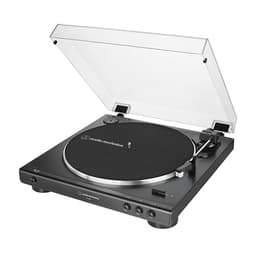
Audio-Technica AT-LP60X
A safe, genuinely automatic first deck under $200
The one you will not outgrow
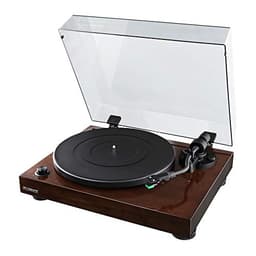
Fluance RT81
First serious turntable that you won't outgrow in a year
Price as of October 14, 2026. #ad How we’re funded
Frequently asked questions
Are suitcase record players bad for your records?
The typical ones are, yes. Most use a ceramic cartridge on a fixed arm tracking at several grams — far heavier than the 1.5-2 g a magnetic cartridge uses — with a conical tip that is often worn and rarely replaced. That combination accelerates groove wear. The damage is gradual and permanent.
Will a Crosley or similar suitcase player ruin my records in one play?
No. A single play on a working suitcase player with an undamaged stylus does not destroy a record. The problem is cumulative — dozens of plays at high tracking force with a worn tip measurably degrade a groove. If you have been using one, your records are not written off; stop using it and they will not get worse.
Why do suitcase record players track so heavily?
Because the tonearm has no counterweight. Automation and simplicity require a fixed arm at a known force, and the manufacturer sets that force high deliberately — a heavy stylus is far less likely to skip, and skipping generates more complaints than slow groove wear does.
What is wrong with a ceramic cartridge?
A ceramic (piezoelectric) cartridge needs a much stronger mechanical push from the groove to produce its output than a magnetic one does, which is why it must track heavily. It also produces a signal that does not need RIAA correction in the usual way, which is why these players do not need a phono preamp — and it has no meaningful upgrade path.
Are all all-in-one record players bad?
No, and this is the distinction worth making. The problem is the ceramic cartridge and fixed heavy arm, not the built-in speakers. All-in-ones that fit a replaceable magnetic cartridge — an Audio-Technica AT-3600L, for example — track at sensible forces and are not damaging your records. Check the cartridge specification before dismissing or buying one.
What is the cheapest turntable that will not damage records?
A deck with a replaceable magnetic cartridge tracking at a normal force. The Audio-Technica AT-LP60X is the standard answer at the bottom of that category: fully automatic, factory-set tracking force, a replaceable AT3600L cartridge, and a switchable preamp so it works with powered speakers.
Can I upgrade the stylus on a suitcase record player?
Sometimes a like-for-like replacement is available, and if yours has a visibly worn or chipped stylus that is worth doing immediately — a damaged tip does far more harm than a merely heavy one. But you cannot upgrade to a better cartridge, because the arm has no counterweight to rebalance.
Sources
- Crutchfield — How to choose the right turntable — Buying-guide reference on drive type, cartridges, preamps and setup (accessed July 24, 2026)
- Crutchfield — Phono cartridge guide — Reference on cartridge types, styli and mounting (accessed July 24, 2026)
- Library of Congress — Caring for and cleaning grooved discs — Preservation guidance on cleaning and storing records to prevent damage (accessed July 24, 2026)
- Elusive Disc — Turntable setup guide: tracking force & anti-skate — Step-by-step on balancing the tonearm, setting tracking force and anti-skate (accessed July 24, 2026)
Keep reading
The Best Vinyl Gifts
The well-meant vinyl gift to avoid, and three that actually work.
See the picksDo Cheap Turntables Ruin Records?
The wider version of this question, across every price point.
Read the guideBest All-in-One Record Players
The all-in-ones that use a proper magnetic cartridge.
See the picksBest Record Players Under $200
What the same money buys if you skip the suitcase.
See the picksBest Turntable and CD Player Combos
The other one-box class, and which of them will tell you what the stylus is.
See the combosHow to Clean Vinyl Records
The other thing that determines how long a record lasts.
Read the guide