HumminGuru HG01 Review
Ultrasonic cleaning used to start around four figures. This is the machine that moved it into the range of a decent cartridge — and the one piece of record-care equipment that does something a brush physically cannot.
How this is funded: we earn a commission if you buy through our links, at no extra cost to you. It never changes which product we recommend, and we’ll tell you plainly when to skip one. Full disclosure.
The short version
HumminGuru HG01 Ultrasonic
Buy it if you buy used records in quantity. Skip it if your collection is mostly new and you own a brush and a fluid - the arithmetic does not work until the records do.
Strengths
- 40 kHz ultrasonic cavitation reaches into the groove in a way no brush can
- Fully automatic clean and dry cycle — load it and walk away
- Thermal monitoring guards against the water heating enough to warp a record
Trade-offs
- By far the most expensive item on this site — it costs more than most of our turntables
- Needs distilled water and periodic filter maintenance, and cleans one record per cycle
| Type | Ultrasonic record cleaning machine |
|---|---|
| Frequency | 40 kHz, dual transducers |
| Cycle | Automatic clean and dry |
| Water | 350 ml distilled, reusable filtration |
| Safety | Thermal sensor monitors water temperature |
| Record size | 12" |
Specifications read from the manufacturer / product listing, accessed 2026-08-12. We have not measured this unit — what we do instead.
Price as of November 2, 2026. #ad How we’re funded
What it is, in one paragraph
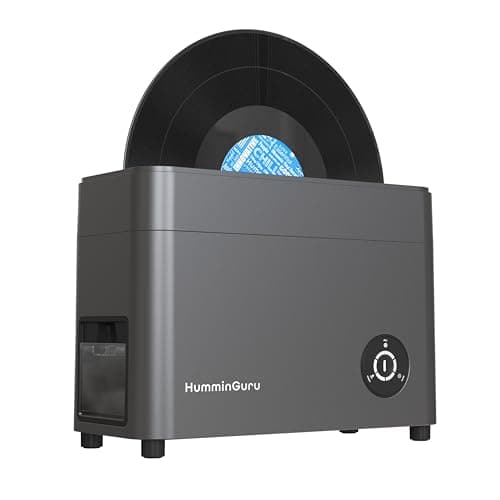
The HG01 is a countertop ultrasonic record cleaner that washes and dries a record without supervision. HumminGuru publishes the model as HG01, the size as 34 x 15 x 27.4 cm, the weight as 3.1 kg, the power input as DC 12 V / 5.0 A and the output power as 45 W, with the machine “compatible with 100v-240v” and automatically cleaning and drying a record “in just 7 to 15 minutes”. The box contains the unit, a cleaner lid, a power cord, a manual, a removable water tank, a maintenance tool and a replacement kit. The retail listing adds the figure HumminGuru’s specification block omits: 40 kHz, with auto drying and a water-reuse filter. We have not run one. Every number here is published by HumminGuru or printed on the live listing, both cited in Sources.
Why ultrasonic is a different category, not a better brush
Most record-cleaning products do the same thing with different ergonomics: they drag something across the surface of the record. A carbon fiber brush does it dry, a wet-brush kit does it with fluid, a vacuum machine does it with fluid and then sucks the fluid away. All of them are limited by the same physical fact — the groove is narrower than the bristle.
An LP groove is a few tens of microns across at the top and narrows from there. A stylus tip rides in the bottom of it. Brush fibers, however fine, sit above that region and move contamination around the upper walls. This is not a criticism of brushes; it is why our cleaning guide puts a dry brush first and treats it as the single highest-value habit in record care. It is simply a limit.
Ultrasonic cleaning works by a different mechanism. Transducers drive pressure waves through liquid at a frequency above hearing, and those waves repeatedly form and collapse microscopic cavitation bubbles. The collapse releases its energy wherever the liquid is in contact with a surface — which, in a tank, is everywhere the liquid reaches, including the full depth of the groove. Nothing has to be small enough to fit. That is the entire argument, and it is a real one.
What it means in practice: the HG01 addresses the contamination that is already down in the groove on a record that has been played dirty, stored badly or handled by strangers for forty years. It is the right tool for the exact problem that makes used records sound noisy after you have brushed them and they still crackle.
The published figures, read properly
45 W output power.This is HumminGuru’s own figure and it is the one that puts the machine in context. Professional ultrasonic tanks run considerably more power across a larger volume. Forty-five watts in a small record-shaped bath is a modest, deliberately gentle arrangement — which is the correct choice for vinyl, because ultrasonic energy is not inherently kind to every material and a record is a soft thermoplastic. Do not read a low wattage here as a weak product; read it as a machine scaled to a record rather than to a gearbox casing.
40 kHz, per the retail listing.Frequency determines bubble size: higher frequencies produce smaller, more numerous cavitation bubbles and a gentler, finer cleaning action, lower frequencies produce larger and more aggressive ones. 40 kHz is the standard choice for delicate work and is what you would want for vinyl. We attribute this to the listing rather than to HumminGuru because it does not appear in the specification block on HumminGuru’s own product page, and its feature pages would not serve an automated request on the date we checked.
7 to 15 minutes, washing and drying combined.One figure, not two — HumminGuru publishes the combined cycle and does not break out separate wash and dry times on that page. The important word is “drying”: the machine finishes the job. A record that comes out of a bath still wet has to be dried without re-contaminating it, and that step is where DIY ultrasonic setups traditionally fall apart. Built-in drying is most of what you are paying for.
3.1 kg and 34 x 15 x 27.4 cm. It is a countertop appliance that lives out, not a thing you put away between uses. Worth knowing before you buy: with a removable water tank and a published cycle of up to a quarter of an hour per record, a cleaning session is a kitchen-counter activity, and the footprint is roughly a large toaster laid on its side.
What is not published, and why that matters here
This site records absences as carefully as figures, and on this product there are several. Not published in HumminGuru’s specification block: the ultrasonic frequency (hence the attribution above), the transducer count, separate wash and dry times, the supported record sizes, the filter specification, the water-temperature cutoff and the warranty terms. HumminGuru’s own feature pages returned HTTP 429 to an automated request on the date we checked, so none of those could be read first-hand from the maker either, and we have not filled any of them in from a retailer or a forum.
Two of those absences have practical consequences. The record sizes one: the machine is a 12-inch design and HumminGuru sells a separate bundle that includes 7-inch and 10-inch adapters, so if singles are a real part of your collection, confirm what is in the box you are ordering rather than assuming. And the filter one: the listing advertises a water-reuse filter system, which implies a consumable, and there is no published service interval or replacement cost for it. Budget for a consumable of unknown price.
Where it fits in a record-care budget
Honestly, for most people, last. The order of spending that actually improves how records sound runs: set the deck up properly, replace a worn stylus, buy a brush and a fluid, replace paper inner sleeves, then consider a machine. The HG01 costs several times what the first four cost together, and it addresses a problem the first four do not create.
The case where it jumps the queue is volume of used records. If you buy in bulk from fairs and bins, you are acquiring groove contamination faster than any manual method clears it, and you are also playing it — which drags abrasive particles under a stylus and does permanent work on both. At that point a machine stops being an indulgence and starts being the thing protecting both the collection and the stylus. Our record cleaning machine roundup ranks it against the vacuum alternatives on exactly that basis.
One more thing it buys that is easy to overlook: it is unattended. A vacuum machine is a job you do; this is a job you start. For a stack of forty thrift-shop records, the difference between standing over a machine and loading one every ten minutes is the difference between the stack getting cleaned and the stack staying in the hallway.
Who should buy it, and who should not
Buy itif used records are how your collection grows, if the collection is big enough that per-record time matters, and if you have counter space for an appliance that stays out. It is the cheapest honest route into a cleaning method that physically reaches where a brush cannot, from a maker that publishes a real specification block for the machine itself — and on this site that last clause is not a small thing in the record-care aisle.
Do not buy it if your records are mostly new. A sealed modern pressing has pressing-release compound and dust on it, not forty years of embedded grime, and a brush and fluidhandle that completely. Do not buy it to rescue damaged records, because cleaning cannot replace deformed vinyl — our guide to spotting a bad pressing covers telling the two apart. And do not buy it before the basics: a deck that is level, a tracking force that is set, and a stylus that is not worn will each do more for your records than any cleaner, and all three are free or nearly so. Our maintenance guide is the cheaper place to start.
Frequently asked questions
Is the HumminGuru HG01 worth it?
It depends entirely on where your records come from. For a collection fed by thrift shops, record fairs and discount bins, it is the only piece of cleaning equipment that reaches groove contamination a brush cannot touch, and it does it unattended in 7 to 15 minutes per record. For a collection of mostly new, sealed pressings, a carbon fiber brush and a bottle of fluid do almost all of the available good for a fraction of the money. The machine does not make a clean record cleaner.
How does ultrasonic record cleaning actually work?
Ultrasonic transducers drive pressure waves through a liquid at a frequency above hearing. Those waves form and collapse microscopic cavitation bubbles, and the collapse releases energy right at the surface the liquid is touching - including inside a groove far narrower than any brush fiber. That is the whole mechanical argument for ultrasonic cleaning: it is the only method that gets into the groove rather than across the top of it. HumminGuru's product page publishes a 45 W output power; the retail listing publishes 40 kHz as the frequency.
How long does one record take?
HumminGuru publishes that the machine "automatically cleans and dries your record in just 7 to 15 minutes" - one combined figure, washing and drying together, with no separate wash and dry times published on that page. Call it four to eight records an hour, unattended. That is slow compared with a brush and fast compared with a vacuum machine you have to stand over.
Does it clean 7-inch and 10-inch records?
The machine is a 12-inch design and adapters for smaller records exist - HumminGuru sells a bundle with 7-inch and 10-inch adapters as a separate product. The supported record sizes are NOT published in the specification block on HumminGuru's own product page, so if 7-inch singles are a significant part of your collection, confirm the adapter situation with the seller before ordering rather than assuming the base machine covers them.
Do I still need a brush if I own one of these?
Yes, and this is the point most ultrasonic coverage skips. The machine handles deep contamination; a carbon fiber brush handles the dust that settles on a record between the sleeve and the platter, which is most of what a stylus actually meets. Our record cleaning kit picks cover the brush-and-fluid layer, and the two jobs are complementary rather than competing. An ultrasonic machine plus no brush is a worse setup than a brush plus no machine.
Will it fix a scratched or badly worn record?
No. Cleaning removes contamination; it cannot replace vinyl that a stylus has already deformed, and it cannot fill a scratch. If a record clicks in the same place every revolution, that is damage and no machine addresses it. Our guide to spotting a bad pressing covers the distinction between dirt, damage and a pressing fault - worth reading before spending money on a machine to solve a problem it cannot solve.
What does HumminGuru not publish?
Four things we would want, and we are not going to supply them from elsewhere: the ultrasonic frequency is absent from the specification block on its own product page (it appears on the retail listing, which is where this site attributes it from), the transducer count is absent, separate wash and dry times are absent, and the supported record sizes, the filter specification, the water-temperature cutoff and the warranty terms are all absent from that page. HumminGuru's own feature pages returned HTTP 429 to an automated request on the date we checked, so none of it could be read first-hand there either.
Sources
- HumminGuru — HG01 ultrasonic record cleaner, published specifications — The maker's own specification block, read live on this date: product name "HumminGuru Ultrasonic Vinyl Record Cleaner", model "HG01", product size "34 x 15 x 27.4 cm", product weight "3.1 kg", input "DC 12V 5.0A", output power "45W". The description adds that it "automatically cleans and dries your record in just 7 to 15 minutes" and is "compatible with 100v-240v", and lists the box contents as the unit, a cleaner lid, power cord, manual, removable water tank, maintenance tool and replacement kit. NOT published on this page: the ultrasonic frequency, the transducer count, separate wash and dry times, the supported record sizes, the filter specification, the water-temperature cutoff and the warranty terms. HumminGuru's own /pages/hg01 and /pages/how-it-works both returned HTTP 429 to an automated request on this date, which is why the 40 kHz figure on this site is attributed to the live retail listing instead (accessed November 2, 2026)
- HumminGuru HG01 — live retail listing (B0BHSFHGF4) — Cited for the one headline figure HumminGuru's own product page does not print. The listing title, resolved live on this date, reads "HumminGuru Ultrasonic Vinyl Record Cleaner Machine, HG01 Dark Gray, 12 Inch | 40kHz Vinyl Record Cleaning Machine with Auto Drying & Water Reuse Filter System, Compact Record Washer LP Deep Cleaning Kit" - so 40 kHz, 12-inch capacity, auto drying and a water-reuse filter are published on the listing. Availability "In Stock" at $599.99 on 2026-11-02 (accessed November 2, 2026)
- Library of Congress — Caring for and cleaning grooved discs — Preservation guidance on cleaning and storing records to prevent damage (accessed July 24, 2026)
- camelcamelcamel — HumminGuru HG01 ultrasonic price history (B0BHSFHGF4) — Tracked since November 28, 2022. Third-party new: lowest ever $479.00 (May 1, 2023), highest $599.99 (July 22, 2024), $599.99 on July 8, 2026, average $538.31. The most expensive gift on this site has never been cheapest in November (accessed September 13, 2026)
Keep reading
Best Record Cleaning Machines
Where this machine sits against the vacuum and wet-brush alternatives, compared on what each maker publishes.
See the picksBest Record Cleaning Kits
The brush-and-fluid layer that an ultrasonic machine does not replace.
See the picksHow to Clean Vinyl Records
The method, in order, from a dry brush to a wet clean - and when to stop.
Read the guideHow to Spot a Bad Pressing
Telling dirt from damage before you spend money trying to wash damage away.
Read the guide