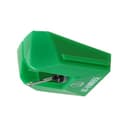
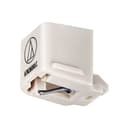
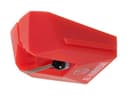
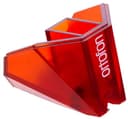
First: find out which stylus your cartridge takes
Styli are not universal. An assembly fits exactly one cartridge family, and the families do not cross over. Before buying, identify your cartridge:
- Look at the cartridge body.The model is usually printed on the side or top — AT-VM95E, 2M Red, MP-110.
- Check the turntable’s manual or product page. Every maker lists the fitted cartridge.
- If your deck has a fixed tonearm— an Audio-Technica AT-LP60X or similar — the stylus is model-specific to the deck. For the AT-LP60X and AT-LP60XBT that is the ATN3600LC.
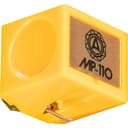
Then match. An AT-VMN95 stylus fits any AT-VM95 body. An Ortofon 2M stylus fits a 2M body. A JN-P110 fits a Nagaoka MP-110. Nothing fits anything else.
How long a stylus lasts
Manufacturers who publish figures generally quote several hundred to around a thousand playing hours, with advanced profiles lasting longer because contact pressure is spread over a larger area. Audio-Technica publishes approximately 300 to 500 hours for the ATN3600LC, which is an unusually specific number in a category where most makers say nothing.
Those are playing hours, not calendar time. An hour a day is roughly a year to eighteen months on a conical tip. Signs it is due:
- High frequencies going dull — cymbals losing shimmer.
- Sibilance turning harsh or spitty, worst toward the middle of a side.
- Distortion appearing on inner grooves, which are hardest to track.
- More surface noise on records you know are clean.
- Visible flat facets on the tip under a loupe or phone macro lens.
Before concluding it is worn, clean it. Dust on the tip produces almost identical symptoms and is far more common — see how to replace a turntable stylus.
Tip profiles, and what upgrading actually changes
This is where the money goes and where the audible difference lives. All four profiles below are available for the VM95 body, which is why that family is the best value in the hobby.
Conical (spherical)
A simple rounded point. Rides relatively high in the groove and cannot follow the finest modulations, which is where high-frequency detail lives. Forgiving of alignment error, which is why fixed-arm decks use it. The ATN3600LC is here.
Elliptical
Narrower side-to-side, so it sits deeper and traces finer detail. The standard first upgrade and the profile on the AT-VMN95E and the Nagaoka JN-P110.
Nude elliptical
The same shape, but the diamond is mounted directly rather than bonded to a metal shank. Less mass at the tip means more accurate tracking at high frequencies. The Ortofon 2M Blue stylus is the best-known example.
Micro-linear and Shibata
Long, narrow vertical contact patches that touch far more of the groove wall. Two consequences: they retrieve detail the simpler profiles physically cannot reach, and they spread contact pressure over more area, which reduces wear on both stylus and record. The AT-VMN95ML is 2.2 x 0.12 mil micro-linear; the AT-VMN95SH is 2.7 x 0.26 mil Shibata.
The catch: advanced profiles are less forgiving. Alignment, tracking force and anti-skate all have to be right or you lose the benefit and wear grooves unevenly. See how to set up a cartridge.
The upgrade trick worth knowing
If you own anyAT-VM95 cartridge — the conical AT-VM95C, the elliptical AT-VM95E, or the version fitted to an AT-LP120X — you never need to buy another cartridge. Buy the stylus.
The AT-VMN95ML costs less than the complete AT-VM95ML cartridge, produces an identical result, and requires no realignment because the body never moves. Ortofon works the same way: the 2M Blue stylus upgrades a 2M Red body, which is exactly what our 2M Red vs 2M Blue comparison recommends.
This is the strongest argument for buying into one of these families in the first place. Every future improvement is a ten-second swap.
Genuine or third-party?
Search any stylus model and you will find branded parts alongside cheaper “compatible” ones. We list only manufacturer parts here, for one reason: a stylus is a diamond of a specific geometry on a cantilever of a specific compliance, and you cannot inspect either at home. A third-party tip with the wrong profile or a stiffer cantilever tracks badly and wears grooves permanently.
The saving is typically $10-30. The risk is your record collection. This is the one place on this site where we would tell you not to economize.
The fixed-arm exception
If your turntable has a fixed tonearm — no counterweight, no anti-skate — you cannot change cartridge or tip profile. The ATN3600LC is a like-for-like conical replacement, not an upgrade.
That is not a reason to skip it. A worn stylus on a fixed-arm deck damages records exactly as much as one on an expensive deck, and this part is the only maintenance that deck accepts. If you want a better tip profile, that needs a deck with an adjustable arm — see automatic vs manual turntables.
Where a stylus sits among everything else you could spend money on is the subject of our upgrade order guide — it comes first, ahead of the cartridge, the phono stage and the mat, and on most cartridge families it is the only upgrade that needs no realignment at all.