Do Cheap Turntables Ruin Records?
Some do, and it is not really about the price. One specification separates a safe $100 record player from one that quietly wears your collection out.
How this is funded: we earn a commission if you buy through our links, at no extra cost to you. It never changes which product we recommend, and we’ll tell you plainly when to skip one. Full disclosure.
Short answer: some cheap turntables damage records and some do not, and the price is not what decides it. A $100 record player with the right cartridge is safe. A $90 one with the wrong cartridge will wear your collection out over dozens of plays.
Here is the mechanism, the specification to check, and how to tell which one you are looking at.
How a turntable damages a record
A record groove is a modulated valley with walls carrying information at a scale measured in microns. A stylus rides in that valley under a downward force. Three things turn that from playback into wear:
1. Excessive tracking force
The weight pressing the stylus into the groove. A properly-specified moving-magnet cartridge tracks at roughly 1.5 to 2.5 grams. The ceramic cartridges fitted to the cheapest record players commonly track at several times that.
More force means more pressure on the groove walls, more friction, more heat at the contact patch, and gradual deformation of the vinyl. The record does not break — it dulls, permanently.
2. A worn or crude stylus tip
A fresh, correctly-shaped stylus rides on the groove wall. A worn one with flat facets presses on edges. Cheap players make this worse in two ways: they use a crude tip profile to begin with, and their stylus is often not replaceable, so it keeps being used long after it should have been retired.
3. No anti-skate
Friction pulls the arm inward as a record plays. Without anti-skate, the stylus presses harder on the inner groove wall than the outer, so one wall wears faster. Cheap players have no anti-skate at all, though this matters less than the first two.
Too littleforce is also damaging, which surprises people. A stylus tracking below specification skitters in the groove, striking the walls instead of riding them. Correct, per the cartridge’s specification, is the only safe setting — see how to set up a cartridge.
The one specification that decides it
Almost everything above reduces to a single question: what kind of cartridge does it have?
Ceramic cartridges — the problem
A ceramic (or crystal) cartridge generates its signal by flexing a piezoelectric element. It produces a high output cheaply, which lets a manufacturer skip the phono preamp entirely. The costs are the ones that matter here: it requires a much higher tracking force to work, and in cheap players it is typically sealed, so the stylus cannot be replaced when it wears.
That combination — high force, no adjustment, no replacement — is what wears records. This is the cartridge in almost every sub-$80 suitcase player.
Magnetic cartridges — the safe option
A moving-magnet cartridge generates its signal from a magnet moving near fixed coils. It tracks at a sane force, its stylus is replaceable, and it is what every deck we recommend uses, including the cheapest.
This is why the Victrola Eastwood II appears on this site while superficially similar players do not: it uses a replaceable Audio-Technica magnetic cartridge. Same form factor, entirely different consequence for your records.
How to check before you buy
- Search the listing for “cartridge”.If it names a brand — Audio-Technica, Ortofon — or says magnetic or moving magnet, that is a good sign.
- Search for “ceramic”. If it appears, walk away unless you only intend to play records you do not care about.
- Look for a replacement stylus. If the manufacturer sells one, the cartridge is designed to be maintained. If no replacement exists anywhere, that tells you what the design assumes.
- Silence is a warning. A listing that says nothing at all about the cartridge, on a very cheap player, is almost always ceramic.
What cheap decks do not do
It is worth being precise, because this topic attracts exaggeration.
- They do not destroy a record in one play. Damage is cumulative over dozens of plays. That is what makes it insidious rather than dramatic.
- They do not scratch records.Scratches come from mishandling — dropping the arm, sliding a record across a surface — not from tracking force.
- A cheap deck is not automatically dangerous. An entry automatic with a magnetic cartridge is completely safe. Price is a proxy, not the cause.
- An expensive deck is not automatically safe. A $600 turntable with a worn stylus or an unbalanced arm damages records too. Setup and maintenance matter more than price.
If you already own one
Don’t panic, and do two things. Keep your valuable or irreplaceable records off it — use it for charity-shop finds and copies you can replace. And plan an upgrade to a deck with a magnetic cartridge; the safe entry point is not expensive, and the sub-$200 shortlist is where to look.
Records already played on a ceramic deck are not necessarily ruined. Wear is gradual, and a record played a handful of times will be fine. What you cannot do is reverse it: no cleaning kit, fluid or machine restores a worn groove. That is the whole reason this is a before-you-buy question rather than an after-the-fact one.
Cheap decks that are safe for records
Both use a replaceable magnetic cartridge rather than a sealed ceramic pickup, which is the specification this whole page turns on. Prices are live and dated.
Victrola Eastwood II
An all-in-one you won't have to throw away later
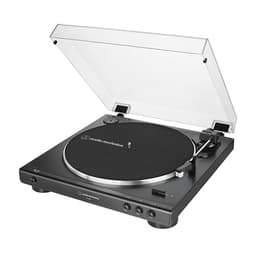
Audio-Technica AT-LP60X
A safe, genuinely automatic first deck under $200
Frequently asked questions
Do cheap turntables ruin records?
Some do. The damage comes from the cartridge, not the price tag: sealed ceramic cartridges track at a much higher force than magnetic ones and cannot be replaced when they wear. A cheap deck with a replaceable magnetic cartridge tracking at a normal force does not damage records.
Are suitcase record players bad for records?
The cheapest ones are, because they almost all use a sealed ceramic cartridge with no adjustment and no replaceable stylus. Suitcase-style players that use a replaceable magnetic cartridge are a different proposition and are safe for your collection.
How do I know if a record player will damage my records?
Check the cartridge. If the listing says magnetic, moving magnet or names an Audio-Technica or Ortofon cartridge, it is fine. If it says ceramic, or says nothing at all about the cartridge and there is no replaceable stylus, treat that as a warning.
What tracking force is safe for vinyl?
Whatever the cartridge specifies — typically 1.5 to 2.5 grams for a moving-magnet cartridge. Ceramic cartridges in cheap players commonly track at several times that. Too light is also unsafe: a skittering stylus hammers the groove walls.
Can a damaged record be repaired?
No. Groove wear is deformed vinyl, and no cleaning, fluid or machine restores it. This is why the cartridge question matters before you buy rather than after — cleaning fixes dirt, and nothing fixes wear.
Will one play on a cheap record player ruin a record?
One play on a heavy-tracking ceramic cartridge will not destroy a record. The damage is cumulative, developing over dozens of plays. That is what makes it insidious: nothing sounds wrong on day one, and by the time it does the wear is permanent.
Sources
- Crutchfield — How to choose the right turntable — Buying-guide reference on drive type, cartridges, preamps and setup (accessed July 24, 2026)
- Crutchfield — Phono cartridge guide — Reference on cartridge types, styli and mounting (accessed July 24, 2026)
- Elusive Disc — Turntable setup guide: tracking force & anti-skate — Step-by-step on balancing the tonearm, setting tracking force and anti-skate (accessed July 24, 2026)
- Library of Congress — Caring for and cleaning grooved discs — Preservation guidance on cleaning and storing records to prevent damage (accessed July 24, 2026)
Keep reading
How to Spot a Bad Pressing or a Fake
The other way a record goes wrong — before you even play it.
Read the guideAre Suitcase Record Players Bad?
The specific case where the answer is a clear yes.
Read the guideBest Record Players Under $200
The budget decks that pass the cartridge test.
See the picksBest All-in-One Record Players
Self-contained players ranked honestly, including what to avoid.
See the picksHow to Set Up a Turntable
On an adjustable deck, this is what keeps records safe.
Read the guideHow to Replace a Turntable Stylus
The other way a deck damages records: a worn tip nobody replaced.
Read the guideRecord Player vs Turntable
Where the ceramic cartridge comes from, and which product category avoids it.
Read the comparison