Record Player vs Turntable
The two words mean the same machine. On a shop page they quietly mean two different products — and that difference decides how many boxes you end up buying.
How this is funded: we earn a commission if you buy through our links, at no extra cost to you. It never changes which product we recommend, and we’ll tell you plainly when to skip one. Full disclosure.
Ask this in a record shop and you will get a confident answer, and it will contradict the confident answer you got in the last one. Some people will tell you a turntable is the serious version and a record player is the toy. Others will tell you they are simply the same thing and the question is silly.
Both are half right, and the half that matters is the one nobody states plainly: the words describe the same machine, but sellers use them to point at two different products. Knowing which product you are looking at is the whole of this question, and it decides how many boxes you have to buy before you hear anything.
The short answer
A record player and a turntable are the same device: a motor that spins a disc and a stylus that reads its groove. There is no technical line between them. In the trade, “record player” usually means an all-in-one with speakers built into the case, and “turntable” usually means a deck with no speakers that connects to a separate system. That is a convention, not a rule — and manufacturers break it constantly.
- Same object. Neither word is more correct, and neither implies a quality level on its own.
- Different shopping categories.Search “record player” and you get boxes with speakers in them. Search “turntable” and you get decks that need a system around them.
- The label tells you nothing useful about quality. Four specifications do, and they are listed further down this page.
The difference that actually changes what you buy
Playing a record takes three things: something to read the groove, something to amplify what it reads, and something to move air. The only real question behind “record player or turntable” is how many of those three come in the box.
An all-in-one contains all three. A component deck contains the first one and, usually, part of the second — you supply the rest. Everything else people argue about follows from that single split.
| All-in-one “record player” | Component “turntable” | |
|---|---|---|
| Speakers | Built into the case | You supply them |
| Amplifier | Built in, fixed | Inside powered speakers, or a separate amp |
| Phono preamp | Built in, not switchable | Built in and switchable, or deliberately absent |
| Cartridge | Ceramic on the cheapest; magnetic on the good ones | Magnetic, with a replaceable stylus |
| Tonearm | Fixed — no counterweight, no anti-skate | Adjustable from roughly $250 up |
| Upgrade path | A new stylus, at best | Stylus, cartridge, preamp, amp and speakers, separately |
| Boxes to buy | One | Two, sometimes three |
| Cost to first sound | Roughly $50–$150 | Roughly $180 deck plus $80–$150 powered speakers |
| Moves around the house | Easily — that is the point | Not really; it wants a level shelf and cables |
Read that table twice and the choice usually makes itself. If the phrase “two, sometimes three” is a problem, you want an all-in-one and no amount of audiophile advice should talk you out of it. If the phrase “a new stylus, at best” is the problem, you want a component deck.
What you get when you search “record player”
This is the higher-volume phrase by a wide margin, and it is also the one that surfaces the most genuinely bad products. The sub-$80 shelf is dominated by suitcase players: a lid, two small drivers, a Bluetooth chip and a sealed ceramic cartridge.
The ceramic cartridge is the problem, and it is worth being precise about why. It produces a much larger output than a magnetic cartridge, which is convenient because it needs almost no amplification. To do that it uses a stiff crystal element, which needs a heavy tracking force — several grams against roughly two for a magnetic cartridge. It is also sealed, so when the tip dulls, nothing can be replaced. A dull tip at a heavy force is exactly the combination that wears a groove permanently. The mechanism is set out in full in do cheap turntables ruin records?
That is not an argument against all-in-ones. It is an argument against one specific component that happens to be common in them. An all-in-one with a replaceable Audio-Technica magnetic cartridge tracks at a sane force and can have its stylus renewed, and it will not damage anything. The Victrola Eastwood II below is on this site for precisely that reason, and the honest shortlist is in best all-in-one record players.
What you get when you search “turntable”
The same search intent, filtered towards separates. These decks have a magnetic cartridge, a proper tonearm, RCA outputs, and no speakers. Around $180 buys a fully automatic deck with a switchable phono preamp built in. Around $300 buys a manual deck with a counterweight, anti-skate and an elliptical stylus. Past $600 the built-in preamp usually disappears, because at that point the designers would rather you chose your own.
Note the word “switchable” there, because it is what makes a component deck a platform rather than a purchase. A switchable built-in preamp means the deck outputs line level today — straight into powered speakers, no third box — and can be flipped to raw phono output later when you add a better stage. If you are not sure whether you need one at all, the do I need a phono preamp? decision tree settles it in about thirty seconds.
The chain, and where each word sits in it
Every vinyl setup that has ever worked contains the same four stages in the same order. The difference between the two words is only how many of those stages share a chassis.
- The deck— platter, motor and tonearm. Spins the record at a steady speed and holds the stylus at the correct angle and force.
- The cartridge and stylus— the part that actually reads the groove and turns its wiggles into a very small electrical signal.
- The phono preamp— raises that signal to line level and applies the RIAA playback curve. Without it a record sounds faint and thin, not merely quiet.
- Amplification and speakers— the power stage and the drivers that move air.
An all-in-one puts all four in one case. A typical component deck gives you one, two and three, and you add four in the form of powered speakers. A higher-end deck gives you one and two only, and you supply three and four. Nothing else about the vocabulary changes that arithmetic — vinyl setup for beginners walks the whole chain with complete systems costed at three budgets.
The four specs that matter more than either word
Once you stop treating the label as information, the listing becomes readable. These four lines tell you almost everything, and they are usually all present:
- Cartridge type.Magnetic (moving magnet, moving iron or moving coil) with a replaceable stylus, or sealed ceramic. This is the single most important line on the page and the one most often omitted — if a listing does not say, assume ceramic.
- Tonearm adjustability.A counterweight and anti-skate mean you can set tracking force to the cartridge’s published specification instead of accepting a factory guess. It is also the entry requirement for ever fitting a different cartridge. See automatic vs manual turntables for what automation costs here.
- Drive type. Belt or direct. It matters less than the internet suggests for a home listener, and belt drive vs direct drive explains precisely how much less.
- Built-in phono preamp, and whether it switches off. Present and switchable is the most flexible arrangement. Present and permanent is fine today and a ceiling later. Absent is a deliberate choice on better decks, not an omission.
A machine labeled “record player” that scores well on all four is a better buy than one labeled “turntable” that does not. That is the entire practical value of understanding this question.
The other meanings of “turntable”
Two more uses of the word are worth knowing, because they cause most of the remaining confusion.
The platter itself.Strictly, the turntable is the rotating plate the record sits on. The word expanded outward to cover the whole deck, but both senses are still in use — which is why a spec sheet can advertise a turntable with an aluminum turntable on it and be perfectly consistent.
The DJ instrument.In DJ contexts, “turntables” means direct-drive decks with a high-torque motor, a pitch fader and a platter built to be stopped and moved by hand. Those requirements are specific to performance, and a listener does not need any of them. Home decks built on that heritage exist and are excellent, but the DJ meaning is a separate branch of the word.
You will also meet “deck” as shorthand for the whole unit, and “separates” for a system built from individual components. Neither describes a different machine.
Phonograph, gramophone, Victrola
Three more words for the same category, and none of them is a product type you need to shop for.
Phonograph and gramophoneare older terms for a machine that plays recorded discs or cylinders; you will still see “phonograph” attached to vintage equipment and, occasionally, to modern furniture-style consoles. Victrolais a brand name rather than a category — the Victrola-branded machines sold today are ordinary belt-drive players, and, as with anything else on the shelf, the only question worth asking about one is what cartridge is fitted.
So which one should you buy?
- Buy an all-in-one record player if you want one purchase, one plug and music in ten minutes; you want to carry it between rooms; you are buying a gift; or the collection is thrift-store finds rather than pressings you would be upset to wear. Take one with a replaceable magnetic cartridge, and the usual objection to all-in-ones simply does not apply to you.
- Buy a component turntable ifyou already own speakers or a receiver; you expect to still be doing this in five years; you care about the records themselves; or you want the option to improve one part at a time rather than replacing the whole thing. Budget for speakers in the same purchase, not later — a deck alone makes no sound at all.
The one route to regret is buying a component deck and then discovering it needs two more boxes you had not planned for. That is a budgeting problem rather than a taste problem, and this page exists mostly to make it impossible. If you know which of the two products you are buying, both are good answers.
One of each, with live prices
The three positions this page describes, in one place: everything in the box, everything except speakers, and everything except speakers with an upgrade path. Prices are pulled live and dated.
The all-in-one, done safely
Victrola Eastwood II
Speakers, amp and preamp in the case — and a replaceable magnetic cartridge instead of a sealed ceramic one.
The component deck, made effortless
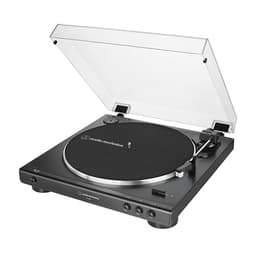
Audio-Technica AT-LP60X
No speakers, but a switchable preamp and full automation. Add powered speakers and you have a system.
The component deck that upgrades
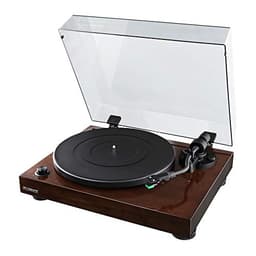
Fluance RT81
Counterweight, anti-skate and a standard cartridge mount — the point where the deck stops being disposable.
Price as of October 15, 2026. #ad How we’re funded
Frequently asked questions
Is a record player the same as a turntable?
As words for the machine that plays vinyl, yes — they are interchangeable and neither is more correct. In practice, sellers use 'record player' most often for an all-in-one with speakers built into the case, and 'turntable' for a deck with no speakers that connects to a separate system. The words describe the same object; the shopping categories they point at are different.
Which is better, a record player or a turntable?
Neither is inherently better. An all-in-one is one purchase that makes sound immediately and moves around the house easily. A component deck sounds substantially better, tracks records more safely, and can be upgraded a piece at a time — but it needs speakers, and usually a phono preamp, before it makes any noise at all.
Do turntables sound better than record players?
A component deck paired with real speakers does, and the gap is large rather than subtle. Almost none of it comes from the platter — it comes from having a magnetic cartridge tracking at an adjustable force, and from speakers that are not two small drivers in the same box as the motor.
Why is the platter also called a turntable?
Because that is the original meaning: the turntable is the rotating plate the record sits on. The word grew to cover the whole deck. It is still used both ways, which is why a spec sheet can list a 'turntable' with an 'aluminum turntable' on it without contradicting itself.
Is a record player bad for your records?
Not because of the label. Wear comes from a sealed ceramic cartridge pressing on the groove at several grams and from a stylus that cannot be replaced when it dulls. Both are common below roughly $80 and both are avoidable — an all-in-one with a replaceable magnetic cartridge does not have this problem.
What should I search for when shopping?
Search both. 'Record player' surfaces all-in-ones and suitcase units; 'turntable' surfaces component decks. Then ignore the word and check four things on the listing: the cartridge type, whether the tonearm has a counterweight, the drive, and whether there is a built-in phono preamp.
What is the difference between a record player and a phonograph?
'Phonograph' and 'gramophone' are older words for the same category of machine, and you will still see 'phonograph' used for vintage equipment. 'Victrola' is a brand name rather than a type — the modern Victrola-branded players are ordinary belt-drive all-in-ones.
Sources
- Crutchfield — How to choose the right turntable — Buying-guide reference on drive type, cartridges, preamps and setup (accessed July 24, 2026)
- Audio-Technica — AT-LP60X turntable — Manufacturer specs for the fully automatic belt-drive AT-LP60X (accessed August 11, 2026)
- Audio-Technica — VM95 Series cartridges — The shared-body VM95 range and its interchangeable stylus upgrade path (accessed July 24, 2026)
- Crutchfield — How to choose a phono preamp — On why a phono signal needs a preamp and never running two at once (accessed July 24, 2026)
- Crutchfield — Home speakers buying guide — Reference on choosing passive vs powered speakers, room size and amplifier pairing (accessed August 11, 2026)
Keep reading
Essential Classic Rock Records on Vinyl
Whatever you call the machine, this is what goes on it.
See the picksBest Record Players
The picks, written for the buyer who used that word — no amplifier assumed.
See the record playersBest All-in-One Record Players
If the answer is 'everything in one box', these are the ones worth owning.
See the all-in-onesBest Turntables
If the answer is 'a component deck', start here.
See the turntablesVinyl Setup for Beginners
The whole chain in order, with three complete systems costed out.
Start hereDo Cheap Turntables Ruin Records?
The one specification that separates a safe budget player from a record-eater.
Read the explainerBest Turntables With Speakers
The same choice priced out both ways: one box, or a deck plus powered speakers.
Compare both routes