Vinyl Setup for Beginners
Every vinyl system has the same four parts. Once you can name them and say which box in your house contains which, every buying decision gets simple.
How this is funded: we earn a commission if you buy through our links, at no extra cost to you. It never changes which product we recommend, and we’ll tell you plainly when to skip one. Full disclosure.
Vinyl has a reputation for being complicated, and the reason is that the vocabulary arrives all at once: preamp, cartridge, phono, tracking force, passive, powered. None of it is difficult. It is just that nobody explains the shape of the system before throwing the words at you.
So here is the shape. Every vinyl system, from a $90 suitcase player to a $50,000 rig, has the same four parts. The only thing that changes is how many separate boxes those four parts live in.
The four parts
1. The turntable
Spins the record and holds the cartridge — the small device with the stylus (needle) that sits in the groove and converts its wiggles into a tiny electrical signal. That signal is the entire music, and everything that follows is just making it loud enough to hear.
2. The phono preamp
The part everyone gets caught by. A cartridge outputs a few thousandths of a volt, and the signal has also been deliberately equalized at the cutting stage (bass reduced, treble boosted) so it fits in the groove. A phono preamp amplifies it to normal line level and applies the exact inverse of that equalization.
Skip it and the sound is faint, thin and tinny. It has to be somewhere: built into your turntable, built into your amplifier or receiver, built into your powered speakers, or in its own box.
3. The amplifier
Takes line level and drives speakers. It might be an integrated amplifier, a stereo receiver, or — most commonly for beginners — hidden inside a pair of powered speakers.
4. The speakers
Turn the signal into sound. Passive speakers need an amplifier. Powered (active) speakers have one inside.
Where those four parts usually live
- All-in-one record player: all four inside one case. Plug it into the wall and it makes sound. Simplest possible option, with the lowest sound ceiling.
- Turntable with built-in preamp + powered speakers: the deck holds parts 1 and 2, the speakers hold 3 and 4. Two boxes, two cables. This is the most common and most sensible starter setup.
- Turntable + amplifier with phono input + passive speakers: the amplifier holds parts 2 and 3. Three boxes, better sound per dollar, everything upgradeable separately.
- Turntable + separate phono stage + amplifier + passive speakers: all four in their own boxes. The most upgradeable and the most expensive route in.
Every buying decision in this hobby is really the question “which of these four parts am I still missing?” If you can answer that, you cannot buy the wrong thing.
The one mistake to avoid entirely
Do not put two phono preamps in the chain.A turntable with its built-in preamp switched on, plugged into an amplifier’s phono input, gives distorted, painfully loud, wrong-sounding audio. It is the most common first-setup error in vinyl.
The fix: if your turntable has a PHONO/LINE switch, set it to LINE when going into a line/aux input or powered speakers, and to PHONO when going into a dedicated phono input. One preamp, exactly one, anywhere in the chain.
What to spend where
Given a fixed budget, this is the order that produces the best result:
- A deck that will not damage records. Non-negotiable. That means a replaceable magnetic cartridge, not a sealed ceramic one. See do cheap turntables ruin records?
- Speakers. They change what you hear more than anything else. If you can only spend well on one thing, spend it here.
- The turntable itself. An adjustable tonearm and an elliptical stylus are a real step up and open the upgrade path.
- The phono stage. Worth improving once the rest is settled.
- Cables and accessories.Last, and much later than the internet suggests. Inner sleeves are the exception — those are cheap and genuinely worth doing early.
After the boxes arrive
Three things, in this order, and none of them costs money:
- Level the turntable and put it on something rigid, away from the speakers. A deck sitting between two speakers picks up their output through its plinth and feeds it back into the cartridge as boom and mud.
- Set tracking force and anti-skate if your deck has a counterweight. Ten minutes, and it is the difference between a cartridge working properly and wearing your records. See how to set up a turntable.
- Brush every record before you play it.A carbon-fiber brush and five seconds per side prevents most of the surface noise people assume is damage — see how to clean vinyl records.
What you do not need yet
A subwoofer. Expensive interconnects. A record weight or clamp. A new mat. An ultrasonic cleaning machine. A moving-coil cartridge. Every one of these has a legitimate use case further down the road, and none of them will improve a beginner system as much as correct setup and a better pair of speakers.
When you are ready to take the next step, the highest-value one is almost always the cartridge, and after that a better phono stage.
Three complete systems
Every component below is a real, currently-purchasable product with a live, dated price. Add the prices in each row for the system total — we don’t quote a fixed figure because prices move.
The simplest system
A fully automatic deck with a built-in preamp, straight into powered speakers. Two cables, no third box, nothing to set up wrong.
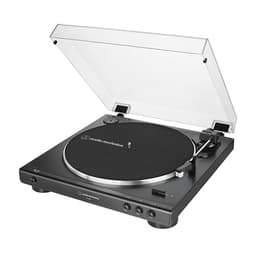
Audio-Technica AT-LP60X
A safe, genuinely automatic first deck under $200
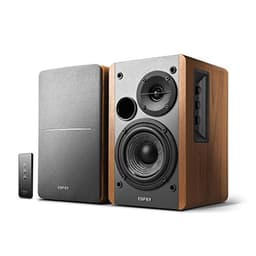
Edifier R1280T
The best-value complete-system speakers
Price as of October 15, 2026. #ad How we’re funded
The system most people should buy
An adjustable deck with a switchable preamp and a better pair of powered speakers. Same simplicity, a real cartridge and an upgrade path.
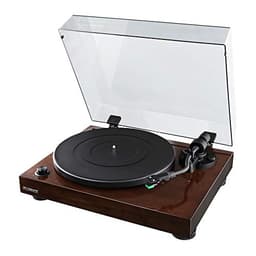
Fluance RT81
First serious turntable that you won't outgrow in a year
Price as of October 15, 2026. #ad How we’re funded
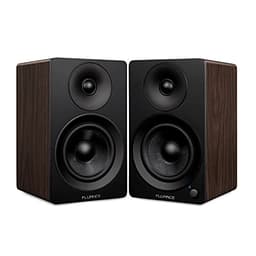
Fluance Ai41
Bigger, fuller powered sound with room to grow
Price as of October 15, 2026. #ad How we’re funded
The separates system
A deck, an amplifier with a phono input and passive speakers. More boxes, better sound per dollar, and every part upgradeable on its own.
Fluance RT81
First serious turntable that you won't outgrow in a year
Price as of October 15, 2026. #ad How we’re funded
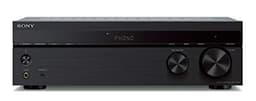
Sony STR-DH190
One box that replaces both the phono preamp and the amplifier
Price as of October 15, 2026. #ad How we’re funded
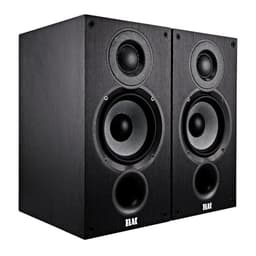
ELAC Debut 2.0 B5.2
The best-balanced passive pair around $250
Frequently asked questions
What do I need to start playing vinyl?
Four things, though they often come bundled: a turntable, a phono preamp, an amplifier and speakers. An all-in-one record player contains all four. A turntable with a built-in preamp plus powered speakers covers all four in two boxes, which is the most common starter setup.
How much does a decent starter vinyl setup cost?
A safe, genuinely good-sounding system starts around the price of an entry automatic turntable plus a pair of powered speakers. Spending roughly double that gets you an adjustable tonearm, an elliptical cartridge and speakers you will not outgrow quickly.
Can I plug a turntable straight into powered speakers?
Only if the turntable has a built-in phono preamp — most decks under $400 do, usually with a PHONO/LINE switch. Powered speakers expect line level, so a raw phono signal into them sounds very quiet and thin.
Do I need a receiver for a record player?
Not necessarily. A receiver is one way to supply amplification and often a phono input, but powered speakers supply the amplification themselves. You need a receiver or amplifier only if your speakers are passive.
What should I buy first if I am on a budget?
A turntable that will not damage your records — meaning one with a replaceable magnetic cartridge rather than a sealed ceramic pickup. Everything else can be upgraded later; records worn by a bad deck cannot be un-worn.
Is a suitcase record player a bad first buy?
Usually. The cheapest ones use a sealed ceramic cartridge that tracks at a much higher force and cannot be replaced, which wears records over time. Suitcase-style players with a replaceable magnetic cartridge are a different and much safer proposition.
Sources
- Crutchfield — How to choose the right turntable — Buying-guide reference on drive type, cartridges, preamps and setup (accessed July 24, 2026)
- Crutchfield — How to choose a phono preamp — On why a phono signal needs a preamp and never running two at once (accessed July 24, 2026)
- Crutchfield — Home speakers buying guide — Reference on choosing passive vs powered speakers, room size and amplifier pairing (accessed August 11, 2026)
- Elusive Disc — Turntable setup guide: tracking force & anti-skate — Step-by-step on balancing the tonearm, setting tracking force and anti-skate (accessed July 24, 2026)
Keep reading
Best Record Weights & Clamps
The accessory above that we told you to skip — and the mass rules that decide when it stops being a skip.
See the picksThe First 10 Records to Buy
What to spin first, once the setup above is done.
See the picksBest Turntable Mats
Not yet — but when you do, thickness is the number that decides it.
See the picksHow to Build a Hi-Fi System
The next step up: four functions, and what fraction of the budget each deserves.
Read the guideBest Turntables for Beginners
The decks that make the fewest demands on day one.
See the picksHow to Set Up a Turntable
Once the boxes arrive, this is the next half hour.
Read the guideDo I Need a Phono Preamp?
The single question that trips up most first setups.
Check yoursTurntable Troubleshooting
When it is connected and something still sounds wrong.
Fix itWhat Is Hi-Fi?
What the word means, and what separates a system from a record player.
Read the explainerHow to Connect a Turntable Without a Receiver
Four routes to sound if there is no receiver in the house.
Read the guide