Automatic vs Manual Turntables
Automation is not a shortcut for people who don't care. It is a trade — and knowing exactly what it costs makes the decision straightforward.
How this is funded: we earn a commission if you buy through our links, at no extra cost to you. It never changes which product we recommend, and we’ll tell you plainly when to skip one. Full disclosure.
There is a persistent idea in vinyl circles that automatic turntables are for people who do not really care about the music. That is wrong, and it leads people to buy manual decks they then never set up properly — which produces worse sound than the automatic they avoided.
Automation is a trade, and it is worth understanding precisely because the cost is specific and predictable.
What each one does
Fully automatic: press start and the arm lifts, swings across, lowers onto the lead-in groove, plays the side, then lifts and returns to its rest when the side ends. You never touch the arm.
Semi-automatic: you cue the arm at the start of the side yourself, but at the end the deck lifts the arm and stops the platter on its own.
Manual: you lower the arm with a cueing lever at the start and lift it at the end. The deck does nothing on its own.
What automation costs: the tonearm
On decks at the affordable end, automation is mechanical — a system of cams and levers driven off the platter. For that mechanism to work reliably, the arm has to be a known, fixed quantity: fixed mass, fixed cartridge, fixed tracking force set at the factory.
The consequence is that a budget automatic deck has no counterweight and no anti-skate adjustment. Three things follow:
- You cannot change the tracking force. Which is fine, since the factory value suits the fitted cartridge. It is also final.
- You cannot fit a different cartridge. A better cartridge needs a different force and often a different mass. This is the real ceiling.
- The fitted cartridge is chosen to be forgiving— usually a conical stylus, which tolerates a slightly wrong angle at the cost of the fine detail an elliptical retrieves.
That last point is why automatic decks are often described as sounding less good. It is not the automation. It is the tip profile that the automation implies.
What manual costs: your attention
A manual deck hands you a counterweight and anti-skate, which is genuinely more capable. It also hands you two obligations:
- Setting it up.Balancing the arm, setting tracking force to the cartridge’s specification and matching anti-skate takes about ten minutes — see how to set up a turntable. Skip it and you have an expensive deck tracking at an unknown force.
- Lifting the arm at the end of a side. Forget, and the stylus circles the run-out groove until someone notices. Fall asleep to a record and that is hours of unnecessary wear on both stylus and vinyl.
Neither is difficult. Both are real, and the second one is the argument for semi-automatic that most buyers never hear.
The semi-automatic middle ground
Semi-automatic decks are the least-discussed and often most sensible option. You keep the adjustable arm — counterweight, anti-skate, standard cartridge mount, full upgrade path — and the deck handles the one thing humans reliably forget.
There is also a rarer category worth knowing about: fully automatic decks that still have an adjustable counterweight. The Denon DP-300F is the clearest example, and it genuinely does offer both. If automation matters to you but you refuse to give up cartridge upgrades, that combination is what to look for.
The honest recommendation
- Buy fully automatic if: this is a first turntable, other people in the house will use it, it is somewhere children can reach, or you know yourself well enough to know you will not do a setup procedure.
- Buy semi-automatic or an adjustable automatic if: you want the upgrade path but also want the arm to lift itself.
- Buy manual if: you intend to change the cartridge at some point, you want the best sound per dollar, and cueing an arm is part of the appeal rather than a chore.
The one outcome to avoid is buying a manual deck and never adjusting it. An unbalanced manual arm tracks at whatever force the counterweight happened to be left at, which can be far too light or too heavy — and both wear records. That is strictly worse than the automatic you passed over.
A note on what automation does not affect
Automation is independent of drive type: there are automatic and manual decks in both belt drive and direct drive. It is also independent of whether the deck has a built-in preamp, Bluetooth or USB. When comparing two turntables, treat these as separate axes rather than a single “cheap versus serious” scale — and see belt drive vs direct drive for the other one.
One of each, with live prices
The three positions on the spectrum, in one place: full automation, the rare automatic that still gives you a counterweight, and a straightforward manual deck.
Fully automatic
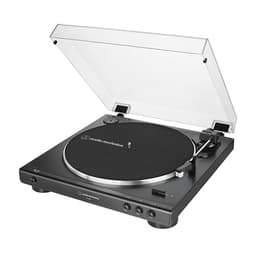
Audio-Technica AT-LP60X
A safe, genuinely automatic first deck under $200
Automatic with an adjustable arm
Denon DP-300F
Automatic play with a heavier, adjustable build
Manual
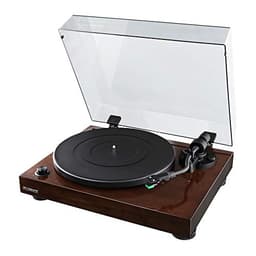
Fluance RT81
First serious turntable that you won't outgrow in a year
Price as of October 15, 2026. #ad How we’re funded
Frequently asked questions
What is the difference between an automatic and a manual turntable?
An automatic turntable cues the arm onto the record, plays the side and lifts and returns the arm on its own. A manual turntable requires you to lower and lift the arm yourself, but gives you a counterweight and anti-skate so you can set the tracking force the cartridge specifies.
Do automatic turntables sound worse?
Not because of the automation itself. The reason cheap automatic decks generally sound less good is that their mechanism requires a fixed tonearm, which means a factory-set tracking force and a simpler cartridge. Automatic decks with adjustable arms exist and sound very good.
Are automatic turntables safer for records?
In one specific way, yes. They remove the two most common human errors: dropping the stylus while cueing, and leaving the arm circling the run-out groove after the side ends. On a shared deck or one children use, that is a real advantage.
What is a semi-automatic turntable?
One you cue by hand, but which lifts the arm and stops the platter automatically at the end of a side. It is a genuine middle ground: you keep the adjustable tonearm and lose the risk of leaving the stylus running in the run-out groove.
Should a beginner buy an automatic or a manual turntable?
Automatic if you want to press a button and hear music with no learning curve. Manual if you are willing to spend ten minutes balancing a tonearm, because that adjustability is the entry point to cartridge upgrades. A manual deck left unadjusted is the worst of both.
Can you upgrade the cartridge on an automatic turntable?
On most budget automatics, no. Their tonearms use a proprietary fixed mount with no counterweight, so there is no way to set the tracking force a different cartridge needs. Automatic decks with a standard half-inch mount and a counterweight — such as the Denon DP-300F — are the exception.
Sources
- Crutchfield — How to choose the right turntable — Buying-guide reference on drive type, cartridges, preamps and setup (accessed July 24, 2026)
- Elusive Disc — Turntable setup guide: tracking force & anti-skate — Step-by-step on balancing the tonearm, setting tracking force and anti-skate (accessed July 24, 2026)
- Audio-Technica — AT-LP60X turntable — Manufacturer specs for the fully automatic belt-drive AT-LP60X (accessed August 11, 2026)
Keep reading
Best Automatic Turntables
If you have decided on automation, the six decks worth it and what each one does at the end of a side.
See the picksDenon DP-300F Review
The automatic deck with a counterweight — this page's exception, reviewed.
Read the reviewHow to Balance a Tonearm
The ten-minute job a manual deck asks of you.
Read the guideAT-LP60X vs Fluance RT81
This exact trade-off, argued between two specific decks.
Read the comparisonAT-LP60X vs AT-LP120XUSB
Automatic against manual inside one brand, where nothing else changes.
Read the comparisonBest Turntables for Beginners
Both kinds, with the setup demands of each called out.
See the picksHow to Set Up a Turntable
What a manual deck actually asks of you.
Read the guideBelt Drive vs Direct Drive
The other fork in every turntable decision.
Read the comparisonRecord Player vs Turntable
The fork before this one: one box with speakers inside, or a deck plus a system.
Read the comparison