Do Vinyl Records Have to Be Stored Vertically?
Yes, and it is the cheapest preservation decision you will ever make — because the alternative applies a slow, constant, uneven load to a material that remembers it.
How this is funded: we earn a commission if you buy through our links, at no extra cost to you. It never changes which product we recommend, and we’ll tell you plainly when to skip one. Full disclosure.
The short answer is yes, and unlike a lot of vinyl advice this one is not a matter of degree or taste. Vertical storage is what every preservation authority recommends, including the Library of Congress, and the reason is a straightforward property of the material.
What is worth knowing is why, because understanding the mechanism also tells you which near-misses matter — leaning, over-packing, warm rooms — and which do not.
The mechanism: vinyl creeps
A record is a thermoplastic disc about 1.5 mm thick. Thermoplastics exhibit creep: under a sustained load, they deform slowly and permanently, at stresses far below what would break them in a single moment. The deformation is a function of three things — how much load, for how long, and at what temperature.
Stored vertically, a record’s own weight bears on its bottom edge. That edge is the disc’s stiffest axis, the load is small, and the playing surfaces carry nothing at all.
Stored flat in a stack, every record carries the weight of all the records above it, spread across its face. And it is not spread evenly: the raised label area at the center is thicker than the playing surface, so a stack rests on its labels and bows the grooved area around them. Add any existing warp, or a piece of grit trapped between sleeves, and you have a concentrated pressure point.
Give that months and the record takes a permanent set. Add heat — an attic, a sunny window, the top of an amplifier — and the creep rate rises sharply. That is the whole story.
Leaning is the mistake people actually make
Almost nobody deliberately stacks their collection flat. What people do is fill a shelf halfway and let the records lean, and that is nearly as damaging while looking completely innocuous.
A leaning record bears its weight on one corner of its bottom edge and along one face, held at an angle by the records beside it. The load is sustained and uneven, and the resulting warp is a characteristic gentle curve across the disc — the exact shape you would expect from bending it slowly over months.
The fix costs nothing: keep each shelf section filled enough that records stand upright, and use a divider or a bookend where a section is not full. A divider every thirty records or so also makes browsing easier, which is the sort of coincidence worth taking.
How tightly to pack them
Both extremes cause problems, and the target is narrow but easy to hit.
Too loose and records lean, with the consequences above.
Too tightand three things go wrong: sleeve edges get crushed and seams split, pulling a record out drags its neighbors’ sleeves against each other abrasively, and if you have to squeeze a record back in you will eventually force one at an angle and crease it.
The test: you should be able to lift one record out with two fingers without its neighbors coming with it, and without them falling over once it is gone. If it takes a tug, the section is too tight; if the gap flops closed, it is too loose.
What else the vertical rule assumes
Standing them up is necessary and not by itself sufficient. Three companions:
- Inner sleeves.A paper inner sleeve is abrasive and sheds fiber into the grooves. Anti-static poly-lined inners cost very little and remove one of the main sources of surface noise — see record storage and sleeves.
- Outer sleeves. Protect the cover, which is often the part with the resale value, and stop covers abrading against each other in a packed shelf.
- A cool, dry, dark location. Heat drives creep, humidity encourages mold on cardboard, and sunlight fades covers. An interior wall away from a window and away from any heat source is free and does more than any product.
The full version of all of this, including shelving depth and environment, is in how to store vinyl records.
The one place a record should never live
On top of an amplifier or a receiver, which is exactly where a flat surface tempts people to put one down. Those boxes are warm by design, and warmth is the multiplier in the creep equation. The same applies to the top of the turntable dust cover, which additionally means the record is in the path of any speaker vibration reaching the deck.
If a record is already warped
Two levels of severity, and it is worth diagnosing before doing anything.
A slight dish or gentle curve. Often still perfectly playable. The arm rides up and down once per revolution, producing very-low-frequency energy below the audible band. A phono stage with a subsonic filter removes that energy before it reaches your amplifier, which stops woofers flapping and recovers headroom.
A pronounced warp that makes the stylus skip.Now you have a choice, and neither option is free. Purpose-built record flatteners apply controlled heat and even pressure, and they work. The improvised methods — glass sheets in an oven, sun on a car dashboard, hot water — are how records get destroyed, because vinyl deforms permanently well below the temperatures those methods reach and the pressure is never as even as it looks.
Which is the real argument of this page: warping is cheap to prevent and expensive or impossible to reverse. Standing your records up costs the price of a crate.
Getting them upright and supported
The two things that matter are vertical and snug. A crate or a cube shelf handles the first; sleeves and not over-packing handle the second.
The cheapest way to store upright

Crosley AC1004A Record Storage Crate
A first crate for a collection under 75 albums
Price as of October 15, 2026. #ad How we’re funded
A shelf sized for records

Furinno Cubicle 2-Cube Record Player Stand
Putting the deck and the records in one piece of furniture
Inner and outer sleeves
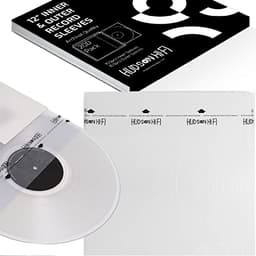
Hudson Hi-Fi 100x Inner & 100x Outer Sleeves
Sleeving 100 records in one go
Price as of October 15, 2026. #ad How we’re funded
Frequently asked questions
Do vinyl records have to be stored vertically?
Yes. Preservation guidance from the Library of Congress and every record manufacturer says the same thing: store discs upright, supported, and not leaning. Vertical storage puts the record's weight on its own edge, which it is shaped to handle. Any other orientation loads the playing surface instead.
What happens if you store records flat?
The weight of the records above presses on the ones below, unevenly — the raised label area and any warp or debris become pressure points. Vinyl is a thermoplastic and it creeps under sustained load, so over months the disc takes a permanent set. Heat accelerates it dramatically.
Is it OK to stack a few records flat for a short time?
A handful for a few days is not going to do measurable harm at normal room temperature. The damage is a function of weight, time and heat together. A tall stack, or any stack left for months, or a stack in a warm room, is where it becomes real.
Is leaning records at an angle bad?
Yes, and it is the most common mistake because it looks harmless. A leaning record has its weight bearing on one edge and one face rather than distributed along the bottom edge, which produces a characteristic curved warp. Keep shelves filled enough that records stay upright, and use a divider or bookend where they do not.
How tightly should records be packed?
Snug enough to stay vertical, loose enough to pull one out without dragging its neighbors. Over-packing squeezes covers and makes retrieval abrasive; under-packing lets everything lean. Both are avoidable with a divider every 30 or so records.
Can you fix a warped record?
Sometimes, and the DIY methods are risky. Flattening involves controlled heat and even pressure, and getting it wrong destroys the record — vinyl deforms permanently well below the temperature most improvised methods reach. Purpose-built record flatteners exist. Prevention is dramatically cheaper than any of it.
Where is the worst place to store records?
Anywhere warm: an attic, a garage, next to a radiator, in direct sun, or on top of an amplifier. Heat is the multiplier that turns a survivable load into a permanent warp, and it also attacks the sleeves. A cool interior wall away from sunlight is the free answer.
Sources
- Library of Congress — Care, handling and storage of audio-visual materials — Preservation guidance on vertical storage, sleeve materials and storage environment (accessed August 11, 2026)
- Library of Congress — Caring for and cleaning grooved discs — Preservation guidance on cleaning and storing records to prevent damage (accessed July 24, 2026)
- Crutchfield — How to choose the right turntable — Buying-guide reference on drive type, cartridges, preamps and setup (accessed July 24, 2026)
Keep reading
Record and Accessory Gift Pairings
An album plus a crate is the gift that keeps the rest of them flat.
See the pairingsHow to Store Vinyl Records
The full storage guide: sleeves, shelving, environment.
Read the guideBest Record Storage
Crates, shelves and cubes that hold records the right way up.
See the picksHow to Clean Vinyl Records
The other half of keeping a collection playable.
Read the guideTurntable Troubleshooting
What a warp sounds like, and what else causes it.
Read the guide