How to Store Vinyl Records
Five rules that decide whether a record still plays cleanly in thirty years — and three widely-repeated ones that do not matter.
How this is funded: we earn a commission if you buy through our links, at no extra cost to you. It never changes which product we recommend, and we’ll tell you plainly when to skip one. Full disclosure.
A record is a soft plastic disc with information cut into it at a scale measured in microns. It has no moving parts and nothing to wear out, which means that with sensible storage a pressing from 1972 can still play as well as it did then. Most of the damage collections suffer is storage damage, and nearly all of it is avoidable at no cost.
The Library of Congress publishes preservation guidance for grooved discs, and it comes down to three things: store them vertically with support, use high-density polyethylene sleeves rather than paper or PVC, and keep them cool and stable. Everything below follows from those.
Rule 1: vertical, always
Stacking records flat is the most damaging common habit in the hobby. The weight of the discs above presses those below against whatever grit is trapped between them, and the whole stack slowly dishes. Given a few months, the records at the bottom of a tall stack will be visibly warped.
Vertical storage removes the load. But there is a qualification people miss: records need to stand upright, not lean. A half-empty crate lets the row slump at an angle, and a leaning record dishes for exactly the same reason a stacked one does, just more slowly.
The institutional version of this rule is to insert a rigid full-height support every few inches. Domestically: keep each crate or cube about 80 percent full and use dividers or bookends in the gaps. Not so tight that pulling a record out is a fight, not so loose that the row leans.
Rule 2: get rid of the paper inner sleeves
This is the cheapest genuinely valuable thing you can do for a collection, and almost nobody does it.
Most records ship in a plain paper inner sleeve. Paper is abrasive at the scale a groove operates on, so every time the record slides in or out, it drags across the playing surface. Paper also sheds fibers into the groove, holds static that attracts dust, and in older pressings can be acidic enough to degrade the vinyl surface over decades.
Replace them with polyethylene, or rice paper backed with polyethylene. The record slides freely, static is repelled rather than generated, and nothing sheds.
One material to avoid: soft PVC. It is still sold, often unlabeled, and it can leach plasticizer onto the record surface over years, leaving a haze that is very difficult to remove. Library of Congress guidance explicitly recommends high-density polyethylene and warns against PVC and unknown plastics. Polypropylene is also fine.
Rule 3: cool, dry and stable
Vinyl softens with heat and jackets suffer from humidity. The preservation standard for institutional collections is around 46-50 °F at 30-40 percent relative humidity, which is not a domestic proposition — but the useful version is simple:
- Never in direct sunlight. A record on a sunny windowsill or in a parked car can warp within hours. This is the fastest way to destroy one.
- Never near a heat source. Radiators, heating vents, and the top of an amplifier, which is warmer than people assume.
- Never on a concrete floor or in a damp basement. Moisture wicks into jackets and encourages mold on the paper.
- Stable beats cold. Repeated cycling between warm and cold is worse for both vinyl and jackets than a consistently mild room.
In practice: an interior wall of a normally-heated room, out of the sun, off the floor. That is enough.
Rule 4: sleeve the jacket if the jacket matters
Outer sleeves — clear covers over the whole album jacket — protect artwork rather than vinyl. They prevent ring wear, shelf abrasion and spills.
Whether you need them is a value question. For listening copies, optional. For anything collectible or anything you care about as an object, worth it. Look for 3 mil polypropylene or polyethylene rather than the standard 2 mil, with a flush-cut opening so there is no flap of excess plastic above the jacket.
If you can only afford one: inners protect the record, outers protect the cover. Do the inners first.
Rule 5: clean before you store
Sealing a dusty record into a new anti-static sleeve preserves the dust. Brush each record before it goes away, and give anything visibly dirty or secondhand a proper wet clean first — see how to clean vinyl records and the cleaning kits.
The same applies to daily habits: put the record back in its sleeve after playing rather than leaving it on the platter or propped against the wall. Dust falls continuously, and a record left out collects all of it.
Storage is one half of how long a collection survives; the stylus playing it is the other, and it is the half with published numbers attached. We put the two together in how long do vinyl records last, which is also the page to read if you want the honest answer to “how many plays does a record get.”
Three things that matter less than you have been told
- Alphabetizing. Enormously satisfying, of no preservation value whatsoever. Sort however you like.
- Expensive archival furniture.A shelf that is deep enough, strong enough and rigid enough does the same job as a boutique cabinet. The Library’s guidance is about orientation, support and environment — not about what the shelf cost.
- Sealing records in airtight bags. Trapped moisture is worse than dust. Sleeves should protect from abrasion and airborne dust, not create a sealed micro-climate.
If a record is already warped
Mild dishing sometimes tracks fine, particularly with a phono stage that has a subsonic filterto keep the resulting low-frequency energy out of your woofers. Severe warping generally does not, and home flattening methods — weights, ovens, glass plates — carry a real risk of destroying the record outright.
The realistic advice is to store the rest of the collection correctly so it does not join the warped one. Prevention here is genuinely free; the cure mostly is not.
Two moments break every rule on this page at once: a house move and a trip through the postal system. Both deserve their own method, and packing and shipping records covers it — vertical in small boxes, the record taped beside its jacket rather than inside it, and out of any vehicle that sits in the sun.
The two things worth buying
Sleeves protect the record; a crate keeps it upright. Between them they cover almost everything on this page. Prices are live and dated.
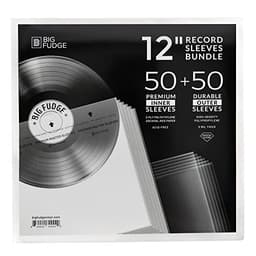
Big Fudge Inner & Outer Sleeves 100pc Kit
Sleeving a 50-record collection properly in one purchase
Price as of October 16, 2026. #ad How we’re funded
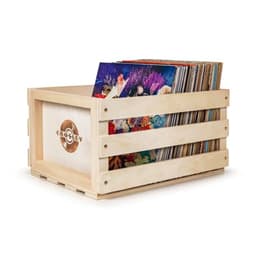
Crosley AC1004A Record Storage Crate
A first crate for a collection under 75 albums
Price as of October 16, 2026. #ad How we’re funded
Frequently asked questions
Should vinyl records be stored vertically or flat?
Vertically. Stacking flat presses the lower records against trapped grit under the weight above, dishing them permanently over months. Vertical storage prevents that, provided the records stand upright rather than leaning at an angle.
What temperature should vinyl records be stored at?
Cool and stable. Library of Congress guidance for institutional collections is roughly 46-50 °F at 30-40% relative humidity. Domestically the practical version is: normal room temperature, away from radiators and direct sun, with as little fluctuation as possible.
Are paper inner sleeves bad for vinyl?
Plain paper is abrasive, sheds fibers, holds static and in older pressings can be acidic. Replacing plain paper inners with polyethylene or rice-paper-backed polyethylene is the cheapest meaningful improvement you can make to a collection's long-term condition.
Can you store records in a basement or garage?
Generally no. Damp is the main problem: moisture wicks into jackets and inner sleeves and encourages mold on the paper. Garages add large temperature swings, which warp vinyl. A stable, dry room at normal living temperature is far better than a cold damp one.
How do I stop my records from warping?
Store them vertically, keep the row upright rather than leaning, and keep them away from heat and direct sunlight. Those three cover almost every case of domestic warping. A record left in a car or on a sunny windowsill can warp within hours.
Is it bad to leave a record on the turntable?
It is not damaging in itself for a short period, but an exposed record collects dust continuously and an uncovered platter collects it too. Return records to their sleeves after playing — it is the habit that keeps a cleaned collection clean.
Sources
- Library of Congress — Care, handling and storage of audio-visual materials — Preservation guidance on vertical storage, sleeve materials and storage environment (accessed August 11, 2026)
- Library of Congress — Caring for and cleaning grooved discs — Preservation guidance on cleaning and storing records to prevent damage (accessed July 24, 2026)
Keep reading
Are Vinyl Box Sets Worth It?
Before you add eight records at once, run the arithmetic.
Read the guideDo Records Have to Be Stored Vertically?
The mechanism behind the single most important storage rule.
Read the guideBest Record Storage & Sleeves
The crates, stands and sleeves that put this guide into practice.
See the picksHow to Clean Vinyl Records
Clean before you sleeve, or you are just preserving the dust.
Read the guideBest Record Cleaning Kits
What to clean a neglected collection with before storing it properly.
See the kitsAre Expensive Turntables Worth It?
Where else your money goes further than on the deck.
Read the breakdown