Vertical, always — and not too tightly packed
Stacking records flat is the single most damaging common storage habit. The weight of the records above presses the ones below against any grit trapped between them, and over months the discs at the bottom dish permanently. A warped record cannot be flattened at home reliably and no amount of cleaning helps.
Vertical storage solves it, with one qualification: records need to stand upright, not leaning. A half-empty crate lets the whole row slump at an angle, which produces exactly the same dishing more slowly. The Library of Congress guidance for boxed storage is to insert a rigid full-size support every few inches for precisely this reason. In domestic terms: keep each crate or cube roughly 80 percent full and use dividers or bookends in the gaps.
Inner sleeves: the upgrade nobody makes
Most records ship in a plain paper inner sleeve, and plain paper is abrasive. Every time the record slides in or out, the paper drags across the groove. Paper also sheds fibers, holds static, and in older pressings can contain acid that degrades the vinyl surface over decades.
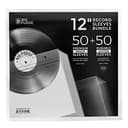
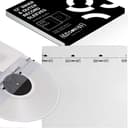
Replacing them is the highest-value thing in this article. A good inner sleeve is polyethylene, or rice paper backed with polyethylene, anti-static and acid-free. The record slides in and out without contact friction, dust is repelled rather than attracted, and nothing shed by the sleeve ends up in the groove.
One materials warning that matters: avoid PVC. Soft PVC sleeves — still sold and often unlabeled — can leach plasticizer onto the record surface over years, leaving a haze that is difficult to remove. The Library of Congress guidance is explicit about avoiding PVC and unknown plastics. Polyethylene and polypropylene are the safe choices.
Outer sleeves: protecting the jacket, not the record
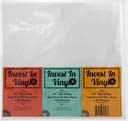
Outer sleeves are clear covers that go over the whole album jacket. They protect the artwork— from shelf wear, ring wear, spills and the slow abrasion of being pulled in and out.
That is a value question rather than a playback one. If your records are listening copies you will keep, outers are optional. If any of them are collectible, or you care about the covers as objects, they are worth it. The practical spec is thickness: 3 mil polypropylene or polyethylene is noticeably more durable than the standard 2 mil, and a flush-cut opening avoids the flap of excess plastic sticking up above the jacket.
If you can only do one: inners protect the record, outers protect the cover. Do the inners first.
Crates, cubes and shelves
The furniture requirements are simple and mostly about load. A record is heavier than it looks and a hundred of them will destroy a shelf not designed for it. What to check:
- Depth of at least 13 inches so a 12-inch jacket sits fully supported rather than overhanging.
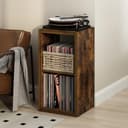
- A stated load rating.The Furinno cube stand quotes 30 lb per shelf and roughly 55 records per cube — a published figure, which is more than most listings offer.
- Wall anchoring for anything tall, especially with a turntable on top.
- Rigidity if the turntable will live on it. A light stand transmits footfall straight into the plinth, which shows up as skipping or muddy bass rather than as obvious vibration.
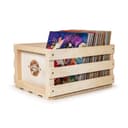
The Crosley crate is the cheapest correct answer for a first 75 records. The Furinno cube stand is the one to buy if you want the deck and the records in the same piece of furniture — its open back also lets cables reach the wall instead of forcing the turntable forward.
Environment: the part that costs nothing
Vinyl deforms with heat and its jacket degrades with humidity and light. The preservation guidance for institutional collections is cool and stable — roughly 46-50 °F at 30-40 percent relative humidity — but the domestic version is simpler and nearly as effective:
- Never in direct sunlight. A record left on a sunny windowsill or in a car will warp within hours.
- Never against a radiator or above a heat source. Including on top of an amplifier.
- Never on a concrete floor or in a damp basement. Moisture wicks into jackets and encourages mold on the paper.
- Stable beats cold. Repeated cycling between warm and cold is worse than a consistently mild room.
Full detail, including the myths worth ignoring, is in how to store vinyl records.
The order to buy in
- Inner sleeves for anything still in plain paper. Cheapest item here, biggest effect on the vinyl itself.
- Somewhere vertical to put them— a crate, a cube, a shelf that is deep and strong enough.
- Outer sleeves if you care about the jackets or the collection has resale value.
- Better furniture once the collection outgrows the crate, which happens faster than anyone expects.
And clean before you sleeve. Sealing a dusty record into a new anti-static inner just preserves the dust — see the record cleaning kits. And if the collection is about to be boxed up for a move or sold on, the sleeves above are step one of a different job: packing and shipping records covers the rest of it.