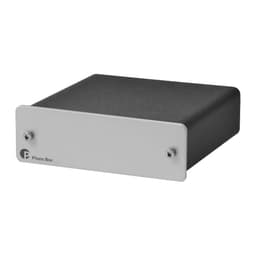
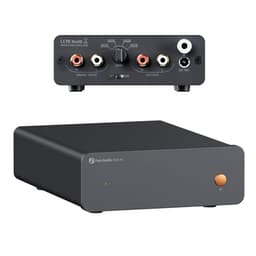
How these were ranked
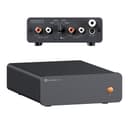
- MC support stated by the maker, not inferred.All three publish moving-coil capability. That is the entry requirement, and it rules out most phono stages at this money — including two of the picks on our under-$100 page, which are moving magnet only.
- Adjustable loading, where it exists. An MC cartridge publishes a recommended load impedance, and getting near it is what a switchable stage is for. Pro-Ject publishes adjustable loading; Fosi publishes that its loading is not adjustable, which is a legitimate trade at the price and is why it is the budget pick rather than the top one.
- Published gain figures, read as figures.Fosi prints four switchable settings — 38, 48, 56 and 66 dB — which is the clearest gain ladder on this page. iFi publishes a noise floor of -141 dBV but does not publish a gain figure at all, so that row reads “Not published” in the table rather than carrying a number from a retailer.
- What else is on the box. A subsonic filter (iFi), a dedicated ground post (Fosi), a metal chassis (all three). These are small things that decide whether a stage is quiet in a real room, and they are published rather than claimed.
- Live and in stock, checked the day this page was written. Prices render from the price feed with their own as-of stamp. One pick came back with limited stock, which the button reflects rather than this sentence.
Gain, in numbers you can act on
The useful way to think about it: gain has to make up the difference between what your cartridge produces and the roughly 200 mV to 2 V a line input wants. A 5 mV moving magnet needs about 40 dB. A 0.5 mV high-output moving coil needs about 60 dB. A 0.2 to 0.3 mV low-output moving coil needs 65 dB or more, and below that you are into step-up transformers and head amps, which are a different purchase entirely and not one this site ranks.
Read your cartridge’s published output first, then pick the stage whose ladder covers it with a setting to spare. Too little gain gives you a thin, quiet record. Too much gives you a noise floor you can hear between tracks — which is why a stage with four settings is more useful than one with a single high setting, and why the Fosi’s 38/48/56/66 dB ladder earns its place here despite the fixed loading.
And the rule that applies regardless of cartridge type: there is exactly one phono stage in a correct chain. A deck with a switchable built-in stage left on PHONO feeding one of these boxes produces distorted, uncontrollably loud mud. Our do I need a phono preamp page walks the decision and phono vs line explains the two input labels that cause it.
Loading, and why the top pick wins on it
Loading is the impedance the preamp presents to the cartridge. For a moving magnet it is close to standardized — 47 kΩ is the near-universal figure, and the Goldring E3 and Ortofon 2M series both publish exactly that. For a moving coil it is not: MC cartridges publish recommended loads that vary widely by design, and the figure interacts with the cartridge’s own internal impedance.
So for MM use, fixed loading costs you nothing. For MC use it can cost you the match, and that is the single reason the Pro-Ject Phono Box DC is ranked first here: it is the only pick that publishes adjustable loading alongside its MC setting. If you already own an MC cartridge, check its published recommended load against what each box offers before you choose — that comparison is more useful than any ranking on this page.
When not to buy any of these
Three cases, and they cover most readers who arrive here.
If your cartridge is moving magnet— which it almost certainly is, including every cartridge this site ranks — you do not need MC capability, and paying for it buys a switch you will never flip. Our phono preamp picks and picks under $100 are the right pages, and a good MM-only stage at the same money will be the better box.
If your deck already has a switchable built-in stage— the Fluance RT81, every current Audio-Technica deck — then the question is whether an external box beats it, not whether you need one. Our page on whether a better phono stage makes a difference answers that by case.
If your tonearm cannot carry or align an MC cartridge properly, the preamp is the wrong end of the problem. MC cartridges reward precise alignment and a well-damped arm, and on an entry deck the money does more in a better stylus. Our upgrade-order page sets out that sequence, and our alternatives to the Ortofon 2M Red covers the high-output cartridges that need none of this.