Do You Need a Phono Preamp With Powered Speakers?
Usually yes — but powered speakers are the one case where the generic answer is wrong often enough to check first, because the preamp can already be hiding in either box.
How this is funded: we earn a commission if you buy through our links, at no extra cost to you. It never changes which product we recommend, and we’ll tell you plainly when to skip one. Full disclosure.
The generic answer to “do I need a phono preamp” is: a turntable needs one somewhere, and most systems do not include it by default. That is correct, and with powered speakers it is wrong often enough to be worth checking before you spend anything.
Powered speakers are the case where a preamp can be hiding in eitherbox — some turntables include one, and a small but growing number of powered speakers do too. If both do, you have to switch one off. If neither does, nothing works. Three minutes of checking saves either a wasted purchase or a confusing sound problem.
What a powered speaker does and does not do
A powered (or active) speaker has an amplifier inside the cabinet. That is the whole meaning of the word. You do not need a separate amplifier, which is why powered speakers are the standard answer for a small vinyl system — two boxes and a cable.
What that amplifier expects is a line-level signal: roughly 0.3 to 2 volts, already RIAA-corrected. A phono cartridge produces a few thousandths of a volt with the RIAA curve still applied. So the amplification inside a powered speaker does not remove the need for a phono stage. They solve two different problems, and do you need an amp covers the other one.
The three-minute check
Answer these two questions before buying anything.
Question 1: does your turntable have a built-in preamp?
Look at the back panel for a switch marked PHONO / LINE, or a specification line saying “built-in preamp” or “phono equalizer”. Most decks under about $400 have one; most enthusiast decks above that deliberately do not. Detailed identification in what is a built-in phono preamp.
Question 2: do your powered speakers have a phono input?
Look for an RCA input labeled PHONO, usually with a small ground screw beside it. The ground post is the giveaway: no manufacturer fits one next to a line input. Most powered speakers — Edifier R1280T, Fluance Ai41 and the rest of the mainstream field — do not have one. Kanto’s YU range, Klipsch’s The Fives and Andover’s Spinbase do.
The four possible answers
| Turntable preamp | Speaker phono input | What to do |
|---|---|---|
| Yes | No | Nothing to buy. Set the deck to LINE, run RCA into the speakers’ line input. |
| No | Yes | Nothing to buy. Run RCA into the speakers’ PHONO input and attach the ground wire. |
| No | No | Add a standalone phono preamp between them. This is the common case. |
| Yes | Yes | Use one only. Either deck to LINE into the speakers’ line input, or deck to PHONO into the speakers’ phono input. |
Which of the three routes to choose
If you are buying the whole system rather than filling a gap, the three routes have genuinely different trade-offs.
Route A — powered speakers with the phono stage inside. Two boxes, one cable, nothing to configure. It is the tidiest vinyl system that exists. The cost is flexibility: you cannot upgrade the phono stage without replacing the speakers, and the built-in stage is fixed-gain moving-magnet only. Our roundup of powered speakers with a phono preamp covers the field.
Route B — a standalone preamp between deck and speakers. Three boxes. The most flexible and the most upgradeable: a $100 stagealready outperforms most built-in circuits, and you can move up later without touching anything else. Also the only route that lets you match gain and loading to a specific cartridge — see gain and impedance.
Route C — a turntable with a switchable preamp inside. Two boxes, and the deck stays useful if you later buy a better stage, because you can switch the internal one out. The most common answer for a first system, and the reason we keep a roundup of decks with one.
The mistake to avoid: two stages in series
If your turntable has a preamp set to LINE and you plug it into a speaker’s PHONO input, the signal is amplified and RIAA-corrected twice. The result is loud, distorted and boomy — unmistakable once you know what it is. It is not a fault and it will not damage anything if you catch it quickly, but it sounds awful.
The rule is simple: exactly one phono stage between cartridge and speaker. Whichever route you pick, make sure the other options are switched off or unused. Full symptom guide in phono vs line.
A note on speakers with a single input
Some powered speakers have only a 3.5 mm input, or only Bluetooth. Those still work — you need an RCA-to-3.5 mm cable and a line-level signal from the deck — but they cannot accept a raw phono signal under any circumstances, so a phono stage upstream is mandatory. And on Bluetooth-only speakers you also need the transmitter to be fed a line-level signal, which is exactly what a Bluetooth turntable’s internal preamp is doing before the radio stage. That is covered in our Bluetooth turntable roundup.
One of these three, never two
Each route puts exactly one phono stage in the chain. Pick whichever matches the equipment you already own.
Route A — speakers with the preamp inside
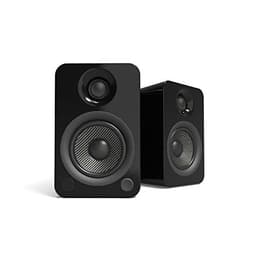
Kanto YU4
A complete turntable system on a desk or a narrow shelf — no separate preamp
Route B — add a preamp box
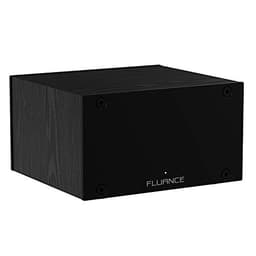
Fluance PA10
A solid mid-priced MM upgrade
Price as of October 15, 2026. #ad How we’re funded
Route C — deck with the preamp inside
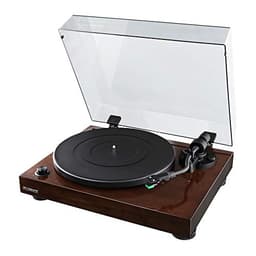
Fluance RT81
First serious turntable that you won't outgrow in a year
Price as of October 15, 2026. #ad How we’re funded
Frequently asked questions
Do I need a phono preamp with powered speakers?
You need a phono stage somewhere in the chain. Most powered speakers accept line-level input only, so unless your turntable has a built-in preamp or the speakers have a PHONO input, you need to add one. Check both boxes before buying anything — a large share of the time one of them already has it.
Can I connect a turntable directly to powered speakers?
Only if there is a phono stage on one side of that connection. A turntable with a switchable built-in preamp set to LINE connects directly to any powered speakers. A preamp-less turntable connects directly only to powered speakers that have their own phono input.
Do powered speakers have a phono preamp built in?
Most do not. Line-level RCA, optical and Bluetooth are the normal inputs. A minority — Kanto's YU range, Klipsch's The Fives, Andover's Spinbase — do include one, and they advertise it prominently because it is a differentiator. Look for an input labeled PHONO and a ground post beside it.
What happens if both my turntable and my speakers have a phono preamp?
Use one and disable the other. If the turntable has a PHONO/LINE switch, set it to PHONO and let the speakers do the work, or set it to LINE and use the speakers' line input. Two phono stages in series produce a loud, distorted, bass-heavy sound.
Do I need an amplifier as well as a phono preamp for powered speakers?
No. Powered speakers contain their own amplification — that is what 'powered' or 'active' means. The only thing potentially missing from the chain is the phono stage. Passive speakers are the ones that also need an amplifier.
Will a phono preamp make my powered speakers louder?
It will bring a turntable up to the level everything else plays at, yes — but that is it doing its job, not adding volume. If a turntable is faint through powered speakers at full volume, the missing phono stage is the cause, and adding one fixes it completely.
Sources
- Crutchfield — How to choose a phono preamp — On why a phono signal needs a preamp and never running two at once (accessed July 24, 2026)
- Crutchfield — Home speakers buying guide — Reference on choosing passive vs powered speakers, room size and amplifier pairing (accessed August 11, 2026)
- Kanto Audio — YU4 powered speakers — Manufacturer page for the built-in phono preamp, aptX Bluetooth and cabinet dimensions (accessed August 19, 2026)
- Andover Audio — Spinbase 2 — Manufacturer page: phono input, ISOGroove anti-feedback design for a turntable placed on top (accessed August 19, 2026)
Keep reading
Best Powered Speakers With a Phono Preamp
The shortlist that removes the extra box entirely.
See the picksPhono vs Line
What the two labels mean, and how each mistake sounds.
Read the explainerBest Powered Speakers
The full powered field, with phono inputs flagged.
See the picksDo You Need an Amp for a Turntable?
The other half of the question: amplification, not equalization.
Read the explainer