How we ranked them
Four criteria, applied in this order. All of them are things a maker either prints or declines to print — none of them is an impression of how a speaker sounds, because we own none of these cabinets and have not heard them.
- Published sensitivity. How loud a speaker plays for a given amount of amplifier power. This is the single most useful number on a tower’s spec sheet for someone building a vinyl system, because it decides whether the amplifier is a $100 purchase or a $500 one. A speaker in the mid-nineties runs happily on a small Class D integrated; a speaker at 86 dB wants real watts.
- The published low-frequency limit. The reason to buy a tower at all. If a floorstander does not reach lower than the bookshelf pair it replaces, it is just a bookshelf speaker with a stand welded on and a larger footprint.
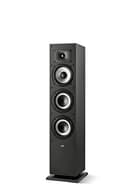
- Nominal impedance, and whether the maker states it plainly. A 6-ohm nominal load is harder work than 8 ohms, and cheap amplifiers do not all cope. Polk goes further than anyone here and prints the amplifier range it wants.
- What the listing actually sells you. A single speaker or a pair. It changes nothing about sound and everything about the price, and it is where the mistakes on this page happen.
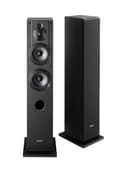
Where a figure is missing, we record Not published and say so rather than borrowing a number from the previous generation of the same model. That matters once on this page, and it is the reason the Sony sits last — see its entry for exactly which sources were read. Everything here follows the approach set out in our methodology.
What a tower actually buys you over a bookshelf pair
One thing, mostly: bass you can hear without a subwoofer. A floorstanding cabinet holds more air and more driver area than a bookshelf box, and both of those convert directly into low-frequency output. The numbers on this page make the case cleanly — 30 Hz for the Fluance Ai81, 35 Hz for the XL8F, 38 Hz for the Klipsch and the Polk — against bookshelf speakers of the same money that typically publish a limit somewhere in the high forties to low sixties.
On records that gap is audible more often than it is on streaming, because a great deal of what people play on vinyl has real low-frequency content: the left hand of a piano, an upright bass, a kick drum recorded in a room rather than sampled. A bookshelf pair rolls those off and your ear fills in the fundamental. A tower plays it.
What a tower does not automatically buy you is better midrange or treble. Three of the six here are two-way designs: one tweeter and one or two woofers that also cover the vocal range. Our bookshelf picks include two-ways using the same driver technology in a smaller box, and on a vocal record the difference is small to none. If you want the tower to improve the middle of the music as well as the bottom, look at the three-ways — the ELAC and the Fluance XL8F — where a dedicated crossover hands bass to its own drivers and leaves the others alone.
And a tower costs you floor space in a way that is easy to underestimate on a listing page. The Fluance XL8F is 45.86 inches tall and 47.70 lbs per cabinet. That is a piece of furniture, twice, and it has to stand away from the wall.
The feedback problem, which is specific to vinyl
This is the part a home-cinema buying guide will not tell you, because it only happens with a turntable in the room.
Acoustic feedback is a loop. The speakers put low-frequency energy into the air and into the floor; that energy reaches the turntable’s plinth and platter; the stylus, which cannot tell the difference between groove modulation and the room shaking, reads it as signal; the amplifier amplifies it; the speakers reproduce it louder. Past a certain volume the loop becomes self-sustaining and you hear a low howl that gets worse the louder you turn it up.
Floorstanders make this more likely than bookshelf speakers for three reasons, all of them mechanical. They produce more output below 60 Hz, which is the frequency range that couples into furniture. They sit directly on the floor rather than on a stand with a decoupling pad under it. And a down-firing woofer — which is exactly what the Fluance XL8F uses to reach 35 Hz — fires that energy straight into the floorboards.
The fixes are all free or nearly free, and they are the same fixes as ever: do not stand the turntable on the same surface as the speakers; do not put it between them; put the deck on a shelf fixed to a wall, or on a heavy, separate piece of furniture; level it; and if the floor is suspended timber rather than concrete, expect to care about all of this more. Our troubleshooting guide walks through diagnosing a feedback loop, and turntable isolation covers the platforms and feet that solve the stubborn cases.
You still have to buy an amplifier — and a phono stage
Five of the six speakers here are passive. They have no amplifier inside them, so a turntable cannot be plugged into them under any circumstances. Between the deck and a passive tower there must be two things: a phono preamp, which boosts the cartridge’s tiny output and applies the RIAA equalization curve, and an amplifier, which drives the speakers. An integrated amplifier with a PHONO input does both jobs in one box, and that is the cheapest sane route; our amplifier picks are chosen on exactly that basis. If you are not sure which pieces you already have, start with do you need an amp for a turntable?
This is where sensitivity stops being an abstraction. A 96 dB speaker and an 86 dB speaker in the same room, fed the same amplifier, do not play at the same volume — and the gap is large enough that it changes what you can buy. The Klipsch is the one on this page that a modest amplifier drives to a volume you will never use indoors. The ELAC, at 86 dB into 6 ohms nominal, is the one that genuinely rewards a bigger amplifier, and the one most likely to sound thin and strained on a cheap one.
The exception is the Fluance Ai81 Elite, which is powered: 150 watts of Class D amplification live in the right-hand cabinet, and the turntable connects to an RCA input directly. It removes a box, a shelf and a purchase. What it does not remove is the phono stage — Fluance prints “Phono Preamp: No” in its own specification table, so the deck needs a built-in switchable stage (most current Fluance, Audio-Technica and Sony decks have one) or a separate preamp between the two. The same question, asked across every brand, is the subject of speakers with a phono preamp built in, where the pairs that need nothing at all are collected.
Single or pair: the listing trap
Floorstanding speakers are the one hi-fi category where the retail convention is genuinely confusing, because the industry sells them both ways and the listings do not shout about it.
On this page the Klipsch R-600F, the ELAC Debut 2.0 F5.2, the Polk Monitor XT60 and the Sony SS-CS3M2 are each priced as one speaker. The Fluance XL8F and the Fluance Ai81 Elite are priced as a pair. That single line reorders the whole page by cost: a tower that looks like the cheapest thing here is, for a stereo system, roughly the same money as one that looks twice its price.
It is also the reason the comparison table at the top of this page has a “Sold as” column before anything about sound. Check it on the product page too, immediately before you buy — sellers list the same model both ways, and the number on the button is the one that is live right now.
Placement, and how much room you actually need
Three practical constraints, none of which appear on a spec sheet.
- Distance from the wall. Four of these six are rear-ported or rear-vented. A port close to a wall loads differently and the result is a thick, one-note bass. Plan on at least a hand’s width behind the cabinet, and more if you can. The Polk is the exception and the reason it is worth knowing about: it uses two passive radiators instead of a port, so it is the most tolerant speaker here of a wall behind it.
- Distance apart, and from you. Towers image best with some separation and a little toe-in toward the listening seat. In a small room a pair of floorstanders pushed into the corners will give you more bass and less of everything else; if the room is genuinely small, a bookshelf pair on stands is often the better speaker.
- What is under them. Carpet spikes or rubber feet both work; what matters is that the cabinet is not rocking. An unstable 40-lb tower is both an acoustic problem and, in a house with children or animals, a real one. Most of these ship with feet or spikes in the box.
Which should you buy?
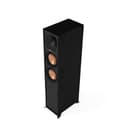
- You already own, or will buy, a small amplifier: the Klipsch R-600F. 96 dB published sensitivity means the amplifier is nearly a non-decision. Remember to buy two.
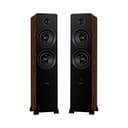
- You want one purchase that finishes the speaker half: the Fluance XL8F. A three-way pair with the deepest published passive bass here, for a pair price that beats two of the single speakers on this page.
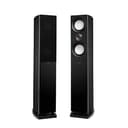
- You do not want an amplifier in the room at all: the Fluance Ai81 Elite — provided your turntable has its own phono stage, because these do not.
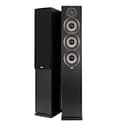
- You care most about the midrange: the ELAC Debut 2.0 F5.2, the only speaker here whose tweeter is never asked to do anything but treble. Budget for a real amplifier to go with it.
- You want the cheapest honest tower: the Polk Monitor XT60, which also happens to be the one you can place closest to a wall.
- You want the widest bandwidth on paper: the Sony SS-CS3M2, with a super tweeter to 50 kHz — as long as you are comfortable choosing an amplifier without a sensitivity figure to work from.