How we chose these seven
Four criteria, applied in this order. None of them is a listening claim, because we make none.
- The maker publishes a load rating. This is the whole specification. An isolator is a spring, and a spring has a working range; without a published figure there is no way to know whether your deck sits inside it. That one rule removed the large majority of what a search for “turntable isolation” returns.
- It is a real, identifiable brand. This category is flooded with aluminum spring feet and cork squares sold under storefront names that change every few months, many of them quoting no load figure whatsoever. Every pick here comes from a company that also makes turntables, platforms or hi-fi accessories under its own name and can be held to what it prints.
- The three jobs all had to be covered. Footfall, acoustic feedback and a poor supporting surface are three different problems with three different answers, and a list of seven platforms would only serve one of them. So the set runs from $20 feet to a wall-mounted steel shelf.
- It has to be buyable today. Every listing here was checked for a live, in-stock offer with a real price before it went on the page. Several well-known products failed that check and are named further down rather than quietly left out.
Load rating is the spec, and it cuts both ways
Almost every isolation product is sold on the claim that it reduces vibration. Almost none explains the condition attached to that claim, which is that the thing has to be carrying roughly the weight it was designed to carry. There are three ways to get it wrong, and two of them are invisible.
- Over-loaded. The compliant element squashes flat and stops behaving like a spring. This is the failure mode Fluance publishes for the IB40: above 25 lb you “compress the feet and reduce” the base’s “ability to isolate the turntable from vibrations.” You have bought a heavy shelf, which is not useless, but it is not what you paid for.
- Under-loaded. The less obvious one, and the reason Vibrapod publishes a range rather than a ceiling. Its Model 5 is specified at 22 to 28 lb per isolator. Put a 6 lb deck on four of them and nothing deflects at all: the deck is effectively standing on hard plastic. This is why “supports up to” figures are weaker information than a range, and it is the most common mistake in the category.
- Overhanging. A platform whose footprint is smaller than the deck does not support the rear feet, and a turntable resting on two of its four feet is worse off than it was on the shelf. Fluance and IsoAcoustics both publish their platform dimensions; you have to supply your deck’s.
So the spec tables on this page lead with the rating, and where a maker does not publish one the row says so rather than guessing. Here is the published set, in one place:
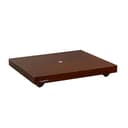
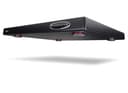
- Fluance IB40 platform — 25 lb (11.34 kg) total, with a maximum turntable footprint of 17.13 x 14.96 in.
- IsoAcoustics zaZen I platform — 25 lb (11.3 kg) total, on a 17 x 15 in surface. The zaZen II is rated to 40 lb, and was not on Amazon when we checked.
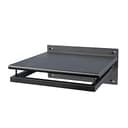
- Pangea Premier SE MKII wall shelf — 40 lb, on an 18 x 15.5 in shelf, with the fastener combination that rating assumes published alongside it.
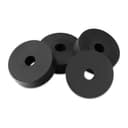
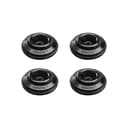
- Pro-Ject Damp It feet — up to 5 kg (11 lb) per foot, up to 20 kg (44 lb) on four. Pro-Ject also publishes a working band of 20 to 500 Hz.
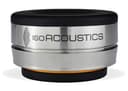
- IsoAcoustics OREA — 8 lb per unit on the Bronze, with a published minimum of three units per component, so 24 lb on three and 32 lb on four. The range runs 4 lb (Graphite) to 32 lb (Bordeaux) per puck.
- Vibrapod Isolators — a range per pod, not a maximum: Model 1 is 2–3 lb, Model 2 is 4–8 lb, Model 3 is 8–12 lb, Model 4 is 14–18 lb and Model 5 is 22–28 lb, each with a published optimum.
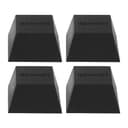
- Hudson Hi-Fi IsoBlock — 37.5 lb per pad on the Firm Block and 15 lb on the Soft Block in the published spec block, though the same page also prints a 150 lb figure in body copy that appears reused from another product.
Measure two things before you order
Your turntable’s weight decides which isolator is in range. Its footprint decides whether a platform is even an option. Both are usually published in the deck’s own manual, and if they are not, a bathroom scale and a tape measure settle it in two minutes. Two worked examples from decks this site covers, both read from Audio-Technica’s published manuals:
- AT-LP120XUSB — 452 mm (17.80 in) wide, 352 mm (13.86 in) deep, 8 kg (17.6 lb) without the dust cover. That width is larger than the IB40’s published 17.13 in footprint limit and larger than the 17 in zaZen I, so neither platform on this page fits it. Its weight, though, sits comfortably inside Pro-Ject’s 20 kg four-foot rating and inside Vibrapod’s Model 2 band on a set of four. For this deck, feet are the answer and a platform is not.
- AT-LP60X — 359.5 mm (14.15 in) wide, 373.3 mm (14.70 in) deep, 2.6 kg (5.73 lb). It fits both platforms with room to spare and is far under both ceilings. But at roughly 1.4 lb per corner it is below the published range of every compliant foot here, including Vibrapod’s lightest. On a deck this light, a platform is the sensible purchase and isolation feet are a guess.
That second example is the one most buying guides get backwards. The cheapest decks are the lightest decks, and the lightest decks are the hardest ones to isolate with feet, because there is not enough mass to work the spring. If your deck weighs under about 8 lb, put it on something heavier and flatter rather than on something softer.
Which of the three problems do you actually have?
Isolation is not a general upgrade. It is a fix for a specific complaint, and the complaint determines the product. Fluance is unusually direct about this for a company selling the thing: it recommends its base specifically “if you are experiencing a rumble that only seems to happen at higher volume levels.” That is one symptom out of three.
- The needle skips when someone walks past. This is footfall through a suspended floor, and it is the one problem no set of feet reliably solves, because the energy is arriving through the structure the furniture is standing on. The answer is to get off that structure: a wall shelf bolted into studs, which is exactly what the Pangea is for. A heavy platform helps at the margins; a wall bypasses the problem.
- Bass goes thick and indistinct as you turn it up, or it howls. This is acoustic feedback — the speakers are reaching the cartridge through the air and the furniture, and the loop gets louder as you do. Move the deck away from the speakers and never between them first, because that is free. Then decouple: feet or a platform, either of which breaks the furniture half of the path.
- The shelf itself is the problem. A flexing MDF bookcase shelf, a cabinet top that drums, or a surface that is not level. Here a platform is the right answer and feet are not, because what you need is a rigid flat plane that the deck can be leveled on. The IB40 is the pick in this case precisely because the adjustable feet and bubble level mean leveling is part of the product, and a level deck is worth more to tracking than any damping material.
Feet, platform or wall shelf
Feet are the cheapest intervention and the only one that does not care how big your deck is. They slide under the existing feet, add 12 to 16 mm of height, and have to be re-leveled afterwards. Their weakness is the load-range problem above: they only work inside a band, and on a very light deck there may be no band that fits.
Platforms add mass and a known-flat surface as well as compliance, which makes them the more complete answer when the supporting surface is the fault. They are also the only type with a hard size limit, and on a wide deck that limit is disqualifying. Between the two here, the Fluance is cheaper and levels itself; the IsoAcoustics is thinner and builds its isolators into the design rather than relying on rubber feet.
A wall shelf is the only one that changes what the turntable is standing on rather than what is between it and the shelf. It costs the most in effort — you are drilling into studs and the 40 lb rating assumes you hit them — and it is the only option that genuinely answers footfall. It is also the one to think about before you buy stands for the speakers, since getting the two apart is half of feedback control.
What none of these makers publish
For all the load ratings, the thing that would actually let you compare these products is missing from every one of them: a resonance frequency and a transmissibility curve, measured, with a stated method. Not one of the seven publishes one on its product page. IsoAcoustics comes closest — its Amazon listing cites testing at the National Research Council of Canada, though its own product page for the OREA does not repeat the claim.
Which means the honest position on every percentage and adjective in this category is skepticism. Hudson Hi-Fi publishes that its feet “absorb up to 95.32% of vibration and resonance” — a figure precise to two decimal places with no frequency, no load and no test method attached, and it is the reason that pick is ranked last despite being the cheapest. Fluance claims “enhanced audio clarity” from its base. Pro-Ject calls its feet a “true sound upgrade.” We are not in a position to confirm or contradict any of it, so we have ranked what is checkable: the ratings, the dimensions, the mechanism and the price band.
Who should not buy any of this
Five cases where the correct spend is zero, and between them they cover most people who land on a page like this.
- Nothing is wrong. If your deck is on a solid surface, away from the speakers, and you are not hearing rumble, feedback or skips, there is no problem here for a product to solve. Isolation is remedial, not an upgrade path — and the company selling the platform says the same thing in its own support article.
- The deck is not level and that is the whole fault. Level it with its own feet, or shim it, and re-check tracking force. Our tonearm balancing guide covers the sequence. A $200 platform under an unlevel turntable is still an unlevel turntable.
- You can move the turntable instead. Getting the deck out from between the speakers, or off the same piece of furniture, removes more feedback than any product on this page and costs nothing.
- The real problem is the record or the stylus. Surface noise, crackle and sibilance are cleaning and wear problems. Start with a cleaning kit and then a fresh stylus. Isolation does nothing for any of them.
- Your deck weighs under about 8 lb and you were going to buy feet. The published ranges say it will not load them. Put the money toward a platform, a better shelf, or nothing.
Products we would have ranked, and could not
IsoAcoustics Delos is the obvious omission from a page about turntable isolation: a butcher-block platform with the same integrated isolators, in maple or walnut, in four sizes. Every listing we checked showed one or two units in stock at $440 to $880, which fails our fourth criterion on both counts, so it is named here rather than ranked. The same applies to the zaZen II, the 40 lb version of a pick that made the list, which is not sold on Amazon at all — if your deck is over 25 lb, that is worth knowing before you click the zaZen I.
Auralex’s GRAMMA v2 platform is a long-standing product in this space and showed four units in stock when we checked, which is too thin to rank; Auralex also markets it for amplifiers and speaker cabinets rather than turntables, and publishes no weight rating for it.
The unbranded end of the market — the aluminum spring feet and cork squares that fill the search results at $10 to $30 — is excluded on the second criterion, not on price. Several of them are physically plausible. None publishes a load range, none names a deck type, and there is no maker standing behind the figure. In a category whose entire mechanism depends on matching a weight to a spring, a spring with nobody’s name on it is not a specification. That is the same exclusion we applied to unbranded record weights and felt platter mats.
Installing them without making things worse
Four habits, none of which cost anything.
- Re-level the deck afterwards, every time. Every product here changes the height of at least one corner. Compliant feet compress unevenly depending on where the deck’s mass sits, and a three-puck installation is balanced on three points. Check the platter with a bubble level before you play anything.
- Do not stack isolation on isolation. Soft feet on a compliant platform gives you two springs in series, neither working in the range it was specified for, and a deck that rocks when you cue it. Pick one layer. If your deck already has genuinely adjustable isolation feet — several Fluance decks do — a platform under them is the layer to add, not more feet.
- Check the dust cover and the height. A platform adds 1.2 to 2.5 in. On a shelf with limited clearance, that can stop the cover opening fully, and a half-open cover resonates — which is a vibration problem you have just created while solving another one.
- Test it honestly. You are trying to fix a specific symptom, so check that symptom: play the record that skipped, at the volume that made bass go thick, and walk past the deck the way you did before. If nothing changed, the problem was not the one you bought for — and that is worth knowing inside the return window.
The honest summary
Isolation is real physics sold with unreal confidence. A turntable genuinely is sensitive to vibration, and decoupling it genuinely helps when vibration is the fault — but the size of the effect depends on a load match that the majority of products in this category decline to specify, and the measurements that would let you compare them do not exist in public. So buy on the published rating and the diagnosis, not on the adjectives.
The short version: if the floor bounces, mount the deck on a wall. If the shelf is poor or the deck is light, buy a platform and make sure your turntable physically fits it. If the deck is wide or heavy, buy feet with a published rating that covers it. And if nothing is actually wrong, put the money toward a better cartridge or better speakers, where the improvement is not conditional on a problem you do not have.
One job none of these products does, whatever it costs: none of them levels anything. A platform sits at the angle of the shelf under it, and a compliant isolator settles to whatever its load dictates — so do the free step first, with our guide to leveling a turntable, and isolate on top of a level surface.