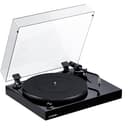
The five things that separate an audiophile deck from a good one
Mass in the right places
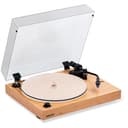
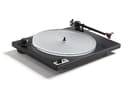
A stylus reads groove modulations measured in microns. Anything that moves the deck — footfall, a speaker cabinet, the motor itself — appears in the signal as noise. Mass and damping are the crude but effective answer, which is why every deck here has a heavy MDF or damped plinth, isolation feet, and an acrylic or heavy-alloy platter. The Fluance RT85’s acrylic platter and the U-Turn Orbit Special’s are the clearest examples.
An arm that doesn’t flex or rattle
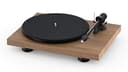
The tonearm has one job: hold the cartridge at a fixed angle while the groove tries to push it around. That demands stiffness without mass, which is why the Pro-Ject Debut Carbon EVO uses a one-piece carbon fiber tube rather than a stamped and welded aluminum one. Bearing quality matters just as much and is almost never published; the proxy is brand pedigree and price.
A cartridge worth the arm
The single component that most determines what you hear. Every deck here ships with a cartridge from Ortofon or Sumiko rather than an unbranded part, and every one of them accepts a standard half-inch mount, so the upgrade path is open. If you are weighing tips, the AT-VM95E vs Ortofon 2M Red comparison explains what elliptical, nude elliptical and micro-linear profiles actually do differently in the groove.
Nothing extra inside the plinth
A phono stage inside a turntable sits inches from a motor and a mains transformer, amplifying a signal of a few thousandths of a volt. Leaving it out is a fidelity decision, not a cost saving. The same logic applies to Bluetooth transmitters, which additionally convert the signal to digital and compress it. If a deck advertises both audiophile intent and Bluetooth, those two claims are in tension.
Speed you can trust
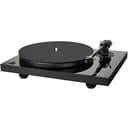
Wow and flutter is the measure of how much the platter’s speed wanders, and it is audible on sustained piano notes long before it is visible on a spec sheet. Fluance publishes 0.07%for the RT85. Several premium brands publish nothing at all, which is a choice we note rather than fill in — the Music Hall listing in particular states almost no figures, and we have left those rows unpublished rather than invent them.
What an audiophile deck demands from you
Buying one of these commits you to three things. First, a separate phono stagefor most of them — and a good one, because a $600 deck through a $20 preamp is a $20 system. Second, setting the deck up properly: level plinth, correct tracking force, correct anti-skate, correct overhang. An audiophile deck set up carelessly performs worse than a $180 automatic set up by the factory. Third, a rigid, isolated surface to put it on. A heavy deck on a wobbly shelf next to a speaker is a feedback loop.
Our cartridge setup guide covers the alignment work these decks assume you will do, and the troubleshooting guide covers what it sounds like when one of those steps is wrong.
Where the audiophile argument stops being honest
Two things worth saying plainly, because a lot of this category’s writing won’t.
The deck is not usually the limiting factor. In a system with a $600 turntable and $200 speakers, the speakers are what you are hearing. Cartridge, phono stage and speakers all sit downstream of the deck and all have more effect on the sound than the difference between two well-made belt-drive turntables at similar prices.
Diminishing returns arrive early and steeply. The jump from a $150 deck to a $350 deck is dramatic. From $350 to $650 is clear but smaller. From $650 to $1,500 is a matter of degree that many listeners cannot reliably identify without knowing which is playing. Are expensive turntables worth it? makes that case in detail, including the cases where the answer is genuinely yes.
The upgrade order we would actually follow
- Set up what you own correctly. Free, and frequently the largest single improvement available.
- Cartridge or stylus. A micro-linear tip on a decent arm changes more than a new deck of similar quality would. See cartridges under $200.
- Phono stage. Especially if you are currently using one built into a receiver or a turntable.
- Speakers, then room placement. The biggest sonic differences in any system, by a wide margin.
- The turntable itself. Last, once everything downstream can show what it does.