PLATTER & PLINTH

The Best Turntables for Sonos

Sonos supplies the amplifier and the speaker. The one thing no Sonos product supplies is a phono stage — so that is the spec this page ranks on.

By Stephen V.Last updated How we pick

The verdict

The Fluance RT81 is the turntable to buy for a Sonos system.Its built-in preamp is switchable with a full bypass, which means it feeds a Sonos line input at line level today and can be switched off later if you ever put a real amplifier on the rack — and it arrives with an elliptical cartridge and an adjustable counterweight rather than a fixed arm. If the deck has to be fully automatic, the Audio-Technica AT-LP60X is the cheapest honest way in and the AT-LP70X is the better-sounding version of the same idea. One thing to settle before you buy anything: your Sonos product needs a line input at all, and most of them do not have one.

Sonos sells speakers and amplification. It does not sell a phono stage, and no Sonos product has ever contained one. That single fact decides this entire purchase, because a turntable’s raw cartridge output is roughly a thousand times quieter than the line-level signal a Sonos line-in expects, and it carries the RIAA curve that has to be undone before it sounds like music. Sonos’ own support article puts it plainly: check whether the turntable has a built-in preamp, and “if your turntable does not have a built-in phono preamp, you will need to first connect your turntable to a phono preamp.”

So every deck below has a switchable built-in phono preamp. That is the ranking criterion, not a feature bullet. Switchable matters as much as built-in: a deck whose stage cannot be bypassed is a deck you have to replace the day you buy an amplifier, and the whole point of a Sonos system is that it grows one box at a time.

The second thing to settle is which Sonos you own. Sonos’ support article lists exactly three ways in: the Five and the older Play:5 have a 3.5 mm line-in socket; the Amp, Port, Connect:Amp and Connecttake an RCA cable into the input marked “IN”; and the Era 100, Era 300 and Move 2 accept line-in through the Sonos Line-In Adapter on their USB-C port. Nothing else on the shelf does. A Beam, an Arc, a Roam or a One cannot take a turntable at any price, and no turntable on this page changes that. Our step-by-step guide to connecting a turntable to Sonos covers the cable, the adapter and the app settings once you have the hardware.

How this is funded: we earn a commission if you buy through our links, at no extra cost to you. It never changes which product we recommend, and we’ll tell you plainly when to skip one. Full disclosure.

Quick picks

Ranked on published specs, drive/motor design and buyer fit. Select a row to jump to the full write-up. We have not heard most of these units — here is exactly what we do instead.

#ProductBest forPrice
1
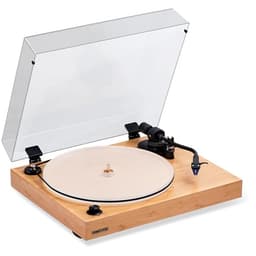
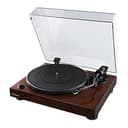
Fluance RT81

Fluance RT81

The best-value entry into real hi-fi: a manual belt-drive deck with an adjustable counterweight and anti-skate, an aluminum platter, and a genuine Audio-Technica elliptical cartridge — for the price of a good all-in-one. The switchable built-in preamp means it works today and upgrades later.

Best overall
$299.99 · View on Amazon

Price as of October 26, 2026. #ad How we’re funded

2
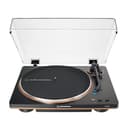
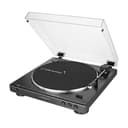
Audio-Technica AT-LP60X

Audio-Technica AT-LP60X

The default first turntable for a reason: it's fully automatic, so you press one button and it cues, plays and returns the arm on its own — nothing to set up wrong. The built-in switchable preamp lets it plug into anything, and it tracks safely enough to trust with your records.

Best budget
$179.00 · View on Amazon

$199.0010% off

Price as of October 26, 2026. #ad How we’re funded

3
Audio-Technica AT-LP70X

Audio-Technica AT-LP70X

The automatic that grew up: it keeps the one-button convenience of the LP60X but adds a proper VM95-series cartridge and a die-cast platter, so it sounds a clear step better while still cueing itself. The natural pick if you want automation without the budget-deck ceiling.

Best automatic
$249.00 · View on Amazon

Price as of October 26, 2026. #ad How we’re funded

4
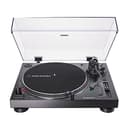
Audio-Technica AT-LP120XUSB

Audio-Technica AT-LP120XUSB

The tinkerer's deck: a direct-drive, fully manual turntable with adjustable tracking force, anti-skate, selectable pitch and a USB output for digitizing records. It ships with the VM95E elliptical and a switchable preamp, so it's ready to play and ready to grow.

Best for digitizing too
$399.00 · View on Amazon

$449.0011% off

Price as of October 26, 2026. #ad How we’re funded

5
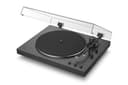
Sony PS-LX3BT

Sony PS-LX3BT

The 2026 replacement for the PS-LX310BT, and the same idea done again with newer radio: one-button fully automatic belt drive, Bluetooth out with aptX and aptX Adaptive, a switchable built-in phono stage, USB out with three gain settings, an aluminum die-cast platter and a pivot-bearing aluminum tonearm. It connects to whatever you already own, which is still the whole point of this deck.

Best hands-off
$348.00 · View on Amazon

$398.0013% off

Price as of October 26, 2026. #ad How we’re funded

The picks in full

#1Best overall

Fluance RT81

The best-value entry into real hi-fi: a manual belt-drive deck with an adjustable counterweight and anti-skate, an aluminum platter, and a genuine Audio-Technica elliptical cartridge — for the price of a good all-in-one. The switchable built-in preamp means it works today and upgrades later.

Strengths

  • Adjustable counterweight and anti-skate — you can set tracking force correctly, which the cheap automatics can't
  • Ships with an Audio-Technica AT95-type elliptical cartridge, a real step up from a conical
  • Built-in preamp is switchable, so you can bypass it when you add a better one

Trade-offs

  • Manual operation — you cue and lift the arm yourself
  • No Bluetooth or USB; this is a wired, listen-at-home deck
  • The fitted AT95E cartridge and its ATN95E stylus are both badged discontinued on Audio-Technica's own site — budget a current cartridge as the first upgrade
DriveBelt drive
OperationManual
CartridgeAudio-Technica AT95E (bonded elliptical)
Built-in preampYes — switchable, full bypass
Speeds33 1/3 and 45 RPM
PlatterAluminum, 1.22 lb (553 g), rubber mat
Wow and flutter0.2%

Note. The counterweight and anti-skate are the reason this deck belongs in a different class from the sub-$150 automatics: it lets you dial in tracking force to the cartridge's spec instead of accepting a fixed factory setting.

Specifications read from the manufacturer / product listing, on October 5, 2026. “Not published” means the maker does not state that figure.

#2Best budget

Audio-Technica AT-LP60X

The default first turntable for a reason: it's fully automatic, so you press one button and it cues, plays and returns the arm on its own — nothing to set up wrong. The built-in switchable preamp lets it plug into anything, and it tracks safely enough to trust with your records.

Strengths

  • Fully automatic — start and stop at the touch of a button, no manual cueing
  • Switchable built-in preamp connects to powered speakers or a receiver
  • Tracks at a sane force with a replaceable Audio-Technica stylus

Trade-offs

  • Fixed tonearm — no counterweight or anti-skate to adjust
  • Conical (spherical) stylus is a rung below the elliptical on step-up decks
DriveBelt drive
OperationFully automatic
CartridgeAudio-Technica AT3600L (conical, replaceable stylus)
Built-in preampYes — switchable
Speeds33 1/3 and 45 RPM
Bluetooth / USBNo

Note. The fixed tonearm is the trade for the automation: you can't adjust tracking force, but you also can't set it wrong. That's the right trade for a first deck.

Specifications read from the manufacturer / product listing, on July 24, 2026. “Not published” means the maker does not state that figure.

#3Best automatic

Audio-Technica AT-LP70X

The automatic that grew up: it keeps the one-button convenience of the LP60X but adds a proper VM95-series cartridge and a die-cast platter, so it sounds a clear step better while still cueing itself. The natural pick if you want automation without the budget-deck ceiling.

Strengths

  • Fully automatic operation, like the LP60X
  • Integral AT-VM95C cartridge takes any VM95-series replacement stylus — a real upgrade ladder
  • Anti-resonance die-cast aluminum platter

Trade-offs

  • Costs more than the LP60X for a similar convenience level
  • Still no on-arm tracking-force adjustment
DriveBelt drive
OperationFully automatic
CartridgeAudio-Technica AT-VM95C (conical, VM95 series)
Built-in preampYes — switchable
Speeds33 1/3 and 45 RPM
PlatterDie-cast aluminum

Note. Because it uses the VM95 cartridge body, you can later drop in a VM95E elliptical or higher stylus without changing the whole cartridge — a real upgrade path the LP60X doesn't offer.

Specifications read from the manufacturer / product listing, on October 5, 2026. “Not published” means the maker does not state that figure.

#4Best for digitizing too

Audio-Technica AT-LP120XUSB

The tinkerer's deck: a direct-drive, fully manual turntable with adjustable tracking force, anti-skate, selectable pitch and a USB output for digitizing records. It ships with the VM95E elliptical and a switchable preamp, so it's ready to play and ready to grow.

Strengths

  • Direct drive with high torque — instant speed and a stable, DJ-style platter
  • USB output records vinyl straight to a computer
  • Full manual control: counterweight, anti-skate, pitch, and three speeds including 78 RPM

Trade-offs

  • Fully manual — no auto return
  • Heavier and larger than the belt-drive decks; overkill if you only ever play at home casually
DriveDirect drive
OperationManual
CartridgeAudio-Technica AT-VM95E (elliptical)
Built-in preampYes — switchable
Speeds33 1/3, 45 and 78 RPM
USB outputYes

Note. 78 RPM plus USB makes this the obvious deck for archiving older records, but note that true 78s need a dedicated stylus — the stock elliptical is cut for modern microgroove records.

Specifications read from the manufacturer / product listing, on October 5, 2026. “Not published” means the maker does not state that figure.

#5Best hands-off

Sony PS-LX3BT

The 2026 replacement for the PS-LX310BT, and the same idea done again with newer radio: one-button fully automatic belt drive, Bluetooth out with aptX and aptX Adaptive, a switchable built-in phono stage, USB out with three gain settings, an aluminum die-cast platter and a pivot-bearing aluminum tonearm. It connects to whatever you already own, which is still the whole point of this deck.

Strengths

  • Bluetooth out pairs straight to a wireless speaker or headphones; aptX Adaptive supports Hi-Res wireless up to 96 kHz / 24-bit
  • One-step auto start, stop and return, with a switchable phono EQ for wired setups
  • Three-level gain select (−4 / 0 / +6 dB) to match the output to whatever is receiving it
  • Aluminum die-cast platter and a precision pivot-bearing aluminum tonearm

Trade-offs

  • Bluetooth trades some fidelity versus a wired connection
  • Fixed cartridge tracking at 3.5 g; no counterweight, so the stylus is the only upgrade
  • The stylus is a Sony part and Sony states other styluses are not supported — no Sony-branded replacement for it is sold on Amazon
  • The RCA lead is permanently attached, and there is no ground terminal
  • Sony publishes no wow-and-flutter or signal-to-noise figure for it
DriveBelt drive
OperationFully automatic (one-step start, stop, return)
WirelessBluetooth output — SBC, aptX, aptX Adaptive (Hi-Res wireless up to 96 kHz / 24-bit with an aptX Adaptive receiver)
Built-in preampYes — switchable, with a rear phono/line selector
Gain selectLow (−4 dB) / Mid (0 dB) / High (+6 dB)
USB outputType-B output port per Sony's spec sheet — but two hands-on reviews list none
Analog outputCaptive RCA lead, standard (not gold-plated) jacks; no ground terminal
CartridgeMoving magnet, factory-fitted; stylus pressure 3.5 ± 0.5 g; headshell not exchangeable
TonearmAluminum alloy, precision pivot bearing; no counterweight
Platter11.65 in aluminum die-cast
Speeds33 1/3 and 45 RPM (7 in / 12 in size selector; 45 adapter included)
Wow & flutterNot published
Signal-to-noiseNot published
WeightApprox. 7 lb 11.5 oz (3.5 kg)

Note. Bluetooth OUT (deck to speaker) is the useful direction here and what makes this deck so flexible; if you care most about sound, use the wired analog output into powered speakers instead. The PS-LX5BT above it adds a one-piece chassis and a higher-grade cartridge for about a hundred dollars more.

Specifications read from the manufacturer / product listing, on September 22, 2026. “Not published” means the maker does not state that figure.

How these were ranked

  • A switchable built-in preamp, confirmed on the maker’s own spec. Every deck here publishes a phono/line switch. That is what lets it send a line-level signal to a Sonos line input with nothing in between, and what lets you bypass the internal stage later. A deck with a preamp you cannot switch off would still work with Sonos today and would be a dead end tomorrow; a deck with no preamp at all needs a second purchase before it makes any sound through a Five.
  • What the arm and the cartridge actually are.Sonos is not the weak link in this chain — the stylus is. Three of the five decks here ship with an elliptical or VM-series stylus you can replace, and the RT81 adds an adjustable counterweight, which is the difference between setting a tracking force and accepting whatever the factory left. A deck that tracks badly sends a damaged signal into a Sonos that will reproduce the damage faithfully.
  • Automatic operation, weighted up rather than sneered at. A Sonos household is usually a convenience household. Two of these decks start, return and stop on their own, and for a record played in a kitchen at 8 a.m. that is worth more than a marginally better cartridge. We have said why in automatic vs manual.
  • No credit for Bluetooth.Several Bluetooth turntables advertise wireless streaming, and it does not get them into a Sonos Five, Amp or Port — those have no Bluetooth receiver. Sonos’ own line-in instructions are wired instructions. Where a deck here has Bluetooth, it is ranked for the wired line output and the Bluetooth is treated as a bonus for a different speaker.
  • Currently buyable, checked the day this page was written. Every ASIN below returned a live, in-stock listing with a real price on October 26, 2026. Prices on this page come from the live price layer, not from a number we typed in — if one reads “check price”, the feed could not confirm it rather than us guessing.

Where the phono stage sits, and why it decides everything

A moving-magnet cartridge puts out a few millivolts. A Sonos line input wants something in the region of a volt, and it wants the signal already corrected for the RIAA equalization curve that was applied when the record was cut. A phono stage does both jobs. Skip it and you get a thin, distant, bass-less noise at a fraction of normal volume — which is the single most common “my turntable does not work with Sonos” complaint, and it is a wiring problem rather than a fault.

The opposite mistake is just as common and sounds much worse. Two phono stages in series — the deck’s own switched to PHONO into a separate preamp, or a built-in stage left on while feeding a dedicated phono box — produces a distorted, uncontrollably loud mess. There is exactly one phono stage in a correct chain, and with Sonos it is either inside the deck or in a box next to it. Never both. Our do I need a phono preamp page walks that decision properly.

Here is the part the box copy does not tell you: the built-in stages on these decks are not all equal, and none of them is the best stage you could own. They are good enough that the deck plays properly out of the box, which is a real achievement at $179. If the system ends up mattering to you, the upgrade path is to switch the deck to PHONO and feed a separate preamp — the reason every pick here is switchable. Our phono preamp picks are what that looks like.

What Sonos gets right for records, and what it does not

Sonos’ honest advantages for a record player are specific. The line-in source becomes a system source, so a record can be grouped to every room in the house from the app, and Sonos supports an Autoplay setting that switches the system to line-in when you start playing. For anyone who wants a record to come out of four rooms at once, no conventional hi-fi does that for the money.

The costs are equally specific. Grouped rooms lag behind the source speaker, which is fine for background listening and distracting if you are in two rooms at once. The signal is digitized the moment it enters the Sonos, which means your analog source is being converted — a philosophical objection for some people and an inaudible one for most. And a Sonos line-in is a fixed destination: you cannot drive a pair of passive speakers with it, so if the long-term plan is bookshelf speakers and an amplifier, Sonos is the stage before that rather than a step toward it.

One hardware note worth getting right before you order a cable. The Five and Play:5 need an RCA-to-3.5 mm stereo cable. The Amp, Port, Connect and Connect:Amp need a plain RCA-to-RCA cable into the socket marked IN. The Era 100, Era 300 and Move 2 need the Sonos Line-In Adapter— a separate purchase — plus the RCA-to-3.5 mm cable. Four of the five decks below have captive RCA leads coming out of the back, so in most cases the cable you need is the adapter or the RCA-to-3.5 mm lead, not a full set of interconnects.

Which one, by the Sonos you already own

A Sonos Five or Play:5.This is the setup these decks suit best: one speaker, one line-in, no amplifier to buy. The RT81 is the pick, and at the budget end the AT-LP60X is the honest answer rather than a compromise — a Five is a single mono-placed box in most rooms, and the ceiling on what the deck can show you is lower than it would be on a stereo pair.

A Sonos Amp. Different calculation. The Amp drives real passive speakers, so the whole chain is capable of more, and a deck with an adjustable counterweight and a replaceable elliptical stylus is worth the extra money. The RT81 is the floor here rather than the target; the Fluance RT85 plus a separate phono stage in the panel above is the pairing we would actually buy for an Amp.

A Sonos Port.The Port feeds your own amplifier, which means you probably already own the amplifier — and if that amplifier has a phono input, you do not need a Sonos line-in for the turntable at all. Wire the deck straight to the amplifier and keep the Port for streaming. Using a Port to put a turntable into a system that could take it directly adds a conversion and a delay for nothing.

An Era 100, Era 300 or Move 2. Budget for the Sonos Line-In Adapter and then buy the cheapest deck on this page that satisfies you. These are single small speakers; the AT-LP60X or the AT-LP70X is the sensible ceiling, and the money saved is better spent on the adapter and a cleaning kit.

Three decks we did not put on this page

Suitcase all-in-ones. They have speakers inside and usually no line output worth the name, and their tracking forces are high enough to wear records. We have written at length on whether suitcase record players are bad; the short version is that they are the wrong purchase for anyone who already owns a Sonos.

Bluetooth-only decks. A turntable whose only output is Bluetooth cannot reach a Five, an Amp or a Port, and a turntable is the one source where a lossy wireless hop is hardest to justify. If Bluetooth is the goal because the speaker is a Bluetooth speaker, our Bluetooth turntable picks are the right page.

Decks whose preamp cannot be switched off. Several cheap turntables have a fixed internal stage. They will work with a Sonos line-in on day one, and they cap the system permanently. Everything on this page is switchable for that reason.
The other route: a better deck plus a phono box

Nothing says the preamp has to live in the turntable. If you would rather spend the money on the cartridge and the platter, a deck with no internal stage plus a separate phono preamp feeds a Sonos line-in just as well - and sounds better doing it. This is the pairing we would buy if the budget stretched.

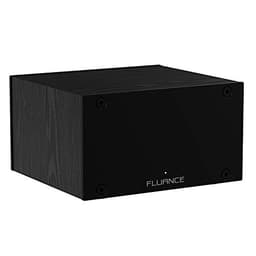
Fluance RT85

Fluance RT85

The most cartridge and platter per dollar under $600

$549.99 · View on Amazon

Price as of October 26, 2026. #ad How we’re funded

Fluance PA10

Fluance PA10

A solid mid-priced MM upgrade

$99.99 · View on Amazon

Price as of October 26, 2026. #ad How we’re funded

Frequently asked questions

Do I need a phono preamp to connect a turntable to Sonos?

Yes - the question is only where it lives. No Sonos product contains a phono stage, and a Sonos line input expects a line-level signal. So either the turntable has a built-in preamp switched to LINE, as every deck on this page does, or you add a separate phono preamp between the deck and the Sonos. Sonos' own support article says exactly this: if the turntable has no built-in phono preamp, you connect it to a phono preamp first.

Which Sonos speakers can a turntable connect to?

Per Sonos' support article: the Five and the older Play:5 have a 3.5 mm line-in socket; the Amp, Port, Connect:Amp and Connect take an RCA cable into the input labeled IN; and the Era 100, Era 300 and Move 2 accept line-in through the Sonos Line-In Adapter on their USB-C port. Models without a line input - the Beam, Arc, One, Roam and the rest - cannot take a turntable at all.

Can I connect a Bluetooth turntable to Sonos wirelessly?

Not to a Five, an Amp or a Port - those have no Bluetooth receiver, and Sonos' line-in instructions are wired instructions. Where a Sonos speaker does accept Bluetooth audio, pairing a turntable to it is still the worse of the two routes: the wired line-in avoids a lossy codec on an analog source. Treat Bluetooth on a turntable as a feature for a different speaker, not as the way into Sonos.

Will the record play in every room?

Yes, once line-in is playing on the connected speaker you can group other rooms to it in the Sonos app, and Sonos supports an Autoplay setting that switches the system to the line-in source when you start playing. Expect the grouped rooms to lag slightly behind the speaker the turntable is plugged into, which is fine for background listening and noticeable if you are standing between two rooms.

Does Sonos digitize the signal from my turntable?

Yes. A Sonos line input is an analog-to-digital converter followed by the same distribution system the rest of Sonos uses. If the appeal of records for you is an unbroken analog path to the speaker, Sonos is the wrong destination and a conventional amplifier is the right one. For most listeners the convenience is worth the conversion, and the stylus and the pressing matter far more to how it sounds than the conversion does.

Is the built-in preamp in these turntables good enough?

Good enough that the deck plays properly out of the box, which at this money is the point. None of them is the best phono stage you could own. Every pick on this page has a switchable stage specifically so you can bypass it later and feed a separate preamp - the single most effective upgrade available to a Sonos turntable setup short of changing the deck.

What cable do I need?

For a Five or Play:5, an RCA-to-3.5 mm stereo cable. For an Amp, Port, Connect or Connect:Amp, a plain RCA-to-RCA cable into the socket marked IN. For an Era 100, Era 300 or Move 2, the Sonos Line-In Adapter - sold separately - plus the RCA-to-3.5 mm cable. Four of the five decks here have captive RCA leads attached, so you are usually buying one cable or adapter rather than a set.

Can I use a Sonos Amp instead of buying a turntable with a preamp?

Not on its own. The Sonos Amp has an RCA line input and no phono input, so it still needs a phono stage in front of it. The Amp changes a different part of the decision: because it drives real passive speakers, the rest of the chain is capable of more, which makes a better deck and a separate phono preamp worth the money in a way they are not on a single Era 100.

Sources

  • Sonos — Listen to your turntable on Sonos — Sonos’ own support article, re-read in full on this date (it was previously cited here from the 2026-08-19 reading). The three line-in routes as Sonos lists them: a built-in line-in port on the Five and Play:5, taking “the single end of an RCA to 3.5 mm cable”; a USB-C port plus the Sonos Line-In Adapter on the Move 2, Era 100 and Era 300, each also needing the RCA to 3.5 mm cable; and an RCA input labelled “IN” on the Amp, Connect:Amp, Port and Connect. The phono-stage requirement in Sonos’ own words: “Check if your turntable has a built-in preamp”, and “If your turntable does not have a built-in phono preamp, you will need to first connect your turntable to a phono preamp”, which is then connected to Sonos. The page also documents Autoplay, which switches the system to line-in mode when a record starts playing. It does NOT publish a line-in level figure or a latency figure — so neither is quoted as a Sonos number anywhere on this site (accessed October 26, 2026)
  • Fluance — RT81 Elite turntable, published specifications — Manufacturer specification table, read live: belt drive, DC motor on three-point rubber isolation, 33 1/3 and 45 RPM (78 RPM "No"), speed variation +/- 1.00%, wow and flutter 0.2%, signal-to-noise "67 dB or higher (A-weighted, 20 kHz LPF)" and "60 dB or higher (unweighted, 20 kHz LPF)", aluminum platter 12 in / 1.22 lb (553 g) / 0.62 in (16 mm) with a rubber mat, static-balanced S-type aluminum tonearm 8.82 in (224 mm) effective length and 0.99 oz (28.2 g) effective mass, adjustable 100 g counterweight, anti-skating, cueing lever, pivot bearing, H-4 bayonet headshell 0.38 oz (10.7 g), "Audio Technica: AT95E" dual moving magnet cartridge with a 0.4 x 0.7 mil bonded elliptical diamond on an aluminum cantilever at 2.0 g tracking force, 20-20,000 Hz, 20 dB channel separation at 1 kHz, 3.5 mV phono output and 140 mV (-17 dBV) line output, switchable PHONO/LINE preamp with full bypass and a ground terminal, MDF plinth in real wood veneer, tinted dust cover, defeatable auto-stop, suspension isolation feet, 14.1 lb (6.4 kg), 1.5 W. Listed at 299.99 USD on the access date with no discontinuation notice. Re-read live on 2026-10-05 for the RT81 vs AT-LP120XUSB head-to-head and the 2M Blue review, every figure above unchanged and still listed at 299.99 USD; two rows quoted on those pages are confirmed verbatim from the same table — "Supported Cartridge Weight: 0.12 to 0.23 oz (3.5 to 6.5 g)", which EXCLUDES the 7.2 g Ortofon 2M Blue, and "Cartridge Weight: 5.7 g (+/- 0.5 g)" (accessed September 26, 2026)
  • Audio-Technica — AT-LP60X turntable — Manufacturer specs for the fully automatic belt-drive AT-LP60X (accessed August 11, 2026)
  • Audio-Technica — AT-LP70X fully automatic belt-drive turntable — The maker's own product page and specification table. Features as published: "Fully automatic belt-drive turntable operation with two speeds: 33-1/3, 45 RPM"; "A fixed-body AT-VM95C Integral Dual Moving Magnet phono cartridge is compatible with any VM95 Series replacement stylus"; "Stylish three-piece chassis construction dampens resonance for improved sound quality*" with the footnote "*Compared to AT-LP60X"; "J-shaped tonearm is engineered to minimize tracking errors"; "Tonearm lock reduces risk of stylus damage"; "Built-in switchable phono/line pre-amplifier"; "Anti-resonance, die-cast aluminum platter with felt mat"; "Includes detachable RCA output cable (dual RCA male to dual RCA male with ground), 45 RPM adapter, and removable hinged dust cover"; "Available in Black/Gray, Black/Bronze, and White/Silver". Spec table: DC motor; belt drive; die-cast aluminum platter; signal-to-noise > 55 dB; "This product is equipped with an AT-VM95C Dual Moving Magnet Stereo Cartridge. The cartridge cannot be removed."; output PHONO 4.0 mV and LINE 252 mV nominal at 1 kHz, 5 cm/sec; phono pre-amp gain 36 dB nominal, RIAA equalized; power consumption 1.5 W; 400 mm (16 in) W x 330 mm (13 in) D x 110 mm (4.3 in) H; approx. 2.9 kg (6.4 lb); effective arm length 220 mm (8.7 in); overhang 18 mm (0.71 in); tracking error angle less than 2.0 degrees; replacement stylus AT-VMN95C; AC adapter 12 V DC, 0.5 A. The upgrade-path block on the same page lists the AT-VMN95C, AT-VMN95E, AT-VMN95EN, AT-VMN95ML and AT-VMN95SH as compatible styli, and the description states the stylus "can also be easily upgraded with any other styli (elliptical, micro linear, or Shibata) in our VM95 Series". The wow-and-flutter cell on the web table was empty on the access date; the figure is taken from the manual instead (accessed September 18, 2026)
  • Audio-Technica — AT-LP120XUSB user manual, full published specification — The complete published table, re-read in full on this date (this manual was previously cited on this site only for the deck's dimensions). Turntable: type "Direct drive", motor "DC servo motor", "3-speed, fully manual operation" at 33-1/3, 45 and 78 RPM, die-cast aluminum platter, starting torque "> 1.0 kgf.cm", braking system "Electronic brake", wow and flutter "< 0.2% WRMS (33 RPM) at 3 kHz", signal-to-noise "> 50 dB", output PHONO "4 mV nominal at 1 kHz, 5 cm/sec" and LINE (MM) "240 mV nominal at 1 kHz, 5 cm/sec", phono pre-amp gain "36 dB nominal, RIAA equalized". Tonearm: "Static balanced S-shaped tonearm", effective length 230.5 mm, overhang 16 mm, maximum tracking error angle "Less than 3", stylus pressure adjustment range "0 to 4 g", applicable cartridge weight range "3.5 to 8.5 g". Cartridge and headshell: AT-VM95E, VM type, 47,000 ohms recommended load, 4.0 mV output, "0.3 x 0.7 mil bonded elliptical stylus", aluminum pipe cantilever, tracking force range "1.8 to 2.2 g (2.0 g standard)", cartridge weight 6.1 g, headshell AT-HS6 at 9 g including lead wire, headshell overhang adjustment "+/- 5 mm". USB function "16 bit 44.1 kHz or 48 kHz USB A/D, D/A selectable", computer interface "USB 1.1 Compliant". General: 452.0 mm (17.80") x 352.0 mm (13.86") x 141.6 mm (5.57"), 8 kg (17.6 lbs) without dust cover, 2.75 W, replacement stylus AT-VMN95E, replacement headshell AT-HS6, with a stylus target light, USB cable and RCA audio cable in the box (accessed October 5, 2026)
  • ecoustics — Sony PS-LX3BT and PS-LX5BT announcement, with a PS-LX3BT / PS-LX5BT / PS-LX310BT specification table — A trade write-up of the launch whose value is the three-column table built from Sony's own specification sheets, which is where several PS-LX3BT figures Sony's 403-walled product page would otherwise hold are readable. For the PS-LX3BT: "Gain Select — Low (-4 dB) / Mid (0 dB) / High (+6 dB)"; "USB connector — Output port Type-B"; "Platter — 11.65" dia. aluminum die-cast"; "ARM Pipe Material — Aluminum Component Alloy"; "Exchangeable Head Shell — No"; "Earth Terminal — No"; "RCA Terminal or Cables — Standard Jacks, RCA cable" (the PS-LX5BT's row reads "Gold-Plated Jacks"); "Phono/Line Selector Switch — Yes"; "Auto Return / Auto Start / Auto Stop — Yes"; "Power Requirement — AC 100-240 V 50 / 60 Hz"; "Power Consumption — 1.8 W"; dimensions 430 x 117 x 366 mm (17 x 4-5/8 x 14-1/2 in); weight 7 lb 11.5 oz / approx. 3.5 kg; list price $399.99. The table carries NO wow-and-flutter and NO signal-to-noise row for any of the three decks, which is the basis for this site recording both as not published rather than as unknown (accessed September 22, 2026)
  • Crutchfield — How to choose a phono preamp — On why a phono signal needs a preamp and never running two at once (accessed July 24, 2026)

Keep reading