PLATTER & PLINTH

The Best Wooden Record Players

A wooden plinth is not a finish choice. It is the mass sitting between a stylus reading micron-deep grooves and everything in the room trying to shake it.

By Stephen V.Last updated How we pick

People search for a wooden record player because they want one that looks like furniture rather than an appliance. That is a perfectly good reason, and it happens to line up with an acoustic one: the plinth is the deck’s structural foundation, and a heavy, dense, well-damped cabinet is measurably better at its job than a hollow plastic one.

One clarification before the picks, because the marketing is loose. Almost no turntable in this price range uses solid hardwood. What manufacturers call a “wood plinth” is nearly always MDF — engineered wood — with a real wood veneer or a lacquer finish over it, and that is genuinely the better material, not a substitute. MDF has no grain direction, so it has no preferred resonant axis, and it is dense and internally lossy. Fluance is explicit about this: its Reference decks are advertised as a “High Mass MDF Wood Plinth”, which is exactly the right thing to build a plinth from.

The genuine solid-material exception below is bamboo, which House of Marley and Fluance both use. Every deck here publishes its cabinet material; where a maker does not state it, the deck is not on this list. Prices are live and dated, and we explain what we do instead of listening tests.

How this is funded:we earn a commission if you buy through our links, at no extra cost to you. It never changes which product we recommend, and we’ll tell you plainly when to skip one. Full disclosure.

Quick picks

Ranked on published specs, drive/motor design and buyer fit. Select a row to jump to the full write-up. We have not heard most of these units — here is exactly what we do instead.

#ProductBest forPrice
1
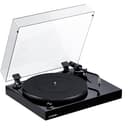
Fluance RT81

Fluance RT81

The best-value entry into real hi-fi: a manual belt-drive deck with an adjustable counterweight and anti-skate, an aluminum platter, and a genuine Audio-Technica elliptical cartridge — for the price of a good all-in-one. The switchable built-in preamp means it works today and upgrades later.

Best overall
$299.99 · View on Amazon

Price as of August 31, 2026. #ad How we’re funded

2
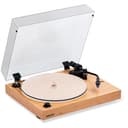
Fluance RT85

Fluance RT85

An acrylic platter and an Ortofon 2M Blue on a deck that still costs less than the cartridge-plus-turntable route usually does. Fluance publishes a 0.07% wow and flutter figure and leaves the preamp out entirely — this is a listening deck, not a convenience deck, and it is the clearest value in the sub-$600 tier.

Best bamboo cabinet
$549.99 · View on Amazon

Price as of August 31, 2026. #ad How we’re funded

3
Fluance RT82

Fluance RT82

A purist step up from the RT81: it drops the built-in preamp entirely and fits an Ortofon OM10 cartridge with a servo-controlled motor for tighter speed accuracy. Buy it if you already have (or will add) a phono preamp and want the cleaner signal path.

Best for an external preamp
$349.99 · View on Amazon

Price as of August 31, 2026. #ad How we’re funded

4
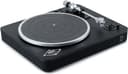
House of Marley Stir It Up Wireless

House of Marley Stir It Up Wireless

A belt-drive turntable built from bamboo and recycled materials, with Bluetooth out and a switchable built-in preamp. It has no speakers of its own — it's a real deck that streams — so it sits between the all-in-ones and the separates, and it's the pick if sustainability matters to you.

Best sustainable build
$249.99 · View on Amazon

Price as of August 31, 2026. #ad How we’re funded

5
Victrola Eastwood II

Victrola Eastwood II

The all-in-one we can actually recommend: a belt-drive player with built-in speakers, a replaceable Audio-Technica cartridge, and Bluetooth in and out — so it plays records on day one but can also stream to a bigger speaker when you outgrow the built-ins. That upgrade path is what separates it from a throwaway suitcase.

Best all-in-one wooden cabinet
$129.99 · View on Amazon

$149.9913% off

Price as of August 31, 2026. #ad How we’re funded

The picks in full

#1Best overall

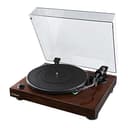
Fluance RT81

The best-value entry into real hi-fi: a manual belt-drive deck with an adjustable counterweight and anti-skate, an aluminum platter, and a genuine Audio-Technica elliptical cartridge — for the price of a good all-in-one. The switchable built-in preamp means it works today and upgrades later.

Strengths

  • Adjustable counterweight and anti-skate — you can set tracking force correctly, which the cheap automatics can't
  • Ships with an Audio-Technica AT95-type elliptical cartridge, a real step up from a conical
  • Built-in preamp is switchable, so you can bypass it when you add a better one

Trade-offs

  • Manual operation — you cue and lift the arm yourself
  • No Bluetooth or USB; this is a wired, listen-at-home deck
DriveBelt drive
OperationManual
CartridgeAudio-Technica elliptical (AT95-type)
Built-in preampYes — switchable
Speeds33 1/3 and 45 RPM
PlatterAluminum

Note. The counterweight and anti-skate are the reason this deck belongs in a different class from the sub-$150 automatics: it lets you dial in tracking force to the cartridge's spec instead of accepting a fixed factory setting.

Specifications read from the manufacturer / product listing, on July 24, 2026. “Not published” means the maker does not state that figure.

#2Best bamboo cabinet

Fluance RT85

An acrylic platter and an Ortofon 2M Blue on a deck that still costs less than the cartridge-plus-turntable route usually does. Fluance publishes a 0.07% wow and flutter figure and leaves the preamp out entirely — this is a listening deck, not a convenience deck, and it is the clearest value in the sub-$600 tier.

Strengths

  • Ortofon 2M Blue nude elliptical cartridge fitted from the factory — a genuine step above the 2M Red and OM series
  • High-mass acrylic platter damps resonance without a separate mat
  • Published 0.07% wow and flutter with an isolated, speed-controlled motor

Trade-offs

  • No built-in phono preamp — you must supply one
  • Fully manual, with no Bluetooth or USB output
DriveBelt drive, isolated speed-control motor
OperationManual
CartridgeOrtofon 2M Blue (nude elliptical)
PlatterHigh-density acrylic
Built-in preampNo
Wow and flutter0.07%
Speeds33 1/3 and 45 RPM

Note. The 2M Blue alone sells for roughly the price of an entry turntable, which is most of why this deck reads as good value — but budget for a phono preamp on top, because there is none inside.

Specifications read from the manufacturer / product listing, on August 11, 2026. “Not published” means the maker does not state that figure.

#3Best for an external preamp

Fluance RT82

A purist step up from the RT81: it drops the built-in preamp entirely and fits an Ortofon OM10 cartridge with a servo-controlled motor for tighter speed accuracy. Buy it if you already have (or will add) a phono preamp and want the cleaner signal path.

Strengths

  • Ortofon OM10 elliptical cartridge — upgradeable up the OM range with a stylus swap
  • Servo-controlled motor for steadier speed
  • No built-in preamp means a shorter, cleaner signal path to an external stage

Trade-offs

  • No built-in preamp — you must have a phono input or a separate preamp
  • Manual operation
DriveBelt drive
OperationManual
CartridgeOrtofon OM10 (elliptical)
Built-in preampNo
Speeds33 1/3 and 45 RPM
MotorServo-controlled DC

Note. Skipping the onboard preamp is a feature here, not a cost cut — but it does mean this deck needs a phono stage somewhere. If you don't have one, the RT81 or a preamp from our roundup solves it.

Specifications read from the manufacturer / product listing, on July 24, 2026. “Not published” means the maker does not state that figure.

#4Best sustainable build

House of Marley Stir It Up Wireless

A belt-drive turntable built from bamboo and recycled materials, with Bluetooth out and a switchable built-in preamp. It has no speakers of its own — it's a real deck that streams — so it sits between the all-in-ones and the separates, and it's the pick if sustainability matters to you.

Strengths

  • Bamboo plinth and recycled/regrind materials — a genuinely eco-focused build
  • Bluetooth output plus a switchable built-in preamp
  • Audio-Technica cartridge and a proper (if simple) tonearm

Trade-offs

  • No built-in speakers — you supply the speaker or headphones
  • Bluetooth-out is convenient but not the highest-fidelity path
DriveBelt drive
WirelessBluetooth output
CartridgeAudio-Technica (moving magnet)
Built-in preampYes — switchable
Speeds33 1/3 and 45 RPM
MaterialsBamboo + recycled/regrind

Note. Because it has a real cartridge and a switchable preamp, it doubles as a legitimate starter deck — pair it with powered speakers over the wired output and it steps well beyond suitcase territory.

Specifications read from the manufacturer / product listing, on August 13, 2026. “Not published” means the maker does not state that figure.

#5Best all-in-one wooden cabinet

Victrola Eastwood II

The all-in-one we can actually recommend: a belt-drive player with built-in speakers, a replaceable Audio-Technica cartridge, and Bluetooth in and out — so it plays records on day one but can also stream to a bigger speaker when you outgrow the built-ins. That upgrade path is what separates it from a throwaway suitcase.

Strengths

  • Uses a replaceable Audio-Technica cartridge rather than a sealed ceramic one
  • Bluetooth OUT lets you send records to a proper speaker as you upgrade
  • Built-in speakers and preamp — genuinely plug-and-play

Trade-offs

  • Built-in speakers are convenient, not hi-fi — the sound ceiling is low
  • Not the deck for a collector who wants the best from valued pressings
TypeAll-in-one with built-in speakers
DriveBelt drive
CartridgeAudio-Technica (replaceable)
BluetoothIn and out
Built-in preampYes
Speeds33 1/3, 45 and 78 RPM

Note. The replaceable Audio-Technica cartridge and Bluetooth-out are the two features that make this a safe all-in-one: you can improve the stylus and route to a better speaker instead of being stuck with a sealed ceramic pickup.

Specifications read from the manufacturer / product listing, on July 24, 2026. “Not published” means the maker does not state that figure.

What the plinth actually does

A cartridge works by detecting relative motion between the stylus tip and the cartridge body. It cannot tell the difference between motion caused by the groove and motion caused by anything else — footsteps, the bass from your own speakers, the motor a few centimeters away. All of it arrives as signal.

The plinth’s job is to make sure the only motion reaching the cartridge is the groove. It does that three ways:

  • Mass.A heavier cabinet needs more energy to move. This is why the specification is always “high mass” rather than just “wood”. Hollow plastic plinths are the ones that fail here.
  • Damping. Energy that does get in has to be converted to heat rather than ringing on. MDF is internally lossy in a way that thin plastic and thin metal are not.
  • Isolation. The feet decouple whatever mass you have from the shelf. Every Fluance Reference deck below adds adjustable resonance-damping feet on top of the cabinet mass.

When those three fail together you get acoustic feedback: the speakers shake the plinth, the plinth shakes the cartridge, the cartridge sends that to the speakers, and the whole loop turns into a low booming howl. It is the single most common cause of muddy vinyl sound in a small room, and it is why the cabinet is worth caring about beyond the way it looks. Our troubleshooting guide covers what to do when it happens.

Wood, MDF, bamboo and plastic, ranked honestly

In rough order of how well they do the job at a sane price:

  1. High-mass MDF with a veneer or lacquer.The default for every serious deck under $1,000, for good engineering reasons rather than cost-cutting ones. This is what “wooden turntable” means in practice.
  2. Bamboo. A genuine solid material, stiff and dense, with the added argument that it is fast-growing. Fluance offers the RT85 in it; House of Marley builds the whole Stir It Up around it.
  3. Acrylic or metal.Different approach, not a worse one — used on decks that pair a rigid chassis with sprung or damped feet.
  4. Thin molded plastic.What the suitcase players use. Light, hollow and resonant, and one of the several reasons those decks sound the way they do — see are suitcase record players bad.

Solid hardwood is not on the list because virtually nobody uses it at these prices, and where it appears on a boutique deck it is chosen partly for looks. A solid plank also moves with humidity, which MDF does not. Do not treat “solid wood” as an upgrade over “MDF” on a spec sheet.

Choosing between the finishes

The three Fluance Reference decks above share the same cabinet construction, so the choice between them is not really a cabinet decision:

  • RT81— walnut, built-in switchable preamp, Audio-Technica elliptical cartridge. The one to buy if you want it to work today with powered speakers. Full write-up in the RT81 review.
  • RT82— piano black over the same MDF, no internal preamp, Ortofon OM10 cartridge. Buy it if you already own a phono stage.
  • RT85— bamboo, acrylic platter, Ortofon 2M Blue. The step up, and the one where the cabinet is a solid material rather than a veneer. See the RT85 review.

If your priority is genuinely how it looks on a shelf and the budget is tight, the Victrola Eastwood II is the honest recommendation: a wooden cabinet with speakers inside, at a fraction of the price of a separates system. It is a decorative, convenient player rather than a hi-fi source, and our all-in-one roundup is candid about where its ceiling is.
Frequently asked questions

Does a wooden turntable sound better?

A heavy, well-damped cabinet sounds better than a light hollow one, and wood or MDF is the usual way to achieve that at a sensible price. The material name is not the thing that matters — mass and damping are. A high-mass MDF plinth outperforms a thin solid-wood one.

Is an MDF plinth worse than solid wood?

No, and usually the opposite. MDF is dense, has no grain direction and therefore no preferred resonant axis, and it does not move with humidity. Nearly every turntable maker under $1,000 uses high-mass MDF with a veneer or lacquer over it, and describes that as a wood plinth — accurately.

What is the best wooden record player?

For most buyers, the Fluance RT81: a high-mass MDF plinth in walnut, an adjustable counterweight and anti-skate, an Audio-Technica elliptical cartridge, and a switchable built-in preamp so it works with powered speakers today. The RT85 in bamboo is the step up if you have a phono stage already.

Why does my record player boom or howl at high volume?

Acoustic feedback. Sound from the speakers is shaking the plinth, the cartridge is reading that vibration as signal, and the loop is self-reinforcing. Move the deck away from the speakers, put it on a separate rigid surface, check it is level, and the cabinet mass will do the rest.

Are bamboo turntables any good?

Bamboo is stiff, dense and a genuine solid material rather than a veneer, so it works well as a plinth. Fluance offers the RT85 in bamboo and House of Marley builds the Stir It Up from it. Judge those decks on their platters, arms and cartridges as usual — the bamboo is a legitimate cabinet, not a gimmick, but it is not what makes the deck good.

Sources

Keep reading