Fluance RT81 Review
The deck that turns a record player into a hi-fi component — an adjustable arm, an elliptical cartridge and a preamp you can switch off later.
How this is funded: we earn a commission if you buy through our links, at no extra cost to you. It never changes which product we recommend, and we’ll tell you plainly when to skip one. Full disclosure.
The short version
Fluance RT81
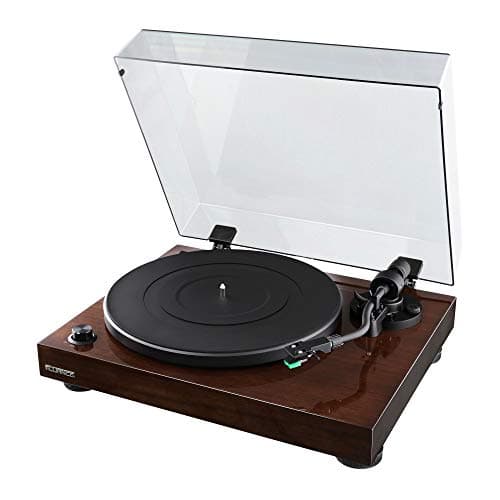
The cheapest turntable we would call a real hi-fi source: an adjustable counterweight and anti-skate, an aluminum platter, a genuine elliptical cartridge and a preamp you can bypass when you outgrow it. The price is that you cue the arm yourself and there is no wireless or USB anywhere.
Strengths
- Adjustable counterweight and anti-skate — you can set tracking force correctly, which the cheap automatics can't
- Ships with an Audio-Technica AT95-type elliptical cartridge, a real step up from a conical
- Built-in preamp is switchable, so you can bypass it when you add a better one
Trade-offs
- Manual operation — you cue and lift the arm yourself
- No Bluetooth or USB; this is a wired, listen-at-home deck
- The fitted AT95E cartridge and its ATN95E stylus are both badged discontinued on Audio-Technica's own site — budget a current cartridge as the first upgrade
| Drive | Belt drive |
|---|---|
| Operation | Manual |
| Cartridge | Audio-Technica AT95E (bonded elliptical) |
| Built-in preamp | Yes — switchable, full bypass |
| Speeds | 33 1/3 and 45 RPM |
| Platter | Aluminum, 1.22 lb (553 g), rubber mat |
| Wow and flutter | 0.2% |
Specifications read from the manufacturer / product listing, accessed 2026-10-05. We have not measured this unit — what we do instead.
Price as of October 14, 2026. #ad How we’re funded
There is a specific line in the turntable market, and the Fluance RT81 sits directly on top of it. Below the line, a turntable is an appliance: the factory makes the decisions and you press start. Above it, a turntable is a component: it has adjustments, those adjustments matter, and what you get out of it depends partly on you.
The RT81 is the cheapest deck we know of that is unambiguously above that line. Understanding what it adds — and what it removes to afford them — is the whole review.
The counterweight, and why it is the headline feature
The rear of the RT81’s tonearm carries a threaded counterweight with a calibrated dial. You balance the arm so it floats level, zero the dial, then turn it to the tracking force the cartridge specifies. That is it. Ten minutes, once.
What it buys you is control over the single most consequential variable in record playback. Too little tracking force and the stylus skitters in the groove, distorting on loud passages and, counter-intuitively, doing more damage than too much. Too much and you add wear and dull the treble. Correct, per the manufacturer’s specification, and the cartridge does what it was designed to do.
A fixed-arm deck picks one value at the factory that is safe for the cartridge it ships with, and that is genuinely fine — until you want a different cartridge, at which point the whole thing is closed. The counterweight is what keeps the RT81 open.
Anti-skate: the adjustment nobody explains
As a record plays, friction between stylus and groove pulls the arm inward toward the spindle. Left uncorrected, that skating force presses the stylus harder against the inner groove wall than the outer — which means uneven wear on your records and uneven channel balance in the sound, usually heard as a right channel that distorts before the left.
Anti-skate applies a small outward force to cancel it. On the RT81 it is a dial you set to roughly the same number as your tracking force. It takes five seconds and it is the setting most often left at zero by people who did not know it was there. Our turntable setup guide walks through both adjustments in order.
The cartridge: an elliptical stylus at this price
The RT81 ships with an Audio-Technica AT95E elliptical cartridge, mounted and aligned — a 0.4 x 0.7 mil bonded elliptical on Fluance’s figures, tracking at 2.0 g. An elliptical stylus has a narrower side-to-side contact radius than a conical one, which means it sits deeper in the groove and traces finer high-frequency modulations. Compared with the conical styli on decks a tier down, you hear more air, better separation and more legible vocal detail.
One thing to know before you plan around it: Audio-Technica’s own site now badges both the AT95E and the ATN95E replacement stylus — the stylus Fluance names for this deck — as discontinued, and lists the stylus as unavailable. That is not a reason to avoid the RT81. It is a reason to treat a current cartridge as its first upgrade rather than a re-tip, and it is why Fluance now sells an RT81+ with the current AT-VM95E fitted. Our RT81 vs RT82 comparison lays out all three options at their real prices.
Just as importantly, it is mounted on a standard half-inch fitting in an H-4 bayonet headshell. That single detail is why this deck has a future: an AT-VM95E or AT-VM95ML at 6.1 g and a Nagaoka MP-110 at 6.5 g both sit inside the 3.5 to 6.5 g cartridge weight Fluance publishes for this arm and bolt straight on. Check the weight before you buy something heavier: Ortofon publishes the 2M Red and 2M Blue at 7.2 g, which is above the RT81’s stated window, though inside the RT82’s. The cartridges under $200 roundup covers what each of those changes, and how to set up a cartridge covers fitting one.
The platter, the plinth and the parts you can’t see
The RT81 uses an aluminum platter with a rubber mat on an MDF plinth, driven by a belt from an offset motor. None of that is exotic and all of it is the correct recipe at this price: aluminum has enough mass to smooth speed variation, the belt isolates motor vibration from the platter, and MDF is dense and dead enough not to ring.
Fluance does publish the figures, which is unusual at this money: 0.2% wow and flutter, speed variation of plus or minus 1.00%, and signal-to-noise of 67 dB A-weighted or 60 dB unweighted. Those are the maker’s numbers on the maker’s terms and we have not measured a unit. They are also the rows where the servo-controlled motor one rung up changes the answer — 0.07% and 0.13% on the RT82, from an identical platter and arm — which is the whole argument of the RT81 vs RT82 head-to-head.
The switchable preamp is a bigger deal than it looks
A switch on the back turns the built-in phono stage on or off. On, the deck outputs line level and works with powered speakers, a soundbar with an analog input, or any aux input. Off, it outputs a raw phono signal for a receiver with a phono input or a standalone phono preamp.
That switch is also the reason this deck sits where it does in the range. The RT81 and RT81+ are the last two Fluance turntables that have a phono stage at all — from the RT82 upward there is none, so the sticker price stops being the price of a working system. Our Fluance range page ranks the whole ladder on that row and on the cartridge fitted to each rung. If the destination is a soundbar specifically, the soundbar guide covers what to check on the bar first.
That switch means the deck fits your system now and your better system later. Buy it with powered speakers today, add a proper phono stage in two years, flip the switch, and nothing else changes. Decks without the switch force you to choose once.
What you give up
Automation. You cue the arm at the start of a side and lift it at the end. If you forget, the stylus circles the run-out groove. This is the single most common reason people buy the AT-LP60X instead, and it is a legitimate reason.
Wireless and USB. There is neither. If you want to stream to a wireless speaker, the Bluetooth decks are a different list; if you want to digitize records, see USB turntables.
Ten minutes of your attention. The setup is easy but it is not optional. An RT81 with the counterweight untouched and anti-skate at zero will perform worse than a factory-set AT-LP60X, which is a genuinely bad outcome for an extra $120.
Who should buy it
Buy the RT81 if you expect vinyl to be a lasting interest rather than an experiment; if the idea of upgrading a cartridge later appeals rather than exhausts you; or if you already have powered speakers and want the best source you can put in front of them for around $300. It is the cheapest deck on this site that will still be worth owning after two upgrades.
Buy something else if you want the arm to move itself, if wireless matters, or if you want to spend as little as possible — in which case the sub-$200 shortlist is the honest place to look.
Frequently asked questions
Is the Fluance RT81 worth it over an Audio-Technica AT-LP60X?
For most people who intend to stay with vinyl, yes. The RT81 adds an adjustable counterweight and anti-skate, an elliptical stylus and a standard cartridge mount — which together mean better sound now and an upgrade path later. The AT-LP60X remains the better buy if you want full automation.
Does the Fluance RT81 have a built-in preamp?
Yes, and it is switchable. Leave it on to plug straight into powered speakers or a line input; switch it off and use an external phono stage or a receiver's phono input once you upgrade. That switch is a large part of the deck's value.
Is the Fluance RT81 fully manual?
Yes. You lower the cueing lever at the start of a side and lift it at the end — there is no auto-return. That is the trade for the adjustable tonearm, since the mechanism that automates a cheap deck is what forces its arm to be fixed.
What cartridge does the Fluance RT81 come with?
An Audio-Technica AT95E elliptical cartridge, pre-mounted and aligned at the factory, which Fluance publishes as a 0.4 x 0.7 mil bonded elliptical tracking at 2.0 g. It is a genuine step up from the conical styli on cheaper decks. Note that Audio-Technica has discontinued both the AT95E and its ATN95E replacement stylus, so plan on a current cartridge rather than a re-tip when the stylus wears; the mount is a standard half-inch fitting, so that is a straightforward swap.
Can I upgrade the Fluance RT81's cartridge?
Yes — that is one of its main advantages, within one published limit. The standard half-inch mount and the adjustable counterweight let you fit a current cartridge and set the tracking force it specifies; an AT-VM95E or AT-VM95ML at 6.1 g and a Nagaoka MP-110 at 6.5 g are inside the 3.5 to 6.5 g cartridge weight Fluance publishes for this arm. Ortofon's 2M Red and 2M Blue are published at 7.2 g, above that window and inside the RT82's, so check the weight before buying a heavier cartridge.
Do I need to set up the Fluance RT81 myself?
Partly. The cartridge arrives mounted and aligned, but you must balance the tonearm, set the tracking force with the counterweight dial and set anti-skate to match. It takes about ten minutes with the supplied instructions and is the step people most often skip.
Sources
- Crutchfield — How to choose the right turntable — Buying-guide reference on drive type, cartridges, preamps and setup (accessed July 24, 2026)
- Audio-Technica — VM95 Series cartridges — The shared-body VM95 range and its interchangeable stylus upgrade path (accessed July 24, 2026)
- Elusive Disc — Turntable setup guide: tracking force & anti-skate — Step-by-step on balancing the tonearm, setting tracking force and anti-skate (accessed July 24, 2026)
- Crutchfield — How to choose a phono preamp — On why a phono signal needs a preamp and never running two at once (accessed July 24, 2026)
Keep reading
Fluance RT81 vs AT-LP120XUSB
This deck against the direct-drive alternative: 78 RPM, USB and a cartridge with a parts supply.
Compare themEssential Classic Rock Records on Vinyl
What to spin first: the cheapest canonical albums still in print.
See the picksAT-LP60X vs Fluance RT81
Automatic convenience against an adjustable arm, for about $120.
Read the comparisonFluance RT81 vs RT82
The next rung up: a servo motor with a third of the published wow and flutter, and no built-in preamp.
Compare themBest Turntables Under $300
Where the RT81 sits against everything else in its tier.
See the picksBest Turntable Cartridges Under $200
The upgrade path this deck's standard mount opens up.
See the cartridgesHow to Set Up a Turntable
The ten minutes of setup this deck needs and rewards.
Read the guide