Fluance RT85 Review
An acrylic platter and a nude-elliptical Ortofon at a price where decks normally ship neither. The missing preamp is the reason both fit in the budget.
How this is funded: we earn a commission if you buy through our links, at no extra cost to you. It never changes which product we recommend, and we’ll tell you plainly when to skip one. Full disclosure.
The short version
Fluance RT85
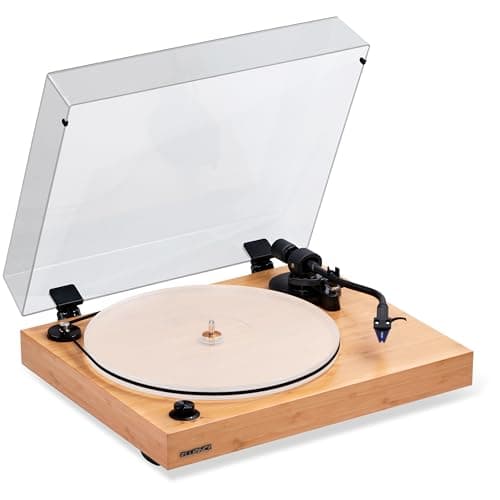
A manual belt-drive deck with a high-density acrylic platter, an isolated speed-control motor, a published 0.07% wow and flutter figure and an Ortofon 2M Blue fitted at the factory. There is no internal phono stage, which is a deliberate allocation of budget rather than an omission. Buy it if you have a phono preamp or will buy one. Skip it if you want to plug into powered speakers out of the box.
Strengths
- Ortofon 2M Blue nude elliptical cartridge fitted from the factory — a genuine step above the 2M Red and OM series
- High-mass acrylic platter damps resonance without a separate mat
- Published 0.07% wow and flutter with an isolated, speed-controlled motor
Trade-offs
- No built-in phono preamp — you must supply one
- Fully manual, with no Bluetooth or USB output
| Drive | Belt drive, isolated speed-control motor |
|---|---|
| Operation | Manual |
| Cartridge | Ortofon 2M Blue (nude elliptical) |
| Platter | High-density acrylic |
| Built-in preamp | No |
| Wow and flutter | 0.07% |
| Speeds | 33 1/3 and 45 RPM |
Specifications read from the manufacturer / product listing, accessed 2026-08-11. We have not measured this unit — what we do instead.
Price as of October 15, 2026. #ad How we’re funded
Where the money went
The RT85 sits at the top of Fluance’s Reference range, and it is easiest to understand as a set of budget decisions rather than a feature list. Take the RT82’s high-mass MDF plinth and isolated speed-control motor, keep them unchanged, then spend the difference on two things: a high-density acrylic platter and an Ortofon 2M Blue cartridge. Leave the phono stage out, as the RT82 already does. Our RT82 vs RT85 comparison prices those two upgrades separately, row by row, against Fluance’s own published tables.
That is an unusually focused allocation. Most decks at this price hedge — a preamp so it works out of the box, a decent-but-not-special cartridge, a platter that is fine. The RT85 spends everything on the two components that touch the record.
The acrylic platter, and why it comes with no mat
An acrylic platter does two jobs, and the second one surprises people.
Mass. A heavier platter carries more rotational inertia, so small variations in motor torque or belt tension turn into smaller variations in speed. Fluance publishes 0.07% wow and flutterfor this deck. That figure is worth noticing not because 0.07% is a remarkable number in absolute terms but because most makers in this price bracket publish no wow and flutter figure at all — a spec you cannot see is a spec nobody has to stand behind.
Damping.Acrylic’s acoustic impedance is close to vinyl’s. When a record sits directly on it, energy from the groove passes into the platter and is absorbed rather than reflecting back up into the stylus. A metal platter cannot do this, which is exactly why metal-platter decks ship with a felt or rubber mat — the mat is standing in for a material property the platter lacks.
The practical consequence: do not put a mat on it. Adding felt between the record and the acrylic reinstates the problem the acrylic was bought to solve. This catches people who upgrade from a metal-platter deck and assume the mat comes with them.
The 2M Blue, fitted at the factory
The RT85 ships with an Ortofon 2M Bluepre-mounted and aligned. The 2M Blue’s distinguishing feature over the 2M Red below it is a nude elliptical diamond— the diamond is the whole tip rather than a small diamond bonded to a metal shank. Less mass at the tip means the stylus can follow rapid groove modulation more accurately, which shows up as high-frequency detail and as cleaner tracking through the inner grooves where the linear velocity is lowest.
Two things follow from that being factory-fitted:
- It is a large share of the deck’s value.Bought separately, a 2M Blue is a significant fraction of the RT85’s price. Compare the RT85 to a cheaper deck plus a cartridge upgrade and the gap narrows sharply.
- The upgrade path stays open and cheap.Ortofon’s 2M styli are interchangeable within the range, so you can eventually move up without replacing the cartridge body. We cover exactly that in 2M Red vs 2M Blue.
No preamp: the deliberate gap
Fluance is explicit that the RT85 has no internal phono stage and needs an external one or an amplifier with a phono input. Plug it into an AUX socket and you get a faint, thin sound that people routinely report as a broken turntable.
The argument for leaving it out is sound. A phono stage amplifies a signal of a few thousandths of a volt; putting that circuit inside a plinth a few centimeters from a motor is a compromise no designer would choose freely. Taking it out shortens the signal path and lets you match a stage to the cartridge — and with a 2M Blue fitted, matching is worth doing. See gain and impedance for what that means in practice.
The argument against is arithmetic. Add the cost of a good phono stageto the deck’s price before you compare it to anything with a preamp inside. Do that honestly and the RT85 is still strong; do it after you have bought the deck and the surprise is unwelcome.
Living with it
It is fully manual— cue down, lift at the end, no auto-return. Setup is the usual sequence: level the plinth, fit the platter and belt, zero-balance the arm, dial the counterweight to the 2M Blue’s specified tracking force, match anti-skate. Fluance publishes setup documentation for the whole Reference range, and our tonearm guide covers the arithmetic.
The isolated speed-control motor means speed changes between 33 and 45 are handled electronically rather than by moving the belt between pulleys — a small daily convenience that also means one less reason to touch the belt.
No Bluetooth, no USB, no automation. This is a deck for a wired system, and the absence of those features is consistent with everything else about how the budget was allocated.
Who should buy it
Buy the RT85 if you already own a phono stage or an amplifier with a phono input; if you want the platter and cartridge to be genuinely good rather than adequate; and if you would rather buy the cartridge upgrade once, with the deck, than twice.
Buy the RT82instead if the budget is tight and you would rather fund the phono stage than the acrylic platter — the plinth and motor are the same. Buy the Pro-Ject Debut Carbon EVO instead if the tonearm matters more to you than the platter. And if you need a built-in preamp at this level, the honest answer is that you are shopping in a different part of the market — start with turntables with a built-in preamp.
Frequently asked questions
Does the Fluance RT85 have a built-in preamp?
No. Fluance states plainly that the RT85 has no internal preamp and that an external phono stage, or an amplifier with a phono input, is required. That is the design intent — the money went into the platter, motor and cartridge instead.
Is the acrylic platter on the RT85 actually better than aluminum?
It does two things an aluminum platter does not. Its greater mass smooths small speed variations, and its surface impedance is close to vinyl's, so it damps groove resonance directly rather than needing a felt mat to do it. Fluance publishes a 0.07% wow and flutter figure for this deck, which is a real number on a spec sheet where most budget makers publish nothing at all.
Do you need a mat with the Fluance RT85?
No, and adding a felt one works against the design. The record is meant to sit on the acrylic so the platter can damp it. Fluance ships the RT85 to be used that way.
Is the Ortofon 2M Blue worth the step up from a 2M Red?
The 2M Blue uses a nude elliptical diamond rather than a bonded one, which means less tip mass and better tracking of high-frequency detail and inner grooves. Having it fitted at the factory is a meaningful part of the RT85's value, because bought separately it is a significant fraction of the deck's price.
What is the difference between the Fluance RT82 and the RT85?
Same high-mass MDF plinth and the same isolated speed-control motor. The RT85 adds a high-density acrylic platter and upgrades the cartridge from an Ortofon OM10 to a 2M Blue. Neither has a built-in preamp. The RT85 is the better deck; whether it is better value depends on how much of the gap you would otherwise spend on a cartridge upgrade anyway.
Is the Fluance RT85 fully manual?
Yes. You lower the arm with the cueing lever at the start of a side and lift it at the end — there is no auto-return. That is the standard trade for a fully adjustable arm with a counterweight and anti-skate.
Sources
- Fluance — RT85 Reference turntable — Manufacturer page: acrylic platter, Ortofon 2M Blue, no internal preamp — an external stage is required (accessed August 19, 2026)
- Fluance — Reference series setup and FAQ (RT82/83/84/85) — Manufacturer setup documentation: counterweight, tracking force and cartridge compatibility for the Reference arms (accessed August 19, 2026)
- Ortofon — 2M Blue — Manufacturer page for the nude elliptical 2M Blue and its stylus interchangeability (accessed August 11, 2026)
- Crutchfield — How to choose a phono preamp — On why a phono signal needs a preamp and never running two at once (accessed July 24, 2026)
Keep reading
Ortofon 2M Blue Review
The cartridge this deck ships with, reviewed on Ortofon's published figures.
Read the reviewEssential Jazz Records on Vinyl
What to spin first on a deck this resolving — and which Blue Note line to buy.
See the picksBest Turntables Under $1000
The tier this deck tops, and what the alternatives spend their money on.
See the picksFluance RT82 Review
The same plinth and motor one step down, with an aluminum platter.
Read the reviewFluance RT82 vs RT85
The two decks side by side, with the platter and the cartridge priced as separate upgrades.
Compare themFluance RT85 vs RT85N
The identical deck with a Nagaoka MP-110 instead of the 2M Blue — a cartridge choice, not a tier.
Compare themFluance RT85 vs RT87
The step up to the dual-plinth flagship, where Fluance's own measured figures actually move.
Compare themFluance RT85 vs Audio-Technica AT-LP120X
This deck's analog chain against a direct-drive machine that digitizes and brings its own preamp.
Compare themOrtofon 2M Red vs 2M Blue
What the cartridge fitted to this deck does that the cheaper one does not.
Read the comparisonBest Phono Preamps Under $200
The box this deck deliberately does not include.
See the picks