Fluance RT85 vs RT87
Same cartridge, different machine. This is the rare intra-brand step up where the maker's own measured figures move rather than just the fittings — and it is worth knowing exactly which ones.
How this is funded: we earn a commission if you buy through our links, at no extra cost to you. It never changes which product we recommend, and we’ll tell you plainly when to skip one. Full disclosure.
Intra-brand step-ups usually shuffle fittings. A better cartridge, a nicer veneer, a heavier platter, and the maker’s published measurements stay exactly where they were. The RT85 to RT87 jump is not that, which is what makes it worth writing about: Fluance publishes 0.06% wow and flutter against 0.07%, and 71 dB signal-to-noise against 69 dB, for a deck fitted with the same Ortofon 2M Blue cartridge.
That is the honest frame for this comparison. Hold the cartridge constant, and the price gap buys chassis, platter and tonearm — nothing else.
The question that decides it: is your listening currently limited by the machine, or by the cartridge and the phono stage in front of it?
The short answer
- Buy the RT85 if you want an acrylic platter and a 2M Blue for the least money, and you will never adjust VTA, never play a 78, and are not chasing the last 0.01% of wow and flutter. It is the better value and it always was.
- Buy the RT87if you want the best-measuring deck Fluance publishes, a tonearm you can set the height of, isolation designed rather than bolted on, and a third speed — and you already own a phono stage worth feeding it into.
The dual plinth is the headline, and it is not marketing
The RT85 is a conventional single-plinth deck: one MDF cabinet carries the motor, the bearing, the platter and the arm, with the motor under-mounted on seven-point silicone isolation and a decoupling ring. That is a good implementation of the normal approach.
The RT87 splits the cabinet. The upper platform carries the spindle, platter and tonearm; the lower plinth carries the motor and the electronics, and the two are separated by isolators. The motor keeps its own seven-point silicone mounting on top of that. The design intent is straightforward: every path from the motor to the stylus is made deliberately bad.
You do not have to take the intent on faith, because Fluance publishes the result. Two decibels of signal-to-noise and a tenth of a percent-point of wow and flutter are not transformative numbers — but they are numbers, they are the maker’s own, and they move in the direction the engineering claims. That is more evidence than most turntable upgrades at any price offer.
The platter: heavier and thicker, for a reason
Both decks use a 12-inch acrylic platter. The RT85’s is 1.56 kg and 16 mm thick; the RT87’s is 1.85 kg and 22 mm.
Mass on a platter does one useful thing: it stores rotational inertia, so short-term variations in motor torque or in stylus drag get smoothed out instead of turning into speed variation. That is the mechanism behind a lower wow and flutter figure, and it is why the platter and the motor should be read as one system rather than two spec rows.
Thickness matters for a second reason. Acrylic is used here because its acoustic behaviour is close to vinyl’s, so the record couples to the platter and energy from the stylus is absorbed rather than reflected back up into the groove. More material means more of that. It is also why neither deck ships a felt mat, and why fitting one would be a step backwards — see our turntable mat guide for when a mat helps and when it undoes what the platter was for.
The tonearm, and the adjustment the RT85 does not have
The RT85 uses a static balanced S-shaped aluminum arm with a 224 mm effective length, an adjustable anti-skate control, a 9 g H-4 bayonet headshell, and a published effective mass of 27.5 g.
The RT87 uses a static balanced straight arm with a one-piece carbon fiber tube at 230 mm effective length, a lighter 7.8 g headshell, and thread-and-hanging-weight anti-skate rather than a slider. Fluance does not publish an effective mass for it, which is why that row in the matrix above says “Not published” rather than a number we worked out.
The functional difference is VTA adjustment: 6 mm of it, on the RT87 only. VTA — vertical tracking angle — is the angle at which the stylus meets the groove, and it changes when you fit a cartridge of a different height, or a thicker mat, or play 180 g records against standard ones. On a deck without VTA adjustment you accept whatever angle the fixed arm height produces. On one with it, you set the arm parallel and then adjust by ear.
Be honest about who that is for. If you will fit one cartridge and leave it there, VTA adjustment is a feature you will use once during setup. If you expect to try several cartridges — and at this money a fair number of buyers do — it is the difference between setting the deck up correctly and hoping.
The third speed, with the usual caveat
The RT87 plays 33 1/3, 45 and 78 RPM. No other Fluance Reference deck offers 78.
The caveat is the same one that applies to every 78-capable modern deck: a shellac 78 has a far wider groove than a microgroove LP, and the stylus fitted to the RT87 — the 2M Blue’s nude elliptical, cut for modern records — is the wrong shape for it. Playing 78s properly means a 78-specific stylus, which is a separate purchase. The speed setting is necessary; it is not sufficient.
What does not change, and why it matters to the maths
Both decks ship the same Ortofon 2M Blue: nude elliptical, r/R 8/18 um tip, 5.5 mV output, 1.8 g recommended tracking force. Both have the same H-4 bayonet headshellstandard, so a cartridge change on either is a pre-aligned assembly swap. Both use the same footprint on the shelf — 16.5 by 14.25 inches. And critically, neither has a phono preamp.
That last one is what to do with the price gap if you do not already own a phono stage. A deck that measures 2 dB quieter feeding a mediocre preamp is a worse system than the cheaper deck feeding a good one, because the preamp is where the signal is at its most fragile: a few millivolts, RIAA-shaped, amplified sixty-fold before anything else touches it. Our phono preamp roundup is the page to read before you decide the turntable is the constraint.
Where the RT85 is still the right buy
Two situations, and both are common.
- Your system is not finished yet. If the money for the RT87 is the same money as a phono stage plus a better pair of bookshelf speakers, the RT85 plus those two beats the RT87 alone by a distance that is not close.
- You will never touch the arm.The RT87’s clearest practical advantages — VTA adjustment, a lighter headshell, a third speed — are all things you have to want to use. Its measured advantages are real but small. If you intend to fit the 2M Blue it comes with and leave it alone for five years, you are paying for headroom you will not spend.
The decision, in one paragraph
The RT87 is the better turntable and Fluance’s own numbers say so, which is rarer than it should be at this end of the market. Buy it if the rest of your system is already good enough to show the difference, if you want an arm you can set the height on, and if you would rather buy the ceiling once. Buy the RT85 if the phono stage or the speakers are still the weakest link, because you get the identical cartridge and the same acrylic-platter design for less, and the difference spent downstream will change what you hear far more than 0.01% of wow and flutter will.
The spec matrix
Both decks are available with an Ortofon 2M Blue, which is the fair way to compare them: hold the cartridge constant and the price gap is entirely chassis, platter and tonearm.
| Specification | RT85Fluance | RT87Fluance |
|---|---|---|
| Drivesame | Belt drive | Belt drive |
| Motorsame | DC motor, servo controller reading speed 500 times/sec | DC motor, servo controller reading speed 500 times/sec |
| Motor isolation | Under-mounted, 7-point silicone with decoupling ring | Bottom-plinth mounted, 7-point silicone with decoupling ring |
| Plinth | Single MDF with real wood veneer | Dual plinth, isolator-separated |
| Speeds | 33 1/3 and 45 RPM | 33 1/3, 45 and 78 RPM |
| Wow and flutter | 0.07% | 0.06% |
| Signal to noise | 69 dB (weighted) | 71 dB |
| Platter | Acrylic, 12 in, 1.56 kg, 16 mm | Acrylic, 12 in, 1.85 kg, 22 mm |
| Tonearm | Static balanced S-type, aluminum, 224 mm | Static balanced straight, one-piece carbon fiber, 230 mm |
| Tonearm effective mass | 27.5 g | Not published |
| VTA adjustment | Not published | Yes — 6 mm |
| Anti-skating | Yes — adjustable | Yes — hanging weight and thread |
| Headshell | H-4 bayonet, 9 g, removable | H-4 bayonet, 7.8 g, removable |
| Cartridgesame | Ortofon 2M Blue | Ortofon 2M Blue |
| Built-in preampsame | No — external stage required | No — external stage required |
| Dimensions (H x W x D) | 6 (+/-0.5) x 16.5 x 14.25 in | 6.3 (+/-0.5) x 16.5 x 14.25 in |
| Weight | 16.76 lb (7.6 kg) | 21 lb (9.5 kg) |
All figures are Fluance’s own published specification tables for the RT85 and the RT87 (2M Blue, walnut), read 2026-09-03 — not listing copy. See Sources below. “Not published” means the figure is not stated in the sources cited below — it is never a value we estimated. Rows marked same are the ones where these decks do not differ.
Both decks, with live prices
The gap between these two is real money. Below is what it buys, and the two situations where it does not buy you anything.
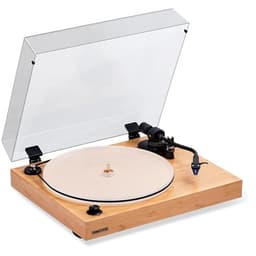
Fluance RT85
The most cartridge and platter per dollar under $600
Price as of October 23, 2026. #ad How we’re funded
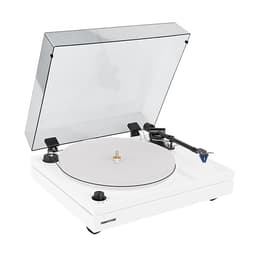
Fluance RT87
The most measurable Fluance, when the RT85's arm is the limit you have hit
Price as of October 23, 2026. #ad How we’re funded
Frequently asked questions
Is the Fluance RT87 worth the extra over the RT85?
It is if the numbers matter to you, because unusually for an intra-brand step up they actually move: Fluance publishes 0.06% wow and flutter against the RT85's 0.07%, and 71 dB signal-to-noise against 69 dB. You also get a dual plinth that separates the motor from the tonearm, a heavier and thicker acrylic platter, a one-piece carbon-fiber arm with VTA adjustment and a third speed. If none of those is something you would use or care about, the RT85 has the same cartridge and is the better value.
What is a dual plinth and does it do anything?
The RT87 splits the chassis in two: the upper platform carries the spindle, platter and tonearm, the lower one carries the motor and electronics, and isolators separate them. The point is that vibration from the motor has to cross a deliberately poor mechanical path before it can reach the stylus. Fluance's own numbers are the honest evidence it works — a 2 dB better signal-to-noise figure and 0.01% less wow and flutter than the single-plinth RT85.
Does the RT87 play 78s?
It has a 78 RPM setting, which no other Fluance Reference deck does. But playing shellac 78s properly needs a 78-specific stylus with a much wider tip than the microgroove stylus fitted to any of these decks. The speed is necessary and not sufficient — treat it as an option you can pursue, not a feature that works out of the box.
Which one has the better tonearm?
The RT87's, on every published measure. It is a one-piece carbon-fiber straight arm at 230 mm effective length against the RT85's S-shaped aluminum arm at 224 mm, and only the RT87 offers VTA adjustment — 6 mm of it — so you can set the arm's height for a taller or shorter cartridge. Note that Fluance publishes an effective-mass figure for the RT85 (27.5 g) and does not publish one for the RT87, so we cannot compare that row.
Do either the RT85 or the RT87 have a built-in phono preamp?
Neither does. Both Fluance tables state 'No - Separate Phono Preamp Required'. That is deliberate at this level, but it is a real cost: budget for a phono stage on top of either deck unless your amplifier or powered speakers already have one.
Should I buy the RT85 and spend the difference on a better cartridge instead?
That is the strongest argument against the RT87, and it holds in one case: if your current limit is the cartridge rather than the chassis. But note that both decks ship the same 2M Blue, so the RT87 is not asking you to pay again for a cartridge you already have — the money goes to plinth, platter and arm. If you have already moved past a 2M Blue and are shopping for somewhere to put a better cartridge, the RT87's adjustable VTA is the more useful spend.
Is the RT87 too big for a normal shelf?
It is the same footprint as the RT85 — Fluance publishes 16.5 by 14.25 inches for both — but it is taller (6.3 inches against 6.0, each plus or minus half an inch) and substantially heavier at 21 lb against 16.76 lb. Measure the height clearance above the shelf as well as the depth, because the dust cover needs room to hinge open.
Sources
- Fluance — RT85 Reference turntable, published specifications — Manufacturer specification table: 0.07% wow and flutter, 69 dB weighted S/N, acrylic platter 1.56 kg / 16 mm, static balanced S-type aluminum arm 224 mm / 27.5 g, H-4 bayonet headshell, Ortofon 2M Blue 0.3 x 0.7 mil nude elliptical, no built-in preamp, 7.6 kg (accessed September 3, 2026)
- Fluance — RT87 Reference dual-plinth turntable, published specifications — Manufacturer specification table: dual plinth, motor on 7-point silicone isolation, 33 1/3 / 45 / 78 RPM, 0.06% wow and flutter, 71 dB S/N, acrylic platter 1.85 kg / 22 mm, one-piece carbon-fiber straight arm 230 mm with 6 mm VTA adjustment, removable H-4 headshell, Ortofon 2M Blue, no built-in preamp, 9.5 kg (accessed September 3, 2026)
- Ortofon — 2M Blue — Manufacturer page for the nude elliptical 2M Blue and its stylus interchangeability (accessed August 11, 2026)
- Fluance — Reference series setup and FAQ (RT82/83/84/85) — Manufacturer setup documentation: counterweight, tracking force and cartridge compatibility for the Reference arms (accessed August 19, 2026)
- Crutchfield — How to choose the right turntable — Buying-guide reference on drive type, cartridges, preamps and setup (accessed July 24, 2026)
Keep reading
Fluance RT85 Review
The full case for the cheaper deck, and the phono stage it assumes you already own.
Read the reviewFluance RT85 vs RT85N
The same chassis with a Nagaoka instead of an Ortofon — a cartridge choice, not a tier.
Compare themBest Turntables Under $1,000
What else the RT87's money buys, from brands that spend it differently.
See the picksAre Expensive Turntables Worth It?
Where the returns on turntable spending flatten out, and how to tell you have reached it.
Read the guide