PLATTER & PLINTH

The Best Turntable Mats

A platter mat is a twenty-dollar part sold with hundred-dollar claims. Two published numbers decide whether it is right for your deck, and most listings only print one of them.

By Stephen V.Last updated How we pick

The mat is the disc between your platter and your record, and on most decks under $500 it is the cheapest component in the whole signal path. It is also the one most often sold on adjectives — warmer, tighter, blacker backgrounds — rather than on the two figures that actually determine whether it belongs on your turntable.

Those figures are thickness and label recess. Thickness matters because the mat sets the height of the record, and the height of the record sets the angle at which your stylus meets the groove. Put a 3 mm mat on a deck whose tonearm height cannot be adjusted and you have changed that angle with no way to change it back. Label recess matters because a record label is thicker than the vinyl around it: on a flat mat the disc rests on its label and rocks fractionally at the rim.

So this roundup is ordered by the job each mat does, not by a sound quality we cannot measure. We own none of these mats and have not listened to any of them. Every dimension below is read from the maker’s own published figures or the live product listing, every “Not published” means the maker does not state it — and on platter mats that gap is the finding, because three of the five will not tell you the recess depth.

All five are currently purchasable with live prices. If you are here because your records crackle rather than because you want a different mat, the honest answer is a brush and fluid, not a purchase: see our record cleaning kits.

How this is funded:we earn a commission if you buy through our links, at no extra cost to you. It never changes which product we recommend, and we’ll tell you plainly when to skip one. Full disclosure.

Quick picks

Ranked on published specs, drive/motor design and buyer fit. Select a row to jump to the full write-up. We have not heard most of these units — here is exactly what we do instead.

#ProductBest forPrice
1
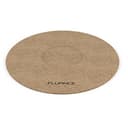
Fluance Turntable Cork Platter Mat (TA21)

Fluance Turntable Cork Platter Mat (TA21)

The mat to buy if you are replacing the felt one your deck came with and would rather not think about it again. Cork at 3 mm, a published 0.5 mm label recess so the record sits flat, and a stated 7 mm spindle hole — the only mat here whose maker publishes every dimension that decides whether it actually fits.

Best overall
$19.99 · View on Amazon

Price as of August 31, 2026. #ad How we’re funded

2
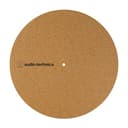
Audio-Technica AT-SMC1 Cork Slipmat

Audio-Technica AT-SMC1 Cork Slipmat

The thin one, and that is the whole reason to buy it. At 1.6 mm it is close enough to a typical factory felt mat that swapping it in barely moves the tonearm — which matters on the many decks whose arm height cannot be adjusted at all.

Best for a fixed-height tonearm
$25.00 · View on Amazon

Price as of August 31, 2026. #ad How we’re funded

3
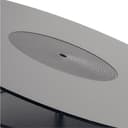
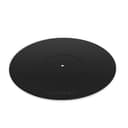
Hudson Hi-Fi Acrylic Turntable Mat (Black)

Hudson Hi-Fi Acrylic Turntable Mat (Black)

A machined solid-acrylic disc, 3 mm thick with a label recess, at cork money. Acrylic is the hard-surface option: it does not absorb the way cork and rubber do, and the maker's argument is that a material with a response close to the record's own is exactly the point.

Best acrylic
$19.95 · View on Amazon

Price as of August 31, 2026. #ad How we’re funded

4
Fluance Turntable Platter Mat, Silicone Rubber (PFHTRP)

Fluance Turntable Platter Mat, Silicone Rubber (PFHTRP)

The heavy one. At a published 226.8 g of silicone rubber it weighs roughly five times the cork mat, and that mass pressed onto the platter is the mechanism — rubber settles a ringing lightweight platter in a way a few grams of cork cannot.

Best for a light, ringing platter
$19.99 · View on Amazon

Price as of August 31, 2026. #ad How we’re funded

5
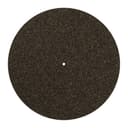
Pro-Ject Cork & Rubber it (3 mm)

Pro-Ject Cork & Rubber it (3 mm)

The composite: cork blended with rubber, so it damps like rubber and sheds static like cork instead of trading one for the other. It is also the only mat here whose maker tells you which thickness to buy for which platter — 3 mm for light, thin metal, 1 mm for heavy and solid.

Best cork-rubber composite
$46.57 · View on Amazon

Price as of August 31, 2026. #ad How we’re funded

The picks in full

#1Best overall

Fluance Turntable Cork Platter Mat (TA21)

The mat to buy if you are replacing the felt one your deck came with and would rather not think about it again. Cork at 3 mm, a published 0.5 mm label recess so the record sits flat, and a stated 7 mm spindle hole — the only mat here whose maker publishes every dimension that decides whether it actually fits.

Strengths

  • Every dimension is published — 3 mm thick, 11.75 in across, 0.5 mm label recess, 7 mm spindle hole
  • The label recess lets the record lie flat instead of rocking on the raised paper label
  • Cork grips the record rather than letting it slide, so the disc cannot creep under the stylus

Trade-offs

  • 3 mm is thicker than most factory felt, so it raises the record and shifts arm geometry slightly
  • Fluance's own static claim is conditional — it states the mat reduces static only on a grounded turntable
  • Cork crumbs at the edge over time; treat it as a consumable, not a lifetime part
MaterialCork
Thickness3 mm (0.12 in)
Diameter11.75 in (298.5 mm)
Label recess0.5 mm (0.02 in)
Spindle hole7 mm (0.28 in)
Weight0.1 lb (about 45 g)

Note. Fluance lists it as compatible with its own RT80 through RT85N decks, but those are ordinary 12-inch platter dimensions. The real constraints are your platter diameter and whether your arm height can absorb 3 mm — not the badge on the plinth.

Specifications read from the manufacturer / product listing, on August 28, 2026. “Not published” means the maker does not state that figure.

#2Best for a fixed-height tonearm

Audio-Technica AT-SMC1 Cork Slipmat

The thin one, and that is the whole reason to buy it. At 1.6 mm it is close enough to a typical factory felt mat that swapping it in barely moves the tonearm — which matters on the many decks whose arm height cannot be adjusted at all.

Strengths

  • 1.6 mm is around half the thickness of the usual 3 mm cork, so it disturbs arm geometry least
  • Audio-Technica states it does not shed particles the way loose-grain cork and felt do
  • Cork grip without the height penalty — fit it and forget it

Trade-offs

  • No label recess is published, so a thick paper label can still lift the record's center
  • The most expensive mat here per unit of material
  • 295 mm is a little under 12 inches, so a sliver of platter shows at the rim
MaterialCork
Thickness1.6 mm
Diameter295 mm (11.6 in)
Label recessNot published
WeightNot published
Listing first datedDecember 2025

Note. This is the mat for the case the others cannot serve: a fixed-height tonearm. If your arm has no height collar, the thinnest mat is the safest mat.

Specifications read from the manufacturer / product listing, on August 28, 2026. “Not published” means the maker does not state that figure.

#3Best acrylic

Hudson Hi-Fi Acrylic Turntable Mat (Black)

A machined solid-acrylic disc, 3 mm thick with a label recess, at cork money. Acrylic is the hard-surface option: it does not absorb the way cork and rubber do, and the maker's argument is that a material with a response close to the record's own is exactly the point.

Strengths

  • Machined flat and rigid, so it cannot compress unevenly the way a soft mat can
  • Includes a label recess, so a thick label does not tilt the record
  • The published 298.5 mm diameter is a true full-size 12-inch platter fit

Trade-offs

  • Hard and static-prone by nature — acrylic does not bleed off charge the way cork does
  • The maker's instruction is explicit: remove the existing mat, never stack this on top of it
  • Nothing damps at the contact point, so a ringing lightweight platter is not helped much
MaterialSolid CNC-machined acrylic
Thickness3 mm (1/8 in)
Diameter298.5 mm (11 3/4 in)
Label recessYes — depth not published
Weight0.66 lb (about 300 g)
OrientationSmooth side down, textured side up

Note. If your deck already has an acrylic platter, you almost certainly do not want this. The entire argument for an acrylic platter is the record sitting on acrylic — which is what you already have.

Specifications read from the manufacturer / product listing, on August 28, 2026. “Not published” means the maker does not state that figure.

#4Best for a light, ringing platter

Fluance Turntable Platter Mat, Silicone Rubber (PFHTRP)

The heavy one. At a published 226.8 g of silicone rubber it weighs roughly five times the cork mat, and that mass pressed onto the platter is the mechanism — rubber settles a ringing lightweight platter in a way a few grams of cork cannot.

Strengths

  • 226.8 g of silicone rubber — by far the most damping mass of the five
  • 2.5 mm is thinner than the 3 mm cork and acrylic mats, so it costs less arm height
  • Carries the same published 0.5 mm label recess as Fluance's cork mat

Trade-offs

  • Rubber holds static rather than draining it — the long-standing complaint about rubber mats
  • Grippy enough that a record can lift the mat with it when you pull the record off
  • Shows and holds dust, so it needs wiping more often than cork does
MaterialSilicone rubber
Thickness2.5 mm (0.1 in)
Diameter11.75 in (298.5 mm)
Label recess0.5 mm (0.02 in)
Weight0.5 lb (226.8 g)
Spindle holeNot published — maker states it conforms to the spindle

Note. Rubber is the mat most likely to make static worse rather than better. If your records already crackle and cling as you lift them, buy cork instead — this one is for damping, not for static.

Specifications read from the manufacturer / product listing, on August 28, 2026. “Not published” means the maker does not state that figure.

#5Best cork-rubber composite

Pro-Ject Cork & Rubber it (3 mm)

The composite: cork blended with rubber, so it damps like rubber and sheds static like cork instead of trading one for the other. It is also the only mat here whose maker tells you which thickness to buy for which platter — 3 mm for light, thin metal, 1 mm for heavy and solid.

Strengths

  • Cork-rubber blend goes after damping and static together rather than picking a side
  • Pro-Ject publishes an actual fitting rule: 3 mm for light thin platters, 1 mm for heavy solid ones
  • 300 mm is a full 12-inch fit, edge to edge

Trade-offs

  • Roughly double the price of every other mat here for a broadly similar job
  • 3 mm sits at the thick end — on a fixed-height arm the 1 mm version is the one to buy
  • Pro-Ject does not publish a label recess depth for it
MaterialCork and rubber blend
Thickness3 mm (a 1 mm version is also sold)
Diameter300 mm
Label recessNot published
ColorBrown
Maker's fitting rule3 mm for light, thin metal platters; 1 mm for heavy, solid ones

Note. Read Pro-Ject's own guidance before choosing a thickness. Buying the 3 mm for a heavy platter is the one way to get this mat wrong, and it is the maker saying so, not us.

Specifications read from the manufacturer / product listing, on August 28, 2026. “Not published” means the maker does not state that figure.

How we chose these five

Four criteria, applied in this order. Nothing here depends on a listening claim, because we make none.

  1. The maker publishes the dimensions.Diameter, thickness and — ideally — recess depth. A mat sold without a stated thickness is a mat you cannot fit responsibly, because thickness is the one property that can make your setup worse. That single rule removed most of the search results.
  2. It is a real, identifiable brand. Platter mats are a category swamped by unbranded 12-inch discs sold under a rotating cast of storefront names, with no maker to publish a spec and nobody to stand behind it. All five picks come from a company that also makes turntables, cartridges or hi-fi accessories under its own name.
  3. The materials had to differ. There is no point ranking five cork mats. The set below covers cork, thin cork, acrylic, silicone rubber and a cork-rubber composite, because the material is the decision and the brand is not.
  4. It has to be buyable today. Every ASIN here was checked against a live retail listing with a real price and a real availability line before it went on the page.

What a mat actually does

Three jobs, all real, none of them magic.

  • It sets what the record sits on. A bare metal platter is hard and reflective; a record pressed against it is coupled to a piece of stamped aluminum that rings when struck. The mat decides whether the record is coupled to something hard (acrylic), something soft and grippy (rubber), or something in between (cork).
  • It manages static, or fails to. Vinyl generates a charge as it is peeled off the mat and as the stylus drags through the groove. Cork is an insulator that does not build and hold charge against the record the way felt does, which is the practical reason cork replaced felt as the default upgrade. Rubber is the worst of the three on this count, and every honest maker of a rubber mat quietly stops talking about static.
  • It decides whether the record is flat.This is the one that gets ignored. A recessed mat drops the label area so the record is supported by its playing surface. A flat mat supports the record on its thickest part — the label — and everything outside that circle is very slightly unsupported.

And what it does not do: it will not fix a worn stylus, a misaligned cartridge, a bouncing shelf, or a record that was never cleaned. If a change of mat is your first response to a noise problem, you are treating a symptom — start with troubleshooting instead.

Thickness: the one way a mat can make things worse

Your tonearm is set at a height that puts the stylus into the groove at a particular angle. Raise the record by adding a thicker mat and you tilt the cartridge back very slightly; lower it and you tilt it forward. On a deck with an adjustable arm height you correct that in thirty seconds. On a deck without one — and that is most decks under about $500 — you cannot correct it at all.

The arithmetic is simple and worth doing before you buy:

  1. Measure what is on there now. Factory felt is usually around 1 to 2 mm; a factory rubber mat is often 3 to 5 mm. A ruler against the edge of the mat is accurate enough.
  2. Compare it to the mat you are buying. Our picks run from 1.6 mm to 3 mm, and every one of those figures is published above.
  3. If the difference is more than about a millimeter and your arm has no height collar, buy the closer match. That is the entire reason the Audio-Technica AT-SMC1 is on this list at 1.6 mm.

Pro-Ject is the only maker here that publishes a fitting rule rather than leaving you to work it out: it sells the Cork & Rubber it in 3 mm and 1 mm and states plainly that the thick one is for light, thin metal platters and the thin one for heavy, solid platters. That is a mass argument rather than a geometry argument, and it is a useful second lens — a heavy platter already has the mass to stay quiet and does not need the mat to supply it.

If your arm does have a height adjustment, none of this is a constraint. Set the arm parallel with a record on the new mat and move on. The same tonearm-balancing discipline applies either way, and it is covered in how to balance a tonearm.

The materials, and what each one trades

Felt.What most decks ship with, and what almost everyone here is replacing. It is light, it is cheap, and it generates and holds static enthusiastically — the mat that lifts off the platter stuck to the record is a felt mat. It also sheds fibers onto the record surface. Its one genuine advantage is that it slips, which is exactly what a DJ wants and exactly what a home listener does not. We have not picked a felt mat because the branded options in this class are essentially absent from the market: what is on sale is unbranded discs with no published specification, which fails our first criterion.

Cork. The default upgrade, and the reason is not subtle: it grips instead of slipping, it does not hold a charge against the record the way felt does, and it is soft enough to damp a little without being spongy. The trade is that cork is a natural material that crumbs at the edges over a few years. Treat it as a consumable.

Cork and rubber blended.The composite exists because cork and rubber each solve half the problem. Rubber brings mass and damping; cork brings the anti-static behavior and the grip. Pro-Ject’s version is the one with a published fitting rule attached, and it is also roughly twice the price of everything else here — which is the honest reason it is fifth rather than first.

Silicone rubber. The mass option. Fluance publishes 226.8 g for its rubber mat against 0.1 lb for its cork one, so you are adding roughly five times the weight at the record interface. On a light stamped platter that is a real mechanical change. The cost is static behavior and dust: rubber attracts both, and it grips hard enough that the mat sometimes comes up with the record.

Acrylic.The hard option, and the one people buy partly for the look. The argument makers put forward is that acrylic responds more like vinyl than metal does, so coupling the record to acrylic rather than to a platter is the closer match. What acrylic does not do is damp, and it does not drain static. If you have already bought a deck with an acrylic platter — a Fluance RT85, for instance — adding an acrylic mat on top is buying the same idea twice.

Leather. Genuinely available and genuinely sold by hi-fi brands, but the current crop of listings is either priced far above this class or thin on published dimensions, so nothing cleared our first two criteria this time. If that changes we will add one.

Measure your platter before you order

Three measurements, two minutes, and it is the difference between a mat that fits and a mat that overhangs.

  • Platter diameter. A full-size platter is close to 300 mm (11.8 in). Some budget decks use a smaller platter with the record overhanging it by design; a 300 mm mat on one of those looks wrong and traps dust at the rim. Our picks run 295 mm to 300 mm.
  • Spindle diameter. A standard spindle is around 7 mm. Only Fluance publishes a spindle-hole figure among these five; soft mats simply stretch over the spindle, but a rigid acrylic mat does not, so the hole has to be right.
  • Current mat thickness. Covered above, and the one that matters most.

When not to buy a mat at all

Four cases where the correct spend is zero.

  • Your deck already has an acrylic platter. The record is already sitting on acrylic. That was the upgrade.
  • Your deck was voiced around its own mat.Some makers ship a specific felt mat and treat it as part of the design rather than as a cost-saving. Changing it is an experiment, not an upgrade, and it is reversible — keep the original.
  • You use the turntable to DJ. Cork, rubber and acrylic all grip. A slipmat is supposed to slip. Buy felt.
  • Your actual problem is elsewhere. A worn stylus, a cartridge that has never been aligned, or dirty records will each do more audible damage than any mat can repair. In rough order of value for money, the spend that beats a mat is a replacement stylus, then a better cartridge, then a cleaning routine.

Fitting it, and the mistake to avoid

Take the old mat off first. This sounds too obvious to state, and Hudson Hi-Fi prints it on the listing anyway, because stacking a new mat on the factory one is a genuinely common mistake — it doubles the height change and it puts a soft layer under a rigid one, which defeats the point of buying a rigid mat.

After fitting, check two things. First, that the record sits flat: spin the platter by hand with a record on it and watch the rim from eye level. Second, that the arm still tracks at the right force — a mat swap does not change tracking force, but it is a good moment to confirm it, and the procedure is in how to set up a turntable.

Then clean the mat on a schedule. Every mat collects dust and hands it straight back to the next record, which quietly undoes a careful brushing habit. Cork and acrylic wipe with a dry microfiber cloth; rubber wants it more often. The rest of that routine is in turntable maintenance.
Frequently asked questions

What is the best turntable mat?

For most decks, the Fluance cork mat — it is the only one here whose maker publishes every dimension that decides fitment, including a 0.5 mm label recess and a 7 mm spindle hole, and cork is the material that handles static and grip best for the money. Buy the 1.6 mm Audio-Technica AT-SMC1 instead if your tonearm height cannot be adjusted, and the Fluance silicone rubber mat if your platter is light and rings when tapped.

Does a turntable mat actually improve sound quality?

It changes what the record is mechanically coupled to, and it changes static behavior — both are real. Whether that is audible on your system is a separate question, and we do not claim to have measured it. The changes you can verify without listening tests are concrete: a recessed mat supports the record on its playing surface rather than its label, cork does not cling to the record the way felt does, and a heavier mat adds damping mass to a light platter.

Is cork or rubber better for a turntable mat?

Cork for static and grip; rubber for damping mass. Cork does not build and hold a charge against the record, and it grips without sticking. Rubber weighs several times more — Fluance publishes 226.8 g for its rubber mat against about 45 g for its cork one — which does more to settle a light, ringing platter, at the cost of attracting static and dust. A cork-rubber composite like the Pro-Ject Cork & Rubber it is the attempt to have both.

Will a thicker turntable mat change my tonearm setup?

Yes. The mat sets the height of the record, and the height of the record sets the angle at which the stylus meets the groove. If your tonearm has a height adjustment, re-level the arm with a record on the new mat and it is a non-issue. If it does not — which covers most decks under about $500 — buy a mat within roughly a millimeter of the thickness you are replacing. That is why the 1.6 mm AT-SMC1 is on this list.

What size turntable mat do I need?

Measure your platter. A full-size platter is close to 300 mm (11.8 in) and the mats here run 295 mm to 300 mm, so any of them fits a standard 12-inch platter. Some budget decks use a smaller platter that the record deliberately overhangs; on those, a full-size mat will overhang too. Also check the spindle diameter — typically about 7 mm — because a rigid acrylic mat will not stretch over a larger one the way a soft mat does.

Can I put a new mat on top of the one my turntable came with?

No. Remove the original first. Stacking doubles the height change your tonearm has to absorb, and putting a soft factory mat underneath a rigid acrylic one cancels the reason you bought a rigid mat. Hudson Hi-Fi states this explicitly on its own listing. Keep the original mat — a mat swap is one of the few upgrades that is completely reversible.

Do I need a mat with a label recess?

It is the difference between the record being supported by its playing surface and being supported by its label, which is thicker than the vinyl around it. Fluance publishes a 0.5 mm recess on both of its mats and Hudson Hi-Fi states its acrylic mat has one without giving a depth; Audio-Technica and Pro-Ject do not publish a recess for the mats here. It is not a dealbreaker — flat mats have been standard for decades — but if the spec is published, it is worth having.

Sources

Keep reading