Fluance RT85 vs RT85N
One turntable, two cartridges, one price. Almost every row of the spec sheet is identical — so the entire decision is which stylus you want reading your records.
How this is funded: we earn a commission if you buy through our links, at no extra cost to you. It never changes which product we recommend, and we’ll tell you plainly when to skip one. Full disclosure.
Most turntable comparisons are a comparison of two machines. This one is not. The RT85 and the RT85N are the same turntable— same belt-drive chassis, same high-density acrylic platter, same 224 mm S-type tonearm, same servo-controlled motor, same MDF plinth, same three-point isolation feet, same 7.6 kg on the shelf, same absent phono stage — sold at the same list price with two different cartridges fitted at the factory.
The question that decides it: do you want the more analytical cartridge or the warmer one?
The short answer
- Buy the RT85 (Ortofon 2M Blue) if your records are mostly modern, well-pressed and quiet, and you want the extra separation and high-frequency reach a nude elliptical is built to give you.
- Buy the RT85N (Nagaoka MP-110) if a lot of your collection is second-hand, busy or brightly mastered, and you would rather the deck flattered those records than exposed them.
Everything below is why those two sentences are the whole comparison, and why the small differences in Fluance’s spec table are downstream of the cartridge rather than evidence of a better deck.
What is genuinely identical
It is worth being specific, because “N” on the end of a model number usually signals a new generation and here it does not.
Fluance publishes both decks as belt drive with a DC motor and a servo controller that reads motor speed 500 times a second, and quotes the same 0.07% wow and flutter for each. Both carry a 12-inch acrylic platter weighing 1.56 kgat 16 mm thick — the part that does most of the work at this price, because acrylic’s resonant behaviour is close enough to vinyl’s to damp the record rather than ring under it, and the mass gives the motor something steady to hold. Both use the same static balanced S-type aluminum arm with a 224 mm effective length and the same H-4 bayonet headshell. Both are 16.76 lb. Neither has a phono preamp inside.
Two rows do move, and both are cartridge consequences rather than build differences. Fluance quotes 69 dB weighted signal-to-noise for the RT85 and 68.5 dB for the RT85N— half a decibel, which is below what anyone identifies in a listening test and tracks the cartridges’ own output difference of 5.5 mV against 5.0 mV. And the tonearm effective mass differs, 27.5 g against 21.1 g, because effective mass counts whatever is bolted to the end of the arm and the two cartridges weigh 7.2 g and 6.5 g.
The cartridges, which is the actual comparison
Ortofon 2M Blue — the detail read
Ortofon publishes a nude elliptical stylus with an r/R 8/18 um tip radius, 5.5 mV output, 25 dB channel separation at 1 kHzand a frequency response of 20–20,000 Hz to a stated +2 / −1 dB tolerance. It wants 1.8 g of tracking force into a 47 kOhm load.
“Nude” is the word doing the work. On a nude stylus the diamond is the entire tip, mounted directly to the cantilever; on a bonded one, a smaller diamond sits on a metal shank. The nude version carries less mass at the point that has to change direction thousands of times a second, and lower tip mass is the mechanism behind the extra air and separation people describe when they move up the 2M range. Our 2M Red vs 2M Blue comparison walks the same ladder one rung lower.
Nagaoka MP-110 — the forgiving read
The MP-110’s published table gives a superfine polished elliptical bonded diamond at 0.4 x 0.7 mil, 5.0 mV output, 23 dB channel separation at 1 kHz, 20–20,000 Hz with no tolerance stated, a 1.5–2.0 g tracking range and a 6.5 g body. Its replacement stylus is the JN-P110.
On paper it loses on every line: bonded rather than nude, a slightly larger tip, 2 dB less separation, no stated response tolerance. In practice the MP-110 is one of the most persistently recommended cartridges in budget hi-fi, and the reason is that its balance is fuller through the midrange and gentler at the top. On a pressing with sibilance problems or surface noise — which describes a large share of any second-hand collection — that is not a worse read. It is a more listenable one.
The compliance numbers do not mean what they look like
Both cartridges publish a dynamic compliance of 20, and it is tempting to read that as identical. It is not, because the two makers are quoting different measurements: Nagaoka states its figure at 100 Hz and Ortofon does not state a measurement frequency at all on its 2M Blue page. Compliance falls as measurement frequency rises, so a 20 quoted at 100 Hz and a 20 quoted at an unstated frequency are not the same stiffness. We are not going to convert between them and pretend the result is a specification.
What matters practically is the outcome, and the outcome is fine either way. Both cartridges are moving-magnet designs of ordinary compliance on a medium-mass arm — Fluance quotes 27.5 g and 21.1 g effective mass for the two builds, which is the range these cartridges are designed to sit in. Neither pairing is a mismatch, and neither will land the arm/cartridge resonance somewhere it causes trouble.
The upgrade paths diverge later
You are not only choosing a sound today; you are choosing which stylus you buy in two years, because a stylus is a consumable measured in hours played.
On the RT85, the 2M Blue’s body accepts Ortofon’s 2M stylus range, so a worn tip can be replaced like for like or moved up the range without changing the cartridge or re-aligning anything. On the RT85N, the MP-110 takes the JN-P110. Both are simple, both are cheaper than a new cartridge, and both are genuinely available — Nagaoka’s distribution is thinner in the US than Ortofon’s, which is worth knowing but is not the obstacle it was a decade ago. Our replacement stylus guide covers what fits what.
And because both decks use the same H-4 bayonet headshell, the decision is reversible. A cartridge swap here is a pre-aligned assembly change, not the evening with a protractor that a fixed headshell demands — see how to set up a cartridge for what you would otherwise be signing up for. What makes buying the right one first worthwhile is money, not difficulty: each of these cartridges costs a substantial fraction of the turntable, so fitting the other one later means paying for two.
What neither of them includes
Both decks state “No — separate phono preamp required”in Fluance’s own table, and that is not a detail to discover after delivery. A turntable’s output is far too quiet and RIAA-shaped to plug into a line input, so one of three things has to be true: your amplifier has a phono input, your powered speakers have one built in, or you buy a separate phono stage. If none of those is true yet, start herebefore you compare cartridges — the preamp changes what you hear more than the choice on this page does.
The decision, in one paragraph
Buy the RT85 if you want the more revealing cartridge and your records deserve it: modern pressings, clean second-hand copies, a system you have already finished. Buy the RT85N if you want the deck to be kind to a mixed collection, or if you have heard a 2M Blue somewhere and found it a touch forward. Do not buy either one expecting a better turntable than the other, because Fluance publishes the same platter, the same arm, the same motor and the same 0.07% for both. If the two are ever priced differently on the day you look, buy the cheaper one and put the difference toward the phono stage neither of them includes.
The spec matrix
Nine of the twenty rows below are identical, because these are the same deck. The cartridge rows are the comparison.
| Specification | RT85Fluance | RT85NFluance |
|---|---|---|
| Drivesame | Belt drive | Belt drive |
| Motorsame | DC motor, servo controller reading speed 500 times/sec | DC motor, servo controller reading speed 500 times/sec |
| Speedssame | 33 1/3 and 45 RPM | 33 1/3 and 45 RPM |
| Plattersame | Acrylic, 12 in, 1.56 kg, 16 mm | Acrylic, 12 in, 1.56 kg, 16 mm |
| Tonearmsame | Static balanced S-type aluminum, 224 mm effective length | Static balanced S-type aluminum, 224 mm effective length |
| Tonearm effective mass | 27.5 g | 21.1 g |
| Headshellsame | H-4 bayonet, removable | H-4 bayonet, removable |
| Cartridge | Ortofon 2M Blue | Nagaoka MP-110 |
| Stylus | Nude elliptical, r/R 8/18 um (0.3 x 0.7 mil) | Bonded elliptical, superfine polished, 0.4 x 0.7 mil |
| Cartridge output | 5.5 mV | 5.0 mV |
| Tracking force | 1.6-2.0 g (1.8 g recommended) | 1.5-2.0 g |
| Channel separation | 25 dB at 1 kHz | 23 dB at 1 kHz |
| Frequency response | 20-20,000 Hz, +2 / -1 dB | 20-20,000 Hz (no tolerance stated) |
| Dynamic compliance | 20 um/mN (frequency not stated) | 20 x 10-6 cm/dyne at 100 Hz |
| Cartridge weight | 7.2 g | 6.5 g |
| Replacement stylus | Ortofon 2M Blue stylus | Nagaoka JN-P110 |
| Wow and fluttersame | 0.07% | 0.07% |
| Signal to noise | 69 dB (weighted) | 68.5 dB (weighted) |
| Built-in preampsame | No — external stage required | No — external stage required |
| Weightsame | 16.76 lb (7.6 kg) | 16.76 lb (7.6 kg) |
Turntable figures are Fluance’s own published specification tables for the RT85 and RT85N; cartridge figures are Ortofon’s for the 2M Blue and the published MP-110 table for the Nagaoka. All read 2026-09-03 — see Sources below. “Not published” means the figure is not stated in the sources cited below — it is never a value we estimated. Rows marked same are the ones where these decks do not differ.
Both versions, with live prices
These two normally list at the same money. If one is discounted on the day you look, that is a real reason to pick it — the hardware underneath is identical.
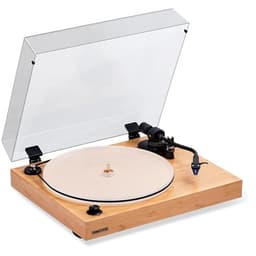
Fluance RT85
The most cartridge and platter per dollar under $600
Price as of October 21, 2026. #ad How we’re funded
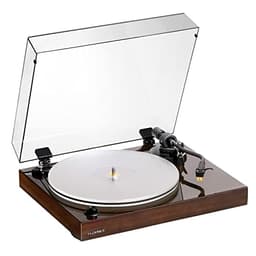
Fluance RT85N
The RT85 mechanical package with a warmer cartridge fitted
Price as of October 21, 2026. #ad How we’re funded
Frequently asked questions
What is the difference between the Fluance RT85 and RT85N?
The cartridge, and nothing else that matters. Both are the same belt-drive deck with the same acrylic platter, the same 224 mm S-type tonearm, the same servo-controlled motor and the same published 0.07% wow and flutter. The RT85 ships an Ortofon 2M Blue; the RT85N ships a Nagaoka MP-110. Fluance also publishes a marginally different weighted signal-to-noise figure — 69 dB against 68.5 dB — and a different tonearm effective mass, both of which follow from the cartridge change.
Is the RT85N better than the RT85?
Neither is better; they sound different. The 2M Blue's nude elliptical stylus and slightly wider channel separation lean toward detail and separation. The MP-110 is the long-standing enthusiast pick for a fuller, warmer balance that flatters busy or older pressings. If your collection is mostly well-pressed modern reissues, the 2M Blue makes more of them. If it is a lot of second-hand rock, jazz and soul, the Nagaoka is the more forgiving read.
Which one has the better stylus on paper?
The 2M Blue. Ortofon publishes a nude elliptical with an r/R 8/18 um tip; Nagaoka publishes a superfine polished elliptical bonded diamond at 0.4 x 0.7 mil. Nude means the diamond is the whole tip, so the moving mass at the end of the cantilever is lower, which in principle tracks fine high-frequency modulation better. Bonded means the diamond is mounted on a metal shank. That is a real difference, and it is also the difference the MP-110's admirers describe as warmth.
Do the RT85 and RT85N need a phono preamp?
Both do. Neither has a phono stage inside — Fluance's own specification table says 'No - Separate Phono Preamp Required' for each. Budget for one on top of either deck, or use powered speakers or an amplifier that already has a phono input.
Can I put the other cartridge on afterwards?
Yes. Both use an H-4 bayonet headshell, so a cartridge swap is a pre-aligned assembly change rather than a full alignment job. That means the choice between these two is not permanent — but buying the deck with the cartridge you want already fitted is cheaper than buying one and adding the other, because the 2M Blue and MP-110 each cost a meaningful fraction of the turntable.
Why is the tonearm effective mass different if it is the same tonearm?
Effective mass is a property of the arm plus everything hanging on the end of it, and the two cartridges differ in weight — Ortofon publishes 7.2 g for the 2M Blue, the MP-110 table publishes 6.5 g. Fluance quotes 27.5 g for the RT85 and 21.1 g for the RT85N. Both sit comfortably in the medium-mass range that moving-magnet cartridges of this compliance are designed for, so neither combination is a mismatch.
Is the RT85N the same as the Wirecutter pick?
Fluance's own RT85N listing quotes a New York Times Wirecutter recommendation, so the RT85N is the version that award attaches to. Treat it as one input rather than the decision: the hardware is common to both, and the cartridge choice is a preference no award can make for you.
Sources
- Fluance — RT85 Reference turntable, published specifications — Manufacturer specification table: 0.07% wow and flutter, 69 dB weighted S/N, acrylic platter 1.56 kg / 16 mm, static balanced S-type aluminum arm 224 mm / 27.5 g, H-4 bayonet headshell, Ortofon 2M Blue 0.3 x 0.7 mil nude elliptical, no built-in preamp, 7.6 kg (accessed September 3, 2026)
- Fluance — RT85N Reference turntable, published specifications — Manufacturer specification table: 0.07% wow and flutter, 68.5 dB weighted S/N, acrylic platter 1.56 kg / 16 mm, static balanced S-type aluminum arm 224 mm / 21.1 g, H-4 bayonet headshell 9 g, Nagaoka MP-110 with a 0.4 x 0.7 mil superfine polished elliptical bonded diamond, no built-in preamp, 7.6 kg (accessed September 3, 2026)
- Ortofon — 2M Blue — Manufacturer page for the nude elliptical 2M Blue and its stylus interchangeability (accessed August 11, 2026)
- Nagaoka MP-110 — published specification table (Fluance) — Published specs for the cartridge Fluance fits to the RT85N: moving magnet, 0.4 x 0.7 mil superfine polished elliptical bonded diamond, 5.0 mV output, 1.5-2.0 g tracking force, 20-20,000 Hz, 23 dB channel separation at 1 kHz, dynamic compliance 20 x 10-6 cm/dyne at 100 Hz, 6.5 g, 47 kOhm load, JN-P110 replacement stylus (accessed September 3, 2026)
- Fluance — Reference series setup and FAQ (RT82/83/84/85) — Manufacturer setup documentation: counterweight, tracking force and cartridge compatibility for the Reference arms (accessed August 19, 2026)
- Crutchfield — Phono cartridge guide — Reference on cartridge types, styli and mounting (accessed July 24, 2026)
Keep reading
Fluance RT85 Review
The full case for the deck underneath both of these, and the preamp it assumes you have.
Read the reviewFluance RT85 vs RT87
The step up from this chassis — dual plinth, carbon arm, and the figures that actually move.
Compare themOrtofon 2M Red vs 2M Blue
What the nude elliptical stylus in the RT85 is worth over the cartridge one rung down.
Read the comparisonBest Phono Preamps Under $200
Neither of these decks has a phono stage. This is the box that finishes the job.
See the picks