Turntable Headshells Explained
The small detachable carrier at the end of some tonearms. Whether you have one decides how easy cartridge changes are — and whether owning two cartridges is practical at all.
How this is funded: we earn a commission if you buy through our links, at no extra cost to you. It never changes which product we recommend, and we’ll tell you plainly when to skip one. Full disclosure.
A headshell is a small aluminum carrier, usually under 10 grams, that sits at the business end of a tonearm. The cartridge bolts to its underside; four color-coded wires run from the cartridge pins into the shell; the whole assembly twists into the arm and locks with a knurled collar.
Whether your turntable has one is not a quality question — excellent decks exist with and without. It is a convenience and flexibility question, and it changes how you should think about cartridge upgrades.
First: does your tonearm have one?
Look at the end of the arm, just behind the cartridge. You are looking for a visible joint with a knurled ring or collar around it. If the arm tube runs unbroken into the cartridge mount, the headshell is integrated and none of the rest of this page applies to your deck.
Rough pattern across the decks this site covers:
- Usually removable:direct-drive and DJ-lineage decks — the Audio-Technica AT-LP120XUSB and AT-LP120XBT-USB, the AT-LP5X (which ships with an AT-HS6), the Denon DP-300F and DP-450USB.
- Usually integrated:most belt-drive listening decks — Fluance’s RT range, Pro-Ject’s Debut series, U-Turn’s Orbit.
- Neither: budget automatics with fixed arms, which have no user-serviceable cartridge mount at all. See are cartridges interchangeable.
There is a design logic to that split. A removable headshell adds a mechanical joint to the arm, and a joint is a place where rigidity can be lost. Manufacturers chasing the most rigid possible arm at a price integrate the headshell; manufacturers whose users swap cartridges regularly do not. Neither is wrong.
What a removable headshell is actually worth
Three concrete advantages, in the order most people come to appreciate them.
1. Cartridge mounting stops being a nightmare
Fitting a cartridge to an integrated headshell means working upside-down under a tonearm, over a plinth, with two screws smaller than a grain of rice and four lead wires that slip off their pins. With a removable shell, you unclip it, sit at a table with good light and tweezers, and do the job comfortably.
2. Owning two cartridges becomes practical
This is the one that changes behavior. Mount a second cartridge on a second shell — a spare AT-HS6 costs a fraction of a cartridge — align it once, and thereafter switching between them takes about ten seconds and requires no alignment. Common pairings:
- An everyday elliptical for ordinary records, and an advanced profile for your best pressings.
- A moving magnet for convenience and a moving coil for serious listening, if your preamp handles both.
- A conical for beaten-up secondhand records, where a finer tip finds only damage.
Without a removable shell, all of those are theoretically possible and practically nobody does them, because each swap is a twenty-minute alignment job.
3. Alignment survives
Once a cartridge is aligned in its shell for your arm, that alignment travels with the shell. Take it off to change stylus, put it back, and the geometry is unchanged.
Mass: the specification that matters
A headshell’s mass adds directly to the tonearm’s effective mass, and effective mass matters because arm and cartridge form a mechanical resonant system. The target is a resonance somewhere around 8 to 12 Hz— comfortably above the frequencies record warps produce and below the audio band.
The relationship, roughly: a heavier arm-and-cartridge combination resonates lower; a lighter one resonates higher. Cartridge compliance— how easily the stylus assembly moves — pushes the same figure the other way. So a high-compliance cartridge wants a lighter arm, and a low-compliance one wants a heavier arm.
In practice, at the price points this site covers, this rarely bites. Most moving-magnet cartridges are moderate compliance, most universal headshells are around 8–12 g, and most arms are medium mass. The Audio-Technica AT-HS6 is published at 9 g, which sits squarely in normal territory.
It becomes a real consideration in two cases: a very high-compliance vintage cartridge, and a very light or very heavy specialist shell. If a cartridge maker publishes a recommended arm effective mass, check the arithmetic. Otherwise a standard aluminum shell is the safe choice.
Materials, and how much they matter
Headshells come in die-cast aluminum, magnesium, carbon fiber, wood and various composites, and the marketing around them is enthusiastic.
What is defensible: the shell is a rigid link in the mechanical path between stylus and arm, so rigidity and internal damping do matter in principle. Audio-Technica’s own description of the AT-HS6 leads on the die-cast aluminum body keeping vibration to a minimum, which is the standard and reasonable claim.
What we will not claim: that we can hear the difference between a good aluminum shell and a good carbon one, because we have not done that comparison — see how we pick. The honest ranking of what changes your sound is cartridge first, alignment and tracking force second, headshell material a long way third.
Buy a well-made aluminum shell with a finger lift, lead wires and screws in the box. Spend the difference on the cartridge.
Fitting one
Four steps, and the whole point is that you do them at a table:
- Attach the lead wires.Four colors to four pins — white left signal, blue left ground, red right signal, green right ground. Tweezers, and do not pull on the wire itself.
- Screw the cartridge on loosely, so it can still slide in the shell’s slots.
- Set overhang with a protractor.This is arm-specific — the shell fixes the angle, not the distance. Full procedure in how to set up a cartridge.
- Tighten, clip the shell into the arm, and rebalance.A different cartridge means a different mass, so zero-balance and re-dial the tracking force — see how to balance a tonearm.
That last step is the one people skip when swapping between two pre-aligned shells, and it matters if the two cartridges differ in weight. If you use two shells regularly, note the counterweight setting for each on a piece of tape.
If your arm has no removable headshell
You have not lost much, and there is nothing to fix. Your arm is likely more rigid for it. Cartridge changes are simply a bigger job: budget half an hour, work at the deck with a protractor and good light, and follow the setup guide.
The practical consequence is that you should choose a cartridge family with a good stylus ladderinstead — the VM95 and 2M ranges both let you upgrade the tip without touching the mounting. That gets you most of the flexibility a second headshell would have provided, with no alignment at all. See cartridges under $200 for which families those are.
Two ways to buy one
A bare shell if you already have a cartridge to mount, or a pre-assembled shell-and-cartridge kit if you would rather skip the screws and lead wires entirely. Both are universal half-inch mounts — check your arm accepts a removable headshell first.
The bare spare shell
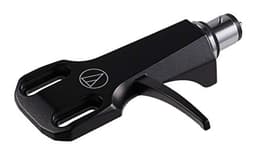
Audio-Technica AT-HS6 Universal Headshell
A second headshell so you can swap cartridges without remounting
Shell with a cartridge already on it
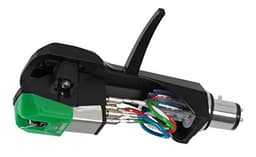
Audio-Technica AT-VM95E/H Headshell + Cartridge Kit
Upgrading the cartridge on a removable-headshell deck without doing the mounting yourself
Frequently asked questions
What is a turntable headshell?
The small detachable carrier at the end of a tonearm that the cartridge bolts onto. It holds the cartridge at the correct angle, carries four color-coded lead wires to the cartridge pins, and clips into the arm with a bayonet collar. Not every tonearm has one — many belt-drive decks integrate the headshell into the arm tube.
Does my turntable have a removable headshell?
Look at the end of the tonearm for a knurled collar that unscrews, with a visible joint just behind the cartridge. Direct-drive and DJ-style decks — the Audio-Technica AT-LP120X series, the AT-LP5X, the Denon DP-300F — usually do. Most belt-drive listening decks, including the Fluance RT range and the Pro-Ject Debut series, do not.
Are turntable headshells universal?
The common standard is a universal half-inch mount with a four-pin bayonet connector, and headshells built to it are interchangeable between arms designed for it. That covers most decks with a removable headshell. It does not help at all if your tonearm has no removable headshell in the first place.
Does headshell mass matter?
Yes, because the headshell's mass adds to the tonearm's effective mass, and that combined figure interacts with the cartridge's compliance to set the arm's resonant frequency — ideally between about 8 and 12 Hz. In practice most medium-mass shells and most moving-magnet cartridges land inside that window. It becomes a real consideration with very high-compliance or unusually heavy cartridges.
Is a second headshell worth buying?
If your arm takes one, it is one of the best-value accessories in vinyl. Mount a second cartridge on it, aligned properly at a table with good light, and you can switch between two cartridges in seconds without touching alignment. That is the difference between owning two cartridges in theory and in practice.
Do I still need to align a cartridge on a headshell?
Yes. The headshell fixes the cartridge's angle relative to the arm, but overhang — how far the stylus sits past the spindle — still depends on where you position the cartridge in the shell's slots, and that is arm-specific. Use a protractor. What the removable shell buys you is the ability to do that job on a table instead of over a plinth.
Sources
- Audio-Technica — Identifying the correct headshell for your turntable — Manufacturer guidance on headshell mounts, fitment and which tonearms accept a removable headshell (accessed August 19, 2026)
- Crutchfield — Phono cartridge guide — Reference on cartridge types, styli and mounting (accessed July 24, 2026)
- Audio-Technica — VM95 Series cartridges — The shared-body VM95 range and its interchangeable stylus upgrade path (accessed July 24, 2026)
- Elusive Disc — Turntable setup guide: tracking force & anti-skate — Step-by-step on balancing the tonearm, setting tracking force and anti-skate (accessed July 24, 2026)
Keep reading
Are Turntable Cartridges Interchangeable?
The fitment question one level up: will the cartridge fit at all.
Read the explainerHow to Set Up a Cartridge
Mounting and alignment, on or off the deck.
Read the guideDenon DP-300F Review
An automatic deck that keeps its removable headshell.
Read the reviewBest Turntable Cartridges
What to put on the shell once you have one.
See the picks