Are Turntable Cartridges Interchangeable?
Mostly yes — the half-inch mount has been an industry standard for decades. The three exceptions are specific enough that you can rule them out in about a minute.
How this is funded: we earn a commission if you buy through our links, at no extra cost to you. It never changes which product we recommend, and we’ll tell you plainly when to skip one. Full disclosure.
The short answer is yes, mostly, and the reason is a piece of standardization that has held since the 1960s: the half-inch mount. Two screw holes 12.7 mm apart, four color-coded pins in a fixed arrangement. Cartridge makers build to it, tonearm makers build to it, and the result is that an Ortofon body will physically bolt onto an Audio-Technica arm without anyone having agreed anything in particular.
The reason the question keeps being asked is that “physically fits” and “will work properly” are two different bars, and three specific situations separate them.
The sixty-second check
Before reading any further, look at your turntable and answer three questions.
- Are there two small screws holding the cartridge to the front of the arm, roughly half an inch apart? Yes means a standard half-inch mount. This is the common case.
- Is there a cylindrical weight on the back of the tonearm that rotates? That is the counterweight. Yes means you can set tracking force, which means you can change cartridges.
- Does your phono stage handle moving-magnet cartridges? Almost all do. Only relevant if you are considering a moving coil.
Three yeses and the whole moving-magnet cartridge market is open to you. Any no sends you to one of the exceptions below.
Exception 1: the fixed arm with no counterweight
This is by far the most common reason a cartridge swap is impossible, and it affects a large share of the turntables people actually own.
Fully automatic decks at the budget end — the Audio-Technica AT-LP60X and its many equivalents — achieve their automation with a mechanical cam-and-lever system. For that to work reliably, the arm has to be a known, constant mass tracking at a known, factory-set force. So there is no counterweight and no anti-skate dial.
Without a counterweight, a different cartridge — with different mass and a different specified tracking force — cannot be balanced. Fitting one anyway means the arm tracks at whatever force happens to result, which is the fastest route to worn records.
What you can do instead:replace the stylus. Most fitted cartridges have a replaceable stylus, and on several decks the manufacturer offers a better one for the same body — a genuine upgrade requiring no setup at all. Our replacement stylus roundup covers the options, and how to replace a stylus covers the two-minute procedure.
The notable counter-example is the Denon DP-300F: fully automatic, and it still has a counterweight, anti-skate and a removable headshell. It is the exception that proves the rule about how rare that combination is.
Exception 2: P-mount (T4P)
A second standard exists. P-mount, also called T4P, was widely used in the 1980s and survives on a few budget decks. The cartridge slides into the end of the tonearm as a single plug and is secured with one small screw. There are no lead wires and no alignment to set — the geometry is fixed by the standard.
How to spot it: the cartridge appears to go into the arm rather than to be bolted under a headshell, and you cannot see four colored wires.
P-mount cartridges are interchangeable with each other, and adapters exist to fit a P-mount cartridge to a half-inch headshell — but not the reverse in any practical way. The current selection is small, which is the real limitation.
Exception 3: moving coil, which fits but may not work
This one is electrical rather than mechanical. Many moving-coilcartridges use the same half-inch mount and will bolt straight on. What differs is output: a low-output MC produces a few tenths of a millivolt against roughly 5 mV from a typical moving magnet.
A standard moving-magnet phono stage cannot amplify that enough. The result is a faint signal buried in hiss, which people reasonably interpret as a faulty cartridge. You need a phono stage with an MC setting — something like the Schiit Mani 2, which offers up to 60 dB of gain and low-impedance loading, or a dedicated step-up transformer.
The full comparison, including why anyone bothers, is in moving magnet vs moving coil.
Two things that are compatibility questions but not deal-breakers
Cartridge mass versus arm mass
A tonearm and cartridge form a mechanical resonant system, and the ideal is for that resonance to sit between roughly 8 and 12 Hz — above record warp frequencies and below the audio band. A very heavy cartridge on a very light arm, or the reverse, pushes it out of that window.
In practice this rarely bites at the price points this site covers, because most arms are medium mass and most moving-magnet cartridges are 5–8 g. It becomes a real consideration with high-compliance vintage cartridges or unusually light arms. If a cartridge maker publishes a recommended arm mass range, check it; otherwise proceed.
Threaded versus unthreaded mounting holes
Some cartridge bodies have threaded holes so the screws bite directly; others are unthreaded and need nuts on top of the headshell. Both are standard and both work. It only matters because the fiddly version needs tweezers and patience — and it is one more argument for doing the job on a removable headshell at a table rather than over a plinth.
What you must redo after any swap
“Interchangeable” does not mean “plug and play”. A new cartridge always needs:
- Alignment— overhang and offset angle set with a protractor, because different bodies place the stylus tip differently relative to the mounting holes.
- Tracking force— zero-balance the arm, then dial the counterweight to the new cartridge’s published figure. See how to balance a tonearm.
- Anti-skate— matched to the new tracking force.
- Sometimes VTA— if the new cartridge is a noticeably different height and your arm allows height adjustment.
None of it is difficult, and all of it is in how to set up a cartridge. Skipping it is worse than not upgrading: a good cartridge tracking at the wrong force is louder about its errors than a cheap one tracking correctly.
What to buy once you know which case you are in
A half-inch mount with a counterweight opens the whole cartridge market. A fixed arm limits you to a replacement stylus — which is still a real upgrade on many decks.
Fits any half-inch mount
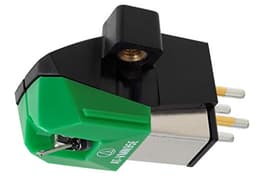
Audio-Technica AT-VM95E
The first cartridge upgrade for most decks
Fits any half-inch mount
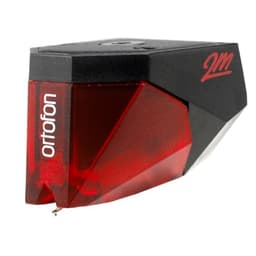
Ortofon 2M Red
A step-up cartridge with a clear upgrade path
If only the stylus can change
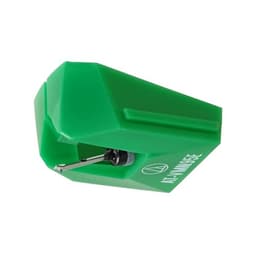
Audio-Technica AT-VMN95E Replacement Stylus
Replacing a worn stylus without touching the alignment
Frequently asked questions
Are turntable cartridges interchangeable?
Between turntables with a standard half-inch (two-screw) mount and an adjustable counterweight, yes — that covers most manual decks and the cartridge market is built around it. The exceptions are fixed-arm automatic turntables with no counterweight, P-mount (T4P) plug-in cartridges, and moving-coil cartridges that need a preamp your system may not have.
How do I know if a cartridge will fit my turntable?
Look underneath the front of the tonearm. Two small screws about half an inch apart holding the cartridge to the headshell means a standard half-inch mount and almost anything fits. A cartridge that appears to slide straight into the arm with no visible screws is a P-mount. No counterweight at the back of the arm means the deck is not designed for cartridge changes at all.
Can I put any cartridge on any turntable?
Physically, most half-inch cartridges fit most half-inch arms. Practically you also need to be able to set the tracking force the cartridge specifies, which requires a counterweight, and you need a phono stage that suits its output — a moving-coil cartridge needs far more gain than a moving-magnet one.
What is a P-mount cartridge?
P-mount, also called T4P, is a plug-in standard used on many 1980s decks and some budget automatics. The cartridge slides into the arm and is held by a single screw; there are no lead wires and no alignment to do. P-mount cartridges are not interchangeable with half-inch ones without an adapter, and the current selection is small.
Can I change the cartridge on an automatic turntable?
Only if it has a counterweight. Fully automatic decks like the Audio-Technica AT-LP60X use a fixed arm with a factory-set tracking force and no way to rebalance, so the cartridge is effectively permanent — the stylus is the upgradeable part. The Denon DP-300F is the well-known exception: automatic, but with a counterweight and a removable headshell.
Do I need to realign a cartridge after swapping it?
Yes. Different cartridge bodies have different geometry, so overhang and offset angle need setting with a protractor, and tracking force and anti-skate need dialing to the new cartridge's specification. On a deck with a removable headshell you can do all of that off the turntable and then clip it on, which is much easier.
Is it worth upgrading the cartridge on a cheap turntable?
It depends on whether the arm can support it. On a deck with an adjustable counterweight, a cartridge upgrade is usually the highest-value change you can make. On a fixed-arm automatic, a better replacement stylus for the existing cartridge is the entire available upgrade — and it is often still worth doing.
Sources
- Crutchfield — Phono cartridge guide — Reference on cartridge types, styli and mounting (accessed July 24, 2026)
- Audio-Technica — VM95 Series cartridges — The shared-body VM95 range and its interchangeable stylus upgrade path (accessed July 24, 2026)
- Ortofon — 2M Red — Manufacturer specs: 5.5 mV output, 1.6-2.0 g tracking (1.8 g recommended), 47 kOhm load (accessed July 24, 2026)
- Audio-Technica — Identifying the correct headshell for your turntable — Manufacturer guidance on headshell mounts, fitment and which tonearms accept a removable headshell (accessed August 19, 2026)
Keep reading
How to Set Up a Cartridge
Mounting, alignment and tracking force once you know it fits.
Read the guideTurntable Headshells Explained
The part that makes cartridge swapping a thirty-second job.
Read the explainerBest Turntable Cartridges
What to fit once you have confirmed the mount.
See the picksCartridge vs Stylus
Which of the two you actually need to replace.
Read the explainer